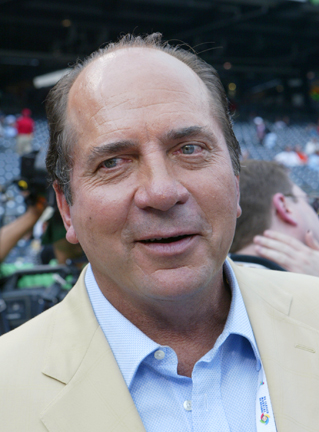
Background and career
Johnny Lee Bench (born December 7, 1947) is an American former professional baseball player. He played his entire Major League Baseball (MLB) career, which lasted from 1967 to 1983, with the Cincinnati Reds, primarily as a catcher. Bench led the Reds team known as the Big Red Machine that dominated the National League in the mid-1970s, winning six division titles, four National League pennants, and two World Series championships. A fourteen-time All-Star and a two-time National League Most Valuable Player, Bench excelled on offense and defense, twice leading the majors in home runs and three times in runs batted in. At the time of his retirement in 1983, he held the major league record for most home runs hit by a catcher. He was also the first catcher to lead the league in home runs. He hit 45 home runs in 1970, the single-season record for catchers until Salvador Perez hit 48 in 2021; Bench still holds the National League record. His 389 home runs and 1,376 runs batted in are the most in Cincinnati Reds history. On defense, Bench was a ten-time Gold Glove Award winner who skillfully handled pitching staffs and possessed a strong, accurate throwing arm. He caught 100 or more games for 13 consecutive seasons. In 1986, Bench was inducted into the Cincinnati Reds Hall of Fame. He was inducted into the Baseball Hall of Fame in 1989 in his first year of eligibility. He was named to MLB's All-Time Team in 1997 and All-Century Team in 1999, and ESPN has called him the greatest catcher in baseball history.
Born and raised in Oklahoma, Bench is 1⁄8 Choctaw. He played baseball and basketball and was class valedictorian at Binger-Oney High School in Binger. He survived a bus crash that killed two of his baseball teammates in 1965. His father, a truck driver, told him that the fastest route to becoming a major leaguer was as a catcher.
The Cincinnati Reds selected Bench as a 17-year-old in the second round, with the 36th overall selection of the 1965 Major League Baseball draft. Bench originally had been scouted by Byron Humphrey and Jim Russo of the Baltimore Orioles, and Russo had recommended to the Reds' Jim McLaughlin that the Reds send a scout to see Bench play in Oklahoma (though Russo still wanted the Orioles to draft Bench). In 1965, Bench played for the Tampa Tarpons and Reds' Florida Instructional League team. He played for the Triple-A Buffalo Bisons in 1966 and 1967. During the Bisons' 1967 season, he hit a grand slam against fellow future Hall of Famer Jim Palmer, then playing for the Orioles' Triple-A farm team, the Rochester Red Wings; Palmer did not allow another grand slam in his entire professional career. Russo had signed Palmer for the Orioles, and had the Orioles followed Russo's advice and drafted Bench, Palmer and Bench would have been teammates instead of opponents.
Bench was called up to the Reds in August 1967. He hit only .163, but impressed many people with his defense and strong throwing arm, among them Hall of Famer Ted Williams. Williams signed a baseball for him and predicted that the young catcher would be a "Hall of Famer for sure!" Williams' prophecy became fact 22 years later in 1989 when Bench was elected to Cooperstown. During a 1968 spring training game, Bench was catching right-hander Jim Maloney, an eight-year veteran. Maloney was once a hard thrower, but injuries had dramatically slowed down his fastball. Maloney nevertheless insisted on repeatedly "shaking off" his younger catcher by throwing fastballs instead of the breaking balls that Bench had called for. When an exasperated Bench bluntly told Maloney, "Your fastball's not popping," Maloney replied with an epithet. To prove to Maloney that his fastball was no longer effective, Bench called for a fastball, and after Maloney released the ball, Bench dropped his catcher's mitt and caught the fastball barehanded. Bench was the Reds' catcher on April 30, 1969, when Maloney pitched a no hitter against the Houston Astros. In 1968, the 20-year-old Bench impressed many in his first full season; he won the National League Rookie of the Year Award, batting .275 with 15 home runs and 82 RBIs. This marked the first time that the award had been won by a catcher. He also won the 1968 National League Gold Glove Award for catchers, the first time a rookie had won that award. He made 102 assists in 1968, which was the first time in 23 years that a catcher had more than 100 assists in a season. During the Vietnam War, Bench served in the United States Army Reserve as a member of the 478th Engineer Battalion, which was based across the Ohio River from Cincinnati at Fort Thomas, Kentucky. This unit included several of his teammates, including Pete Rose, Bobby Tolan, and Darrel Chaney. In the winter of 1970–1971, Bench was part of Bob Hope's USO Tour of Vietnam.
In 1970, Bench had his finest statistical season. At age 22, he became the youngest player to win the National League Most Valuable Player Award. He hit .293, led the majors with 45 home runs and a franchise-record 148 runs batted in as the Reds won the NL West Division. The Reds swept the Pittsburgh Pirates in the National League Championship Series (NLCS) but lost to the Baltimore Orioles in five games in the World Series. Bench had another strong year in 1972, winning the MVP Award for a second time. He once again led the majors in home runs (40) and RBI (125) to help propel the Reds to another NL West Division title and won the NL pennant in the deciding fifth game over the Pittsburgh Pirates. One of his more dramatic home runs was likely his ninth-inning, lead off, opposite field home run in that fifth NLCS game. The solo shot tied the game at three; the Reds won later in the inning on a wild pitch, 4–3. The Cincinnati Enquirer later called that game one of the best in franchise history. However, the Reds lost the World Series to the Oakland Athletics in seven games. After the 1972 season, Bench underwent surgery to remove a lesion from his lung, out of concern that it might be cancerous. The lesion was benign, but Bench stated in an interview that he was never the same player after the surgery. “They cut the ribs, they cut the bones, they cut the nerves, and so I never was the same player afterwards.” He remained productive but never again hit 40 home runs in a season. In 1973, Bench hit 25 home runs and 104 RBI and helped the Reds rally from a 101⁄2-game deficit to the Los Angeles Dodgers in early July to lead the majors with 99 wins and claim another NL West crown. In the NLCS, Cincinnati met a New York Mets team that won the NL East with an unimpressive 82–79 (.509) record, 161⁄2 games behind the Reds. The Mets boasted three of the better starting pitchers in the NL, future Hall of Famer Tom Seaver, Jerry Koosman, and Jon Matlack. Bench's bottom of the ninth-inning home run off Seaver in the first game propelled the Reds to victory, but Seaver would get the best of the Reds and Bench in the deciding Game 5, winning 7–2 to put the Mets into the World Series. In 1974, Bench led the league with 129 RBI and scored 108 runs, becoming only the fourth catcher in major league history with 100 or more runs and RBI in the same season. The Reds won the second-most games in the majors (98) but lost the West Division to the Los Angeles Dodgers. In 1975, the Reds finally broke through in the postseason. Bench had 28 home runs and 110 RBI during the regular season. Cincinnati swept the Pirates in three games to win the NLCS, and defeated the Boston Red Sox in a memorable seven-game World Series.
Bench struggled with ailing shoulders in 1976 and had one of his least productive years, with only 16 home runs and 74 RBI. He finished with an excellent postseason, starting with a 4-for-12 performance in the NLCS sweep over the Philadelphia Phillies. The World Series provided a head-to-head match-up with Yankees' All-Star catcher Thurman Munson. Bench rose to the occasion, hitting .533 with two home runs, while Munson also hit well, with a .529 average. The Reds won in a four-game sweep, and Bench was named the Series MVP. At the post-World Series press conference, Reds manager Sparky Anderson was asked to compare Munson with his catcher. Anderson replied, "I don't want to embarrass any other catcher by comparing him to Johnny Bench." Bench bounced back in 1977 to hit 31 home runs and 109 RBI but the Dodgers won two straight NL pennants. The Reds reached the postseason just once more in his career, in 1979, but were swept in three straight in the NLCS by Pittsburgh.



