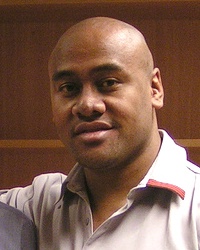
Background and career
Jonah Tali Lomu (12 May 1975 – 18 November 2015) was a New Zealand professional rugby union player. He is widely regarded as one of the greatest and most influential players in the history of the sport, and as one of the most talented sportsmen of all time. Lomu is widely considered to have been the first true global superstar of rugby, and consequently had a huge impact on the game. For his fast and effortless style of play, Lomu was nicknamed the "freight train in ballet shoes", and was celebrated for his ability to shrug off tackles from multiple opponents at once. Born in Pukekohe to Tongan immigrants from Haʻapai, Lomu grew up between rural Tonga and South Auckland. Attending Wesley College, he excelled in athletics and both rugby codes before pursuing a professional career. He became the youngest ever All Black when he played his first international in 1994 at the age of 19 years and 45 days. He was acknowledged as the top player at the 1995 World Cup for his 4-try performance in the semi-final against England. He shares with South African Bryan Habana the Rugby World Cup all-time try scoring record of 15, which he accumulated in only two tournaments. At the height of his fame in the mid-1990s, Lomu became a globally recognised cultural icon of South Auckland and its Pasifika community. His performance at that Rugby World Cup and others that followed established him as "rugby union's biggest drawcard", just as the game turned fully professional, being a major audience pull in any match in which he appeared. He used his celebrity to support Pasifika community efforts and charities such as UNICEF, and often paid bills for his childhood friends in Māngere. Playing on the wing, Lomu finished his international career with 63 caps and 37 tries. Lomu was inducted into the International Rugby Hall of Fame on 9 October 2007, and the IRB Hall of Fame on 24 October 2011. In 1995 he was diagnosed with nephrotic syndrome, a genetic kidney disorder. After a period of hiatus, he returned to play domestically rather than internationally. Lomu played for several domestic New Zealand provincial or Super Rugby sides, and late in his career played club rugby in both Wales and France. These included the Auckland Blues, with whom he won the inaugural 1996 Super 12 Final with, Chiefs and Hurricanes, and Counties Manukau, Wellington, and later North Harbour and the Cardiff Blues. His illness forced his retirement from professional rugby in 2007 at the age of 32. After returning from abroad, Lomu died unexpectedly on 18 November 2015 at home in Auckland.
Lomu was born in Pukekohe, Auckland, on 12 May 1975 to Tongan parents who had emigrated from Holopeka, a village on Lifuka in the Haʻapai islands. Lomu was a Tongan speaker; he spent some of his early childhood in Holopeka with his aunt Longo and uncle Mosese, where he spoke the language to fluency. He then moved back to Auckland suburb of Māngere to be educated, where he spent the rest of his childhood with his parents and siblings. There, he was exposed to nearby gang violence, and lost an uncle and a cousin to attacks. This led his mother to send him to Wesley College in Auckland. At high school, Lomu excelled in athletics, in particular, the 100 metres, shot put, javelin, high jump, hurdles and relay. In his final year, he ran the 100 mts in 11.2 seconds. By 1993, during his last year at Wesley, he started playing rugby more seriously, while still combining it with athletics. He was first spotted playing for Wesley College by Counties Manukau senior coach Ross Cooper in 1991. Cooper gave Lomu his senior provincial debut for Counties against Horowhenua in May 1994, and later that year, as an All Blacks selector, was part of the panel that selected Lomu for his test debut. New Zealand sevens star Eric Rush played a touch game with Lomu when he was 14 years old and was so impressed he invited him to a sevens tournament in Singapore the next day. As a youngster however, Lomu first played rugby league. His introduction to rugby union came through a tournament in Te Kuiti where he stayed with Glyn Meads, son of All Black Colin Meads. Lomu started his rugby union career in the forwards, mostly as an openside flanker (no.7), sometimes to the blindside (no.6), before switching to the left wing in what he described as the "best move he could have made". He represented New Zealand in the national under-19 side in 1993, as well as the under-21 side the following year. He first came to international attention at the 1994 Hong Kong Sevens tournament as part of a team including Rush. At the age of 19 years and 45 days, Lomu became the youngest All Black test player as he debuted on the wing against France in 1994, breaking a record that had been held by Edgar Wrigley since 1905. The match was played at Lancaster Park in Christchurch, and the All Blacks lost 22–8. The second match was played at Eden Park in Auckland with France winning again, 23–20. Lomu marked Emile N'tamack and later said that his inexperience led to him being exposed by the French team.
Despite having just two All Black caps, Lomu was included in the squad for the 1995 World Cup in South Africa. Lomu scored seven tries in five matches, two in the first match against Ireland in Johannesburg, a try in the quarter final against Scotland at Loftus Versfeld, and four tries in the semi-final against England at Newlands. The first try in the English match occurred after Lomu received a pass behind him, beat two defenders and then, after a stumble, ran straight over the top of Mike Catt. This caused one New Zealand commentator, Keith Quinn, to gasp. After the game, England captain Will Carling said: "He is a freak and the sooner he goes away the better". His first score was voted the try of the tournament. In 2002 the UK public voted Lomu's performance no. 19 in the list of the 100 Greatest Sporting Moments. New Zealand played the World Cup final at Ellis Park against South Africa. Neither side scored a try, with South Africa coming out on top 15–12 after kicking a drop-goal in extra time.
Following the World Cup New Zealand played Australia home and away for the Bledisloe Cup with Lomu scoring tries in both matches. He scored two tries in the All Blacks victory over Italy in Bologna. Lomu played against France in Toulouse, where New Zealand failed to score any tries. He scored a try in the second test in Paris, helping his team to victory. Lomu played for the All Blacks in matches against the touring Samoa and Scotland teams in June 1996, scoring in one of the Scottish matches. Just before the World Cup final a deal was struck between South Africa, New Zealand and Australia (SANZAR) to create the Tri-Nations, an annual round robin competition between the three nations launched with the advent of professionalism in rugby. New Zealand won all their games to become the first Tri-Nations winners. Lomu scored a try in a 43–6 victory over Australia in the inaugural match, which has been described by New Zealand Herald journalist David Leggat as "the perfect wet-weather game". At the end of 1996, Lomu was diagnosed with a rare and serious kidney disorder, which saw him take time off from the sport. As a result, he did not play in the 1997 Tri Nations Series, but he was included in the All Blacks tour of the northern hemisphere at the end of the year. Lomu played in the two warm up matches, scoring tries against Wales 'A' and Emerging England. He played the first test against England at Old Trafford, as well as the test against Wales at Wembley Stadium, and the second match against England—he did not score in any of the three games. At the 1998 Commonwealth Games in Kuala Lumpur, he won a gold medal representing New Zealand in the Sevens Rugby event. The English rugby team came to New Zealand the following year for a two test series. Lomu played in both of the matches, scoring in the first, which was a 64–22 win in Dunedin, but not in the second test won 40–10 by the All Blacks.
Lomu's 1999 international season kicked off with a warm-up match against New Zealand A, which was followed by a game against Samoa in which Lomu scored one of the All Blacks' nine tries. He came on as a replacement in every game of the 1999 Tri Nations Series with Christian Cullen and Tana Umaga preferred as starters on the wings. New Zealand were crowned Tri Nations champions despite losing the last game against Australia. Lomu scored eight tries at the 1999 World Cup. In pool matches he scored two tries against Tonga, one against England and two against Italy. The All Blacks finished top of their pool and proceeded to the quarter-finals. They defeated Scotland, with Lomu scoring one of New Zealand's four tries. Lomu scored twice in the semi-final match against France, though it was not enough to see them through to the final as France went on to win 43–31. Following the World Cup, despite speculation that he would be moving to play American football in the National Football League or stay to play rugby in the English Premiership, Lomu returned to New Zealand.
Lomu started 2000 with big victories over Tonga and Scotland. The opening match of the 2000 Tri Nations Series was played in front of a record crowd of 109,874 and has been labelled the "match of the century'.' New Zealand scored three tries in the first five minutes to lead by 21 points, before Australia came back, leveling the scores before half time. With minutes remaining, the Wallabies led 35 to 34; until Lomu "brushed past a desperate Stephen Larkham to tip-toe down the line and score the winning try". The match was followed by a victory over South Africa, and then a re-match with Australia, which Australia won 24 to 23. New Zealand lost the final game to South Africa finishing second in the table, behind Australia. Lomu played in one other test that year; against France at Stade de France in November, which the All Blacks won 39 to 26. Lomu was part of the New Zealand Sevens team that won the 2001 Sevens World Cup, filling in for Rush, who suffered a broken leg during the competition. In the lead up to the 2001 Tri Nations Series, the All Blacks played Argentina and France at home, Lomu scoring a try in the French match. After a try-less opening victory against South Africa Lomu played his 50th test for the All Blacks at the Carisbrook 'House of Pain', scoring a try in the second minute of play. The Wallabies spoiled the party however, winning 23 to 15. This was followed by a win over South Africa, and loss to the Wallabies at Stadium Australia. During the 1999 off season, Lomu transferred to Wellington, signing up with second division club Wainuiomata RFC. Lomu played his debut match against Northern United scoring twice and attracting a bumper crowd and followed that up with a further appearance in 2001. Lomu wore the green and black club socks when he played for the Barbarian F.C. in 2000. At the end of the year, the All Blacks played Ireland at Lansdowne Road in Dublin. Lomu was a central figure in the 40 to 29 win, setting up Aaron Mauger for his debut try, and taking an inside pass to blast through for one of his own. The All Blacks end of season tour continued at Murrayfield in Edinburgh, where they defeated Scotland 37 to six, with Lomu contributing one try. In the final match of the tour, the All Blacks played Argentina at the River Plate Stadium. Lomu put the All Blacks in front with a try after Argentina took an early lead. New Zealand won the match by a score of 24 to 20. In his first test of 2002, he came off the bench in the second half to score a try in a match against Italy. He was again injected into play from the bench in the first of a two test series against Ireland in New Zealand; helping New Zealand to an uninspiring win. Lomu was back starting on the left wing for the second test against the Irish, which New Zealand won 40–8. Lomu did not score in the subsequent match against Fiji; in performance that was labelled "disappointing" by Matthew Cooper after he was beaten on the outside for Fiji's first try. Lomu came off the bench in the All Blacks first game of the 2002 Tri Nations Series against South Africa, though he did not play in the rest of the tournament. He returned to the wing for a game against England in November 2002. Lomu ended up scoring two tries, though it was not enough to secure a New Zealand victory, with England winning 31–28. The subsequent match against France resulted in a draw, the first between the two nations in 96 years. The last match of the end of season tour was against Wales, which the All Blacks won 43–17. These were the last international matches that Lomu would play for New Zealand as his illness worsened and he needed a kidney transplant.
Sources
Net-worth figure: Celebrity Net Worth (October 2026), in USD. Biography and career facts: the person's Wikipedia article and linked reporting. Snapshot date for all StarWorth figures: 28 October 2026.


