Background and career
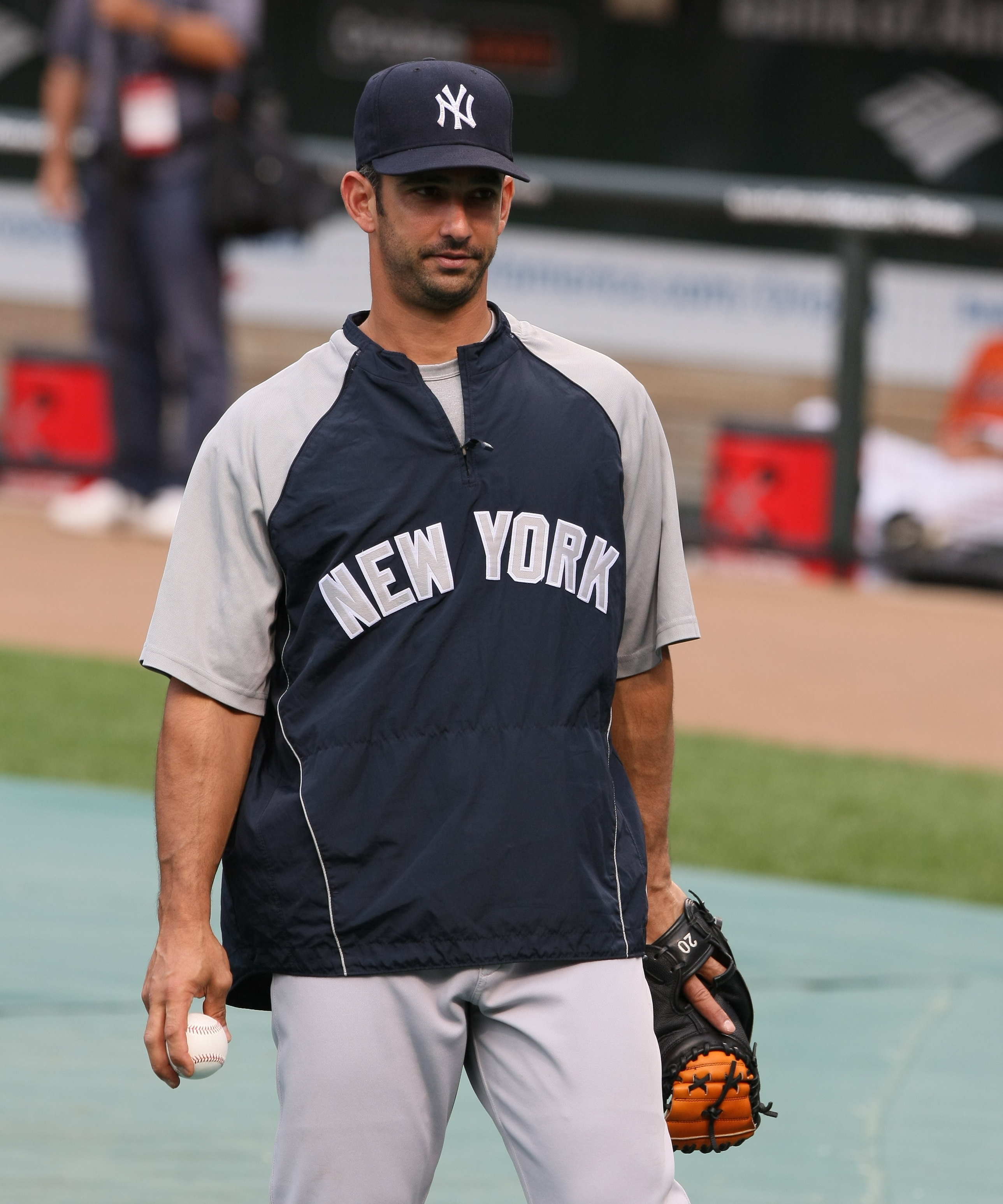
Jorge Rafael Posada Villeta (born August 17, 1970) is a Puerto Rican former professional baseball catcher who played 17 seasons in Major League Baseball (MLB) for the New York Yankees. Posada recorded a .273 batting average, 275 home runs, and 1,065 runs batted in (RBIs) during his career. A switch hitter, Posada was a five-time All-Star, won five Silver Slugger Awards, and was on the roster for four World Series championship teams. Drafted by the Yankees in 1990, Posada was originally an infielder before moving to catcher during his minor league career. He debuted in the major leagues in 1995, but it was not until 1998 that he found regular playing time. A solid-hitting catcher, Posada established himself as a mainstay in the Yankees lineup and as one of the "Core Four" players who contributed to the Yankees' winning seasons. In 2003, he finished third in voting for the American League (AL) Most Valuable Player Award and became only the second Yankees catcher after Yogi Berra to hit 30 home runs in a season. Posada added one of his best seasons in 2007 at age 37 when he batted .338. Following a stint as designated hitter in 2011, he retired. Posada is only the fifth MLB catcher with at least 1,500 hits, 350 doubles, 275 home runs, and 1,000 RBIs in a career. From 2000 to 2011, he compiled more RBIs and home runs than any other catcher in baseball. He is the only MLB catcher to ever bat .330 or better with 40 doubles, 20 home runs, and 90 RBIs in a single season. Away from baseball, Posada is the founder of the Jorge Posada Foundation, which is involved with research for craniosynostosis, a birth defect that impacts his son.
Jorge Posada was born on August 17, 1970, in the Santurce district of San Juan, Puerto Rico to a Cuban father and a Dominican mother. He attended Alejandrino High School in San Juan, where he participated in several sports, including baseball. He was named to the all-star team in 1988–89 as a shortstop. He also umpired for the girls' softball team. Posada's SAT scores were not high enough for him to enroll in a four-year college. Fred Frickie, the head coach of the college baseball team at Calhoun Community College in Decatur, Alabama, recruited Posada without scouting him in 1991. Posada accepted the scholarship at Calhoun without visiting the school. He made friends on the team quickly. Posada has also spoken about the racism he encountered from classmates at the school. He was voted best hitter (1990), co-captain (1991), and selected all-conference (1991). He was inducted in the Alabama Community College Athletic Hall of Fame in 2006 and Calhoun retired his number (#6).
Posada was drafted by the Yankees in the 24th round of the 1990 Major League Baseball draft as an infielder. Yankees scout Leon Wurth followed Posada as he played for Calhoun, and rated his bat and attitude highly. Posada signed with the Yankees for a signing bonus close to $30,000. The team agreed to keep him in their system for three years. Posada played second base in his first season with the Oneonta Yankees in the Class A-Short Season New York–Penn League, in which he had a .235 batting average and four home runs in 71 games played. As the Yankees felt that Posada lacked the speed to remain an infielder, they began to transition Posada into a catcher in 1992. Though Posada initially resisted the position change, as he didn't feel able to catch full-time, he agreed. That year, he played for the Greensboro Hornets of the Class A South Atlantic League. He finished the season with a .277 batting average, 38 extra-base hits, including 12 home runs and 58 runs batted in (RBIs). He caught Andy Pettitte for the first time while they were teammates at Greensboro. A full-time catcher in 1993, Posada started the season with the Prince William Cannons of the Class A-Advanced Carolina League. After he hit 17 home runs and recorded 61 RBIs in 118 games for the Cannons, he was promoted to the Albany-Colonie Yankees of the Class AA Eastern League. He earned Carolina League mid-season and post-season All-Star honors. Still working on his defense, Posada committed 38 passed balls in the 1993 season, the most in the Carolina League. The Yankees promoted Posada to the Columbus Clippers of the Class AAA International League in 1994. He batted .240 with 11 home runs on the year. His left leg was broken and ankle was dislocated in a home plate collision, prematurely ending his season. After recovering from the injury, Posada played for the Clippers for the majority of the 1995 season, batting .255 with eight home runs and 51 RBIs. The Yankees included Posada in trade discussions with the Seattle Mariners in their attempts to acquire Tino Martinez. Three weeks later, the Yankees attempted to trade Posada and Mariano Rivera to the Cincinnati Reds for David Wells, but that trade was not accepted. Returning to Columbus in 1996, Posada batted .271. He appeared in the 1996 Triple-A All-Star Game.
Posada made his MLB debut with the Yankees in 1995, replacing Jim Leyritz in the ninth inning of a game on September 4, 1995. Despite his appearing in only one game during the regular season, the Yankees included Posada on their postseason roster, and he appeared in Game 2 of the 1995 American League Division Series (ALDS) as a pinch runner, scoring a run. The Yankees lost the division series in five games to the Seattle Mariners. Posada began the 1996 season with Columbus, but was promoted to the Yankees late in the season. He appeared in eight games, making his first start on September 25, recording one hit and one walk. Posada did not appear in the postseason but the Yankees still succeeded as they defeated the Atlanta Braves in the 1996 World Series. Despite not being on the 1996 postseason roster for the Yankees, Posada still received a 1996 World Series Championship ring. Posada succeeded Leyritz in 1997 as the backup catcher to Joe Girardi, with Girardi serving as a mentor to Posada. Posada was expected to appear in approximately 40 games in 1997; he started in 52. Posada appeared in 60 games during the 1997 season and batted .250 with six home runs and 25 RBIs. The Yankees made the postseason again, but the team lost in the 1997 ALDS to the Cleveland Indians. After the 1997 season, the Yankees offered Posada and Mike Lowell to the Montreal Expos for Pedro Martínez; the Expos traded Martínez to the Boston Red Sox, instead. During the offseason, Posada hired a personal trainer and running coach, who helped improve his physical conditioning. Going into the 1998 season, Posada pushed the Yankees to increase his playing time. Posada caught David Wells' perfect game on May 17, 1998. Overall, Posada batted .268 with 17 home runs and 63 RBIs over 111 games in the 1998 season. The Yankees reached the postseason for the fourth consecutive year and the team won the 1998 World Series in four games against the San Diego Padres. The Yankees renewed Posada's contract for $350,000 for the 1999 season, less than the $650,000 he requested. Posada struggled in April, batting .146 and striking out 15 times in 46 appearances. After batting .210 at the All-Star Break, he batted .285 for the remainder of the season, ending the year with a .245 batting average, 12 home runs, and 57 RBIs. He allowed 17 passed balls. Posada played in 112 games with 379 at-bats, while Girardi played in 65 games with 209 at-bats. While Girardi began the 1999 postseason as the regular catcher, Posada saw increased playing time. The Yankees entered the postseason once again and won the 1999 World Series against the Braves in only four games.
Girardi left the Yankees as a free agent after the 1999 season, and the Yankees entrusted Posada with the everyday catching job. Yankees' manager Joe Torre selected Posada for his first All-Star Game appearance that season. During the 2000 season, Posada batted .287 with 28 homers, 86 RBIs, 107 walks, and 151 strikeouts. The Yankees reached the postseason once again, and they won the 2000 World Series against the New York Mets. Posada won the Silver Slugger Award for catcher in 2000. Posada appeared in the 2001 MLB All-Star Game. For the season, Posada batted .277 with 22 home runs and 95 RBIs, but led the league in passed balls and errors among catchers. The Yankees entered the postseason for another shot to win a championship, but lost to the Arizona Diamondbacks in the 2001 World Series in seven games. Posada won his second consecutive Silver Slugger Award in 2001. Posada started the 2002 MLB All-Star Game. He batted .268 with 20 home runs and 99 RBIs, and grounded into an AL-leading 23 double plays. He again led all catchers in errors. The Yankees entered the postseason again but lost in the 2002 ALDS to the Anaheim Angels. Posada won a Silver Slugger Award for a third consecutive season. Posada again started at catcher in the 2003 All-Star Game. For the season, he hit 30 home runs and drove in 101 runs, both career highs. He batted .281 and was also fifth in the league in OBP (.405), and sixth in the league in walks (93; walking 17.5% of the time, a career high). He tied Yogi Berra's record for most home runs by a Yankee catcher. The Yankees again reached the postseason but lost to the Florida Marlins in the 2003 World Series, with Posada being tagged by pitcher Josh Beckett for the final out of the series. After the season, Posada won his fourth consecutive Silver Slugger Award. He finished third in the MVP voting, behind Alex Rodriguez and Carlos Delgado.
In 2004, Posada grounded into 24 double plays, which tied for the most in the AL, but batted .272 with 21 home runs and 81 RBIs. After defeating the Minnesota Twins in the 2004 ALDS, the Yankees lost to the Boston Red Sox in the 2004 ALCS despite leading the series three games to none. In 2005, Posada batted .262 with 19 home runs and 71 RBIs. The Yankees reached the postseason again, but lost to the Los Angeles Angels of Anaheim in the 2005 ALDS. In 2006, Posada posted his highest batting average and home run total since 2003. He also led the major leagues with 20 pinch hits. In addition, work with new first base coach Tony Peña, a former catcher, helped him improve his percentage of runners thrown out stealing second almost 60 points above his career average. However, he again led the league in passed balls. He batted .277 and had 23 home runs with 93 RBIs. On May 16, Posada led the Yankees to a victory despite falling behind by nine runs, matching the largest deficit the Yankees overcame for a victory in franchise history. He registered a +0.93 win probability added in that game, the highest of his career.
Sources
Net-worth figure: Celebrity Net Worth (October 2026), in USD. Biography and career facts: the person's Wikipedia article and linked reporting. Snapshot date for all StarWorth figures: 28 October 2026.


