Background and career
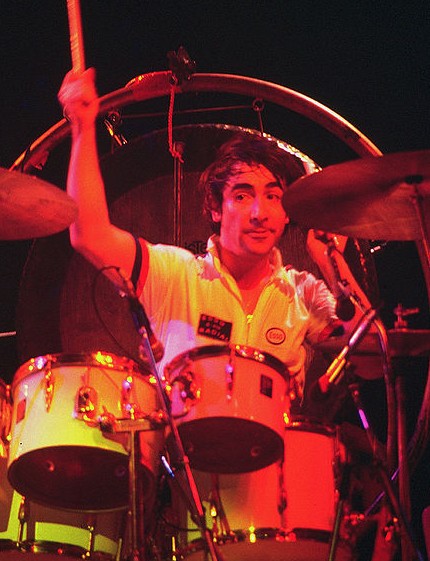
Keith John Moon (23 August 1946 – 7 September 1978) was an English musician who was the drummer for the rock band the Who. Regarded as one of the greatest drummers in the history of rock music, he was noted for his unique style of playing and his eccentric, self-destructive behaviour. Moon grew up in Wembley and took up the drums during the early 1960s. After playing with a local band, the Beachcombers, he joined the Who in 1964 before they recorded their first single. Moon was recognised for his drumming style, which emphasised tom-toms, cymbal crashes, and drum fills. Throughout his tenure with the Who, his drum kit steadily grew in size, and (along with Ginger Baker) he has been credited as one of the earliest rock drummers to regularly employ double bass drums in his setup. Moon occasionally collaborated with other musicians and later appeared in films, but considered playing in the Who his primary occupation, and remained a member of the band until his death. In addition to his talent as a drummer, Moon developed a reputation for smashing his kit on stage and destroying hotel rooms on tour. He was fascinated with blowing up toilets with cherry bombs or dynamite, and destroying television sets. Moon also enjoyed touring and socialising, and became bored and restless when the Who were inactive. His 21st birthday party in Flint, Michigan, has been cited as a notorious example of decadent behaviour by rock groups. Moon suffered a number of setbacks during the 1970s, most notably the accidental death of chauffeur Neil Boland and the breakdown of his marriage. He suffered from alcoholism and acquired a reputation for decadence and dark humour; his nickname was "Moon the Loon". While touring with the Who, on several occasions he passed out on stage and was hospitalised. By the time of their final tour with him in 1976, and particularly during production of the studio album Who Are You (1978) and the concert film The Kids Are Alright, his deterioration was evident. Moon moved back to London from Los Angeles in 1978, dying that September from an overdose of clomethiazole, a drug intended to treat or prevent symptoms of alcohol withdrawal. His drumming continues to be praised by critics and musicians, and he was posthumously inducted into the Modern Drummer Hall of Fame in 1982, becoming the second rock drummer to be chosen, and in 2011 he was voted the second-greatest drummer in history by a Rolling Stone readers' poll. Moon was inducted into the Rock and Roll Hall of Fame in 1990 as a member of the Who.
Keith John Moon was born to motor mechanic Alfred Charles Moon and Kathleen Winifred ("Kit") (née Hopley), on 23 August 1946 at Central Middlesex Hospital in northwest London; he grew up in Chaplin Road, Wembley. Moon was hyperactive as a boy, with a restless imagination and a particular fondness for music and The Goon Show. Moon attended Alperton Secondary Modern School after failing his eleven plus exam, which precluded his attending a grammar school. His art teacher said in a report: "Retarded artistically. Idiotic in other respects." His music teacher wrote that Moon "has great ability, but must guard against a tendency to show off." Moon joined his local Sea Cadet Corps band at the age of twelve on the bugle, but found the instrument too difficult to learn and took up drums instead. He was interested in practical jokes and home science kits, with a particular fondness for explosions. On his way home from school, Moon would often go to Macari's Musical Exchange at 46b Ealing Road to practice on the drums there, learning his basic skills on the instrument. He left school around Easter 1961, at age 14. Moon then enrolled at Harrow Technical College; this led to a job as a radio repairman, enabling him to buy his first drum kit.
Moon took lessons from one of the loudest contemporary drummers, Screaming Lord Sutch's Carlo Little, at ten shillings per lesson. His early style was influenced by jazz, American surf music and rhythm and blues, exemplified by noted Los Angeles studio drummer Hal Blaine. His favourite musicians were jazz artists, particularly Gene Krupa (whose flamboyant style he subsequently copied). He also admired Elvis Presley's original drummer DJ Fontana, the Shadows' original drummer Tony Meehan and the Pretty Things' Viv Prince. Moon also enjoyed singing, and had a particular interest in Motown. Moon idolised the Beach Boys; Roger Daltrey later said that, given the opportunity, Moon would have left to play for the California band even at the peak of the Who's fame. During this time Moon joined his first serious band, the Escorts, replacing his best friend Gerry Evans. In December 1962 he joined the Beachcombers, a semi-professional London cover band playing hits by groups such as the Shadows. During his time in the group Moon incorporated theatrical tricks into his act, including "shooting" the group's lead singer with a starter pistol. The Beachcombers all had day jobs; Moon, who worked in the sales department at British Gypsum, had the keenest interest in turning professional. In April 1964, aged 17, he auditioned for the Who as a replacement for Doug Sandom. The Beachcombers continued as a local cover band after his departure.
A commonly cited story of how Moon joined the Who is that he appeared at a show shortly after Sandom's departure, where a session drummer was used. Dressed in ginger clothes and with his hair dyed ginger (future bandmate Pete Townshend later described him as a "ginger vision"), he claimed to his would-be bandmates that he could play better; he played in the set's second half, nearly demolishing the drum kit in the process. As Moon later recounted: "[T]hey said go ahead, and I got behind this other guy's drums and did one song—'Road Runner.' I'd several drinks to get me courage up and when I got onstage I went arrgggGhhhh on the drums, broke the bass drum pedal and two skins, and got off. I figured that was it. I was scared to death. Afterwards I was sitting at the bar and Pete came over. He said: 'You ... come 'ere.' I said, mild as you please: 'Yes, yes?' And Roger, who was the spokesman then, said: 'What are you doing next Monday?' I said: 'Nothing.' I was working during the day, selling plaster. He said: 'You'll have to give up work ... there's this gig on Monday. If you want to come, we'll pick you up in the van.' I said: 'Right.' And that was it." Moon later claimed that he was never formally invited to join the Who permanently; when Ringo Starr asked how he had joined the band, he said he had "just been filling in for the last fifteen years". Moon's arrival in the Who changed the dynamics of the group. Sandom had generally been the peacemaker as Daltrey and Townshend feuded between themselves, but because of Moon's temperament the group now had four members frequently in conflict. "We used to fight regularly", remembered Moon in later years. "John [Entwistle] and I used to have fights—it wasn't very serious, it was more of an emotional spur-of-the moment thing." Moon also clashed with Daltrey and Townshend: "We really have absolutely nothing in common apart from music", he said in a later interview. Although Townshend described him as a "completely different person to anyone I've ever met", the pair had a rapport in the early years and enjoyed practical jokes and improvised comedy. Moon's drumming style affected the band's musical structure; although Entwistle initially found Moon's lack of conventional timekeeping problematic, it created an original sound. Moon was particularly fond of touring since it was his only chance to regularly socialise with his bandmates, and was generally restless and bored when not playing live. This later carried over to other aspects of his life, as he acted them out (according to journalist and Who biographer Dave Marsh) "as if his life were one long tour". These antics earned him the nickname "Moon the Loon".
Moon's style of drumming was considered unique by his bandmates, although they sometimes found his unconventional playing frustrating; Entwistle noted that he tended to play faster or slower according to his mood. "He wouldn't play across his kit", he later added. "He'd play zig-zag. That's why he had two sets of tom-toms. He'd move his arms forward like a skier." Daltrey said that Moon "just instinctively put drum fills in places that other people would never have thought of putting them". Who biographer John Atkins wrote that the group's early test sessions for Pye Records in 1964 show that "they seemed to have understood just how important was ... Moon's contribution." Contemporary critics questioned his ability to keep time, with biographer Tony Fletcher suggesting that the timing on Tommy was "all over the place". Who producer Jon Astley said, "You didn't think he was keeping time, but he was." In the opinion of Atkins, early recordings of Moon's drumming sound tinny and disorganised; it was not until the recording of Who's Next, with Glyn Johns' no-nonsense production techniques and the need to keep time to a synthesizer track, that Moon began developing more discipline in the studio. Fletcher considers the drumming on this album to be the best of Moon's career. Unlike contemporary rock drummers such as Ginger Baker and John Bonham, Moon hated drum solos and refused to play them in concert. At a Madison Square Garden show during The Who's 1974 tour, Townshend and Entwistle decided to spontaneously stop playing during "Waspman" to listen to Moon's drum solo. Moon continued briefly and then stopped, shouting, "Drum solos are boring!" On 23 June 1977, he made a guest appearance at a Led Zeppelin concert in Los Angeles.
Moon also aspired to sing lead vocal on some songs. While the other three members handled most of the onstage vocals, Moon would attempt to sing backup (particularly on "I Can't Explain"). He provided humorous commentary during song announcements, although sound engineer Bob Pridden preferred to mute his vocal microphone on the mixing desk whenever possible. Moon's knack for making his bandmates laugh around the microphone led them to banish him from the studio when vocals were being recorded; this led to a game in which Moon would sneak in to join the singing. At the end of "Happy Jack", Townshend can be heard saying, "I saw ya!" to Moon as he tries to sneak into the studio. Moon's interest in surf music and his desire to sing led to his performing lead vocals on several early tracks, including "Bucket T" and "Barbara Ann" (Ready Steady Who EP, 1966) and high backing vocals on other songs, such as "Pictures of Lily". His performance on "Bell Boy" (Quadrophenia, 1973) saw him abandon "serious" vocal performances to sing in character, which gave him (in Fletcher's words) "full licence to live up to his reputation as a lecherous drunk"; it was "exactly the kind of performance the Who needed from him to bring them back down to earth." Moon composed "I Need You", the instrumental "Cobwebs and Strange" (from the album A Quick One, 1966), the single B-sides "In The City" (co-written with Entwistle) and "Girl's Eyes" (from The Who Sell Out sessions featured on Thirty Years of Maximum R&B and a 1995 re-release of The Who Sell Out), "Dogs Part Two" (1969) and "Waspman" (1972). Moon also co-composed "The Ox" (an instrumental from their debut album, My Generation) with Townshend, Entwistle and keyboardist Nicky Hopkins. "Tommy's Holiday Camp" (from Tommy) was credited to Moon because he came up with the idea, but the song was actually written by Townshend and, although there is a misconception that Moon sings on it, the album version is Townshend's demo. Moon produced the violin solo on "Baba O'Riley". Moon sat in on congas with East of Eden at London's Lyceum Ballroom, and afterwards suggested to violinist Dave Arbus that he play on the track.


