Background and career
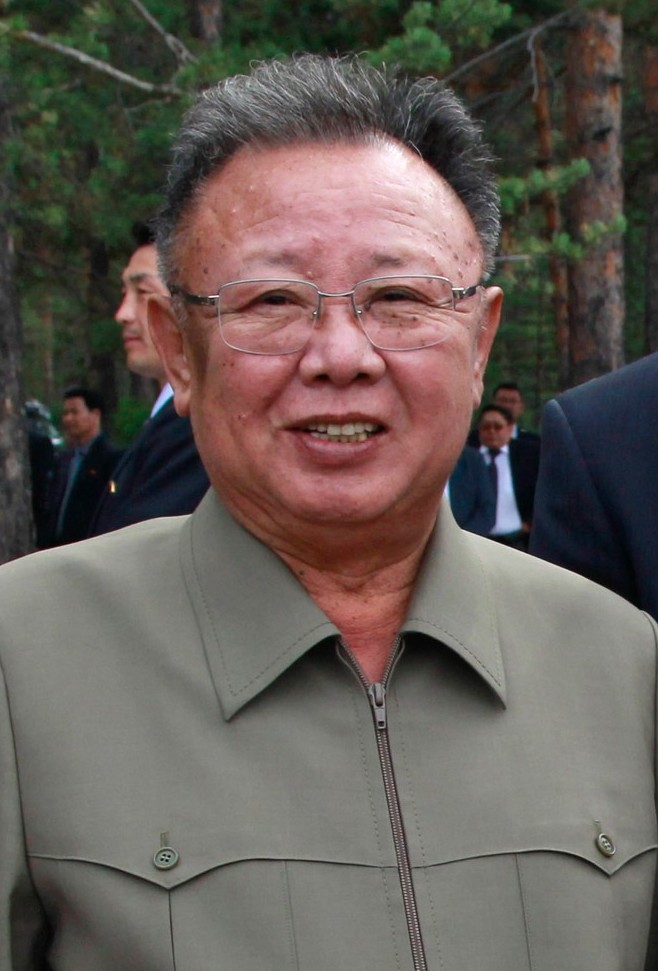
Kim Jong Il (16 February 1941 – 17 December 2011) was a North Korean politician and dictator who was the second supreme leader of North Korea from the death of his father Kim Il Sung in 1994 until his own death in 2011. Posthumously, Kim Jong Il was declared an eternal leader of the Workers' Party of Korea (WPK). Kim was born in the far eastern region of the Soviet Union and moved to Pyongyang in 1945 following the end of Japanese rule. He joined the WPK in 1961 and rose through its ranks, joining the Propaganda and Agitation Department (PAD) in 1966. He was responsible for investigations following the Kapsan faction incident in 1967, and played a key role in the development of the Juche ideology, North Korean cult of personality and the Monolithic Ideological System. He became PAD director in 1973, and took an increasingly prominent role. He was formally designated as Kim Il Sung's successor in 1980 at the 6th Congress of the Workers' Party of Korea. Kim succeeded his father following his death in 1994. Kim was the General Secretary of the WPK, Member of WPK Presidium, Chairman of the WPK Central Military Commission, Chairman of the National Defence Commission (NDC) of North Korea and the Supreme Commander of the Korean People's Army (KPA), the fourth-largest standing army in the world. Like his father, Kim ruled North Korea as a repressive and totalitarian dictatorship. Kim assumed leadership during a period of catastrophic economic crisis amidst the dissolution of the Soviet Union, on which it was heavily dependent for trade in food and other supplies, which brought a famine. While the famine had ended by the late 1990s, food scarcity continued to be a problem throughout his tenure. Kim strengthened the role of the military with his Songun ("military-first") policies, making the army the central organizer of civil society. Kim's rule also saw tentative economic reforms, including the opening of the Kaesong Industrial Region in 2003 as well as a failed currency reform in 2009. The relationship with South Korea initially improved due to the Sunshine Policy, culminating in Kim's meeting with South Korean president Kim Dae-jung in 2000, followed by a meeting with president Roh Moo-hyun in 2007. However, the relationship subsequently deteriorated in 2010 following the sinking of ROKS Cheonan and the bombardment of Yeonpyeong. Under his leadership, North Korea conducted its first nuclear test in 2006, becoming the world's ninth nuclear-armed state, followed by another nuclear test in 2009, leading to international sanctions against North Korea. Following Kim's failure to appear at important public events in 2008, foreign observers assumed that Kim had either fallen seriously ill or died. After this point, Kim made efforts to promote his third son, Kim Jong Un as his successor, promoting him to high ranking posts in the WPK in 2010. On 19 December 2011, the North Korean government announced that he had died two days earlier. After his death, alongside "Eternal General Secretary" of the WPK, Kim Jong Il was declared "Eternal Chairman" of the National Defence Commission, in keeping with the tradition of establishing eternal posts for the dead members of the Kim family.
In literature, it is assumed that Kim was born in 1941 in either the camp of Vyatskoye, near Khabarovsk, or camp Voroshilov near Nikolsk. According to Lim Jae Cheon, Kim cannot have been born in Vyatskoye as Kim Il Sung's war records show that he arrived at Vyatskoye only in July 1942 and had been living in Voroshilov before, thus Kim Jong Il is generally agreed to have been born in Voroshilov. Kim's mother, Kim Jong-suk, was Kim Il Sung's first wife. Inside his family, he was nicknamed "Yura", while his younger brother Kim Man-il (born Aleksandr Kim) was nicknamed "Shura". According to Fyodor Tertitskiy, it is a misconception that Kim was born as Yuri. Kim's official biography states he was born in the Paektusan Secret Camp on Paektu Mountain in Korea under Japanese rule on 16 February 1942. According to one comrade of Kim's mother, Lee Min, word of Kim's birth first reached an army camp in Vyatskoye via radio and neither Kim nor his mother returned there until the following year. Kim Jong Suk died in 1949 from an ectopic pregnancy. In 1945, Kim was four years old when World War II ended and Korea regained independence from Japan. His father returned to Pyongyang that September, and in late November Jong-Il returned to Korea via a Soviet ship, landing at Sonbong. The family moved into a former Japanese officer's mansion in Pyongyang, with a garden and pool. Kim's brother Man Il drowned there in 1948 under mysterious circumstances.
According to his official biography, Kim completed the course of general education between September 1950 and August 1960. He attended Primary School No. 4 and Middle School No. 1 (Namsan Higher Middle School) in Pyongyang. This is contested by foreign academics, who believe he is more likely to have received his early education in China as a precaution to ensure his safety during the Korean War. Throughout his schooling, Kim was involved in politics. He was active in the Korean Children's Union and the Democratic Youth League of North Korea (DYL), taking part in study groups of Marxist political theory and other literature. In September 1957, he became vice-chairman of his middle school's DYL branch (the chairman had to be a teacher). He pursued a programme of anti-factionalism and attempted to encourage greater ideological education among his classmates. Kim is also said to have received English language education in Malta in the early 1970s on his infrequent holidays there as a guest of Prime Minister Dom Mintoff. The elder Kim had meanwhile remarried and had another son, Kim Pyong Il. From 1988 to his retirement in 2019, Kim Pyong Il has served in a series of North Korean embassies in Europe and was the North Korean ambassador to Poland. Foreign commentators suspect that Kim Pyong Il was sent to these distant posts by his father in order to avoid a power struggle between his two sons. He is now reported to be back in North Korea.
Kim Jong Il officially joined the Workers' Party of Korea in July 1961. He rose through the ranks during the 1960s, and benefited greatly from the Kapsan faction incident around 1967, which was the last credible challenge to Kim Il Sung's sole rule. This incident marked the first time Kim Jong Il was – at age 26 – given official duties by his father, when Jong Il took part in the investigation and purges that followed the incident. In addition, Kim Jong Il gave a speech at the plenum; it was his first as a figure of authority. Kim Jong Il's name was also mentioned in public documents, possibly for the first time, indicating that Kim Il Sung might have already planned for Jong Il to succeed him as leader. Only six months later, in an unscheduled meeting of the party, Kim Il Sung called for loyalty in the film industry that had betrayed him with An Act of Sincerity. Kim Jong Il himself announced that he was up to the task and thus begun his influential career in North Korean filmmaking, during which he made significant efforts to further intensify the personality cult of his father and attach himself to it. In 1969, he produced a film adaptation of the North Korean opera Sea of Blood. Kim Jong Il entered the WPK's Propaganda and Agitation Department (PAD) in February 1966. Kim Jong Il's years in the PAD were marked by his effort to become an expert in the field of propaganda. Kim Jong Il's main contribution in the department was to devise the "monolithic ideological system", later codified as the Ten Principles for the Establishment of a Monolithic Ideological System. Kim's various efforts greatly benefited the North Korean cult of personality. In 1969, he was appointed as the head of Kim Il Sung's personal guard. At the time of the 5th Congress of the WPK in 1970, Kim Jong Il reportedly suggested that everyone in the North Korea be mandated to wear badges with Kim Il Sung's portrait, which was subsequently adopted. On 2 November 1971, the earliest document lauding Kim Jong Il was published, where he was called the "Adored Leader" by North Korea's musical ensembles. Kim Jong Il was elected to the Central Committee in 1972 and became its secretary the following year. He became the PAD's chief in 1973, a position which he held until 1985. During this time, the film director Choe Ik-gyu, a close confidant of his, also rose in the ranks of the PAD, becoming its vice director in 1972. Choe developed mass games, which would evolve into the Arirang Festival, The department was important because of its role in mass mobilization of the populace. Kim Jong Il was known as a great fan of music, film, and theater since young age and his position within the department was a natural fit. However, when Kim Il Sung began to contemplate the succession question in the early 1970s, it did not seem certain that Kim Jong Il would be his successor. There was Kim's uncle, Kim Yong-ju, who was once believed to be Kim Il Sung's eventual successor but who had made several mistakes in the struggle for power, had serious flaws, and was becoming increasingly marginalized. Then there was the threat posed by his paternal half-brother, Kim Pyong Il, whose mother, Kim Song-ae, wished to place her son in line for succession instead of Jong Il. In 1973, Kim Jong Il developed the movie Our Family's Problem, which featured the evil wife who was manipulating a good official; this was seen as an indirect message by Jong Il to Il Sung regarding Song-ae. Defector Hwang Jang Yop wrote in his memoirs,
[By early 1973] the power of the Central Committee of the Party was slowly being handed over to Kim Jong Il. Many people were becoming aware that Kim Jong Il was the successor. In North Korea, where pre-modern ideas of ancestry were overwhelming, many people had figured out that Kim Jong Il would be the successor. ... Some people were under the impression that first generation revolutionaries who had pursued the anti-Japan guerilla struggle alongside Kim Il Sung had picked Kim Jong Il as the successor, but that was not true. There was no-one among them who could suggest a successor. Even if there were someone, it would have been impossible had Kim Il Sung showed even a small sign of objection. ... [T]he succession became possible because the totalitarian dictatorship had become firm and prolonged. In other words, since Kim Il Sung lacked a modern sense of politics and was steeped in pre-modern thinking, he came up with the absurd idea of handing the country over to his son. In addition, Kim Jong Il himself was ambitious to succeed his father and made every effort to do so. In February 1974, Kim Yong-ju was criticized by Kim Il Sung at the eighth plenum of the 5th Central Committee and demoted to vice-premier. Kim Yong-ju's allies were removed and eventually he was placed under house arrest, where he remained until 1993. At the same plenum, Kim Jong Il was formally proclaimed as the successor and became a member of the Political Council. In 1976, Kim Song-ae lost her position as chair of the Korean Democratic Women's Union, which was her vital power base. And in 1979, Kim Pyong Il began a series of diplomatic postings in Europe, arranged so as then he could not influence politics in North Korea. Kim Pyong Il only returned to North Korea in 2019. According to Kim Jong Il's official biography, the Central Committee already appointed him successor to Kim Il Sung in 1974. The first public confirmation of Kim Jong Il's position as successor came in 1977, when in a booklet he was designated as Kim Il Sung's only heir. Initially, Kim was only referred as the "Party Centre" by official state publications sent abroad, though publications that were solely for a domestic audience had already started to use his name. In 1978, portraits of Kim Jong Il's position as heir apparent was briefly in doubt, with his portraits being taken down in barracks and mentions of "Party Centre" dropping, though by 1979, his position was back on track.
By the time of the 6th Party Congress in October 1980, Kim's control of the Party operation was complete. He was given senior posts in the Presidium, the Military Commission and the party Secretariat. When he was made a member of the 7th Supreme People's Assembly in February 1982, international observers deemed him the heir apparent of North Korea. Prior to 1980, he had no public profile and was referred to only as the "Party Centre". At this time Kim assumed the title "Dear Leader" (친애하는 지도자; ch'inaehanŭn chidoja), and the government began building a personality cult around him patterned after that of his father, the "Great Leader". Kim was regularly hailed by the media as the "fearless leader" and "the great successor to the revolutionary cause". He emerged as the most powerful figure behind his father in North Korea. By the 1980s, North Korea began to experience severe economic stagnation. Kim Il Sung's policy of Juche (self-reliance) cut the country off from almost all external trade, even with its traditional partners, the Soviet Union and China. South Korea accused Kim of ordering the 1983 bombing in Rangoon, Burma which killed 17 visiting South Korean officials, including four cabinet members, and another in 1987 which killed all 115 onboard Korean Air Flight 858. A North Korean agent, Kim Hyon Hui, confessed to planting a bomb in the case of the second, saying the operation was ordered by Kim personally. Starting from 1983, Kim Jong Il tasked South Korean filmmaker Shin Sang-ok and actress Choi Eun-hee, who were abducted by North Korean agents in 1978, to make films for him. On 24 December 1991, Kim was also named Supreme Commander of the Korean People's Army. Defence Minister Oh Jin Wu, one of Kim Il Sung's most loyal subordinates, engineered Kim's acceptance by the Army as the next leader of North Korea, despite his lack of military service. In 1992, Kim Il Sung publicly stated that his son was in charge of all internal affairs in North Korea. In 1992, radio broadcasts started referring to him as the "Dear Father", instead of the "Dear Leader", suggesting a promotion. His 51st birthday in February was the occasion for massive celebrations, exceeded only by those for the 80th birthday of Kim Il Sung himself on 15 April that same year. In 1992, Kim made his first and only public speech during a military parade for the KPA's 60th anniversary and said: "Glory to the officers and soldiers of the heroic Korean People's Army!". These words were followed by a loud applause and cheers by the crowd at Pyongyang's Kim Il Sung Square where the parade was held. Kim was named Chairman of the National Defence Commission on 9 April 1993, making him day-to-day commander of the armed forces. According to defector Hwang Jang Yop, the North Korean government system became even more centralized and autocratic during the 1980s and 1990s under Kim than it had been under his father. In one example explained by Hwang, although Kim Il Sung required his ministers to be loyal to him, he nonetheless frequently sought their advice during decision-making. In contrast, Kim Jong Il demanded absolute obedience and agreement from his ministers and party officials with no advice or compromise, and he viewed any slight deviation from his thinking as a sign of disloyalty. According to Hwang, Kim Jong Il personally directed even minor details of state affairs, such as the size of houses for party secretaries and the delivery of gifts to his subordinates.


