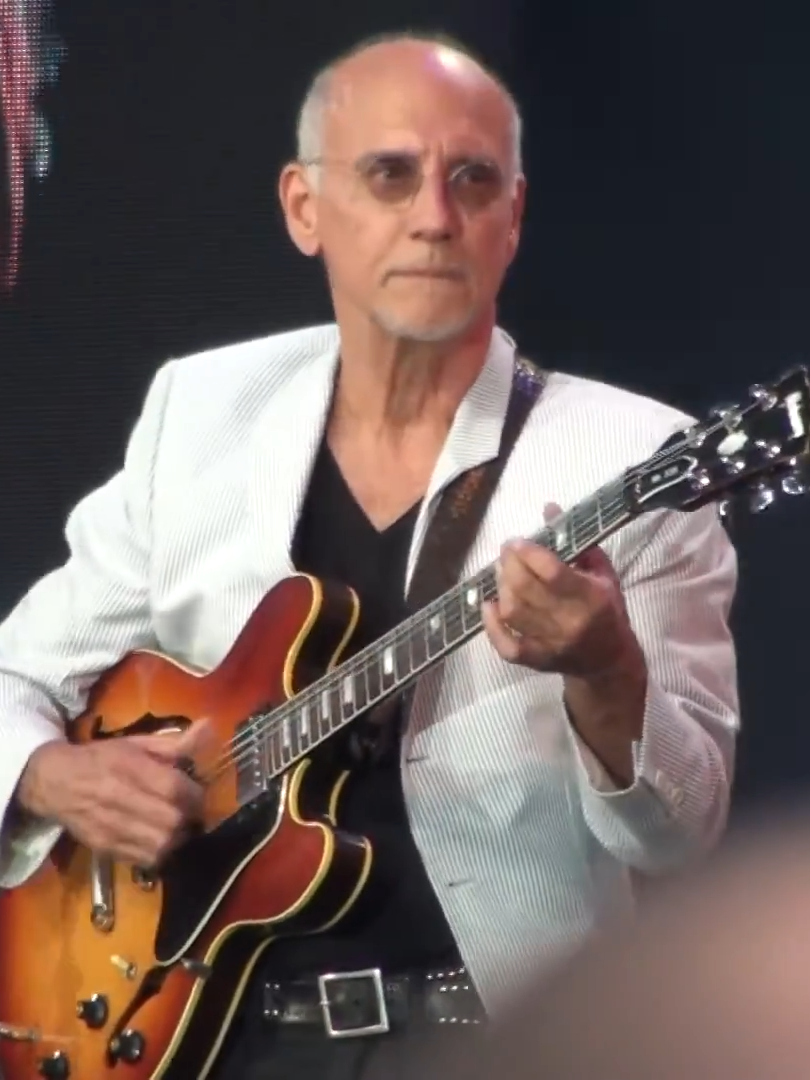
Background and career
Larry Eugene Carlton (born March 2, 1948) is an American guitarist who built his career as a studio musician in the 1970s and 1980s for acts including Steely Dan and Joni Mitchell. One of the most sought-after guitarists of his era, Carlton has participated in thousands of recording sessions, recorded on hundreds of albums in many genres including more than 100 gold records, in addition to music for television and movies. He was a member of the jazz fusion group the Crusaders and the smooth jazz band Fourplay maintaining a long solo career.
Carlton was born in Torrance, California in the South Bay Area of L.A., and, at the age of six, began guitar lessons. In the early 1960s, while he was still in high school, he debuted his talent playing surf guitar with Eddie and the Showmen, who became the house band at the Retail Clerks Union Hall in Buena Park, California. His interest in jazz came from hearing guitarist Joe Pass on the radio, after which he started to listen to jazz guitarists Barney Kessel and Wes Montgomery, as well as blues guitarist B.B. King. He went to junior college and Long Beach State College while playing professionally at clubs in Los Angeles.
During the 1970s, he found steady work as a studio musician on electric and acoustic guitar in a variety of genres: pop, jazz pop, rock, rhythm and blues, soul, and country. Carlton appeared in hundreds of recording sessions with Steely Dan, Joni Mitchell, Linda Ronstadt, Michael Jackson, Quincy Jones, Bobby Bland, Sammy Davis Jr., Paulinho Da Costa, Charly García, the Fifth Dimension, Herb Alpert, Christopher Cross, Dolly Parton, Barbra Streisand, Andy Williams, and the Partridge Family. Carlton performed on Mike Post's 1981 "Theme from Hill Street Blues", which won Grammys for 'Best Instrumental Composition' and for 'Best Pop Instrumental Performance'. In 1982, he appeared on The Nightfly by Donald Fagen, lead singer/keyboardist for Steely Dan. His guitar work on Steely Dan's "Kid Charlemagne" from their 1976 LP The Royal Scam was ranked No. 80 on a list of the best guitar songs by Rolling Stone.
Carlton recorded his debut solo album, With a Little Help from My Friends, in 1968. In the mid-1970s he built a home studio and called it Room 335 after the Gibson ES-335, an electric guitar he is known for playing. He has recorded most of his albums at Room 335. In 1988, with his solo career burgeoning, he was shot in the throat by a teenager outside Room 335 and suffered nerve and vocal cord damage, which delayed completion of the album he was recording at the time, On Solid Ground. His left arm was paralyzed and for six months he was unable to play more than a few notes. Carlton produced six albums from 1978 to 1984. His version of "Sleepwalk" by Santo Farina climbed the pop and adult contemporary charts. From 1985 to 1990, he did various solo projects, including the live album Last Nite. He was commissioned to compose music for the king of Thailand, Bhumibol Adulyadej, in honor of the king's birthday. He recorded The Jazz King (Sony BMG, 2008) with a jazz orchestra including Tom Scott, Nathan East, and Earl Klugh.
Grammy Award for Best Pop Instrumental Performance, "Theme from Hill Street Blues", 1981 Grammy Award for Best Pop Instrumental Performance, "Minute by Minute", 1987 Grammy Award for Best Pop Instrumental Album, No Substitutions: Live in Osaka, 2001 Grammy Award for Best Contemporary Instrumental Album, Take Your Pick, 2010
Carlton is best known for his 1969 Gibson ES-335, being often referred to as “Mr. 335”. Other guitars he owns and plays include a 1951 Fender Telecaster, a 1964 Fender Stratocaster, and a 1955 Gibson Les Paul Special. He has used a 1958 Fender Deluxe amplifier and his standard setup included a Dumble. Now he plays Bludotone amplifiers. In 2020, Carlton began endorsing Sire Guitars, with whom he has a signature line of electric guitars.
Sources
Net-worth figure: Celebrity Net Worth (October 2026), in USD. Biography and career facts: the person's Wikipedia article and linked reporting. Snapshot date for all StarWorth figures: 28 October 2026.



