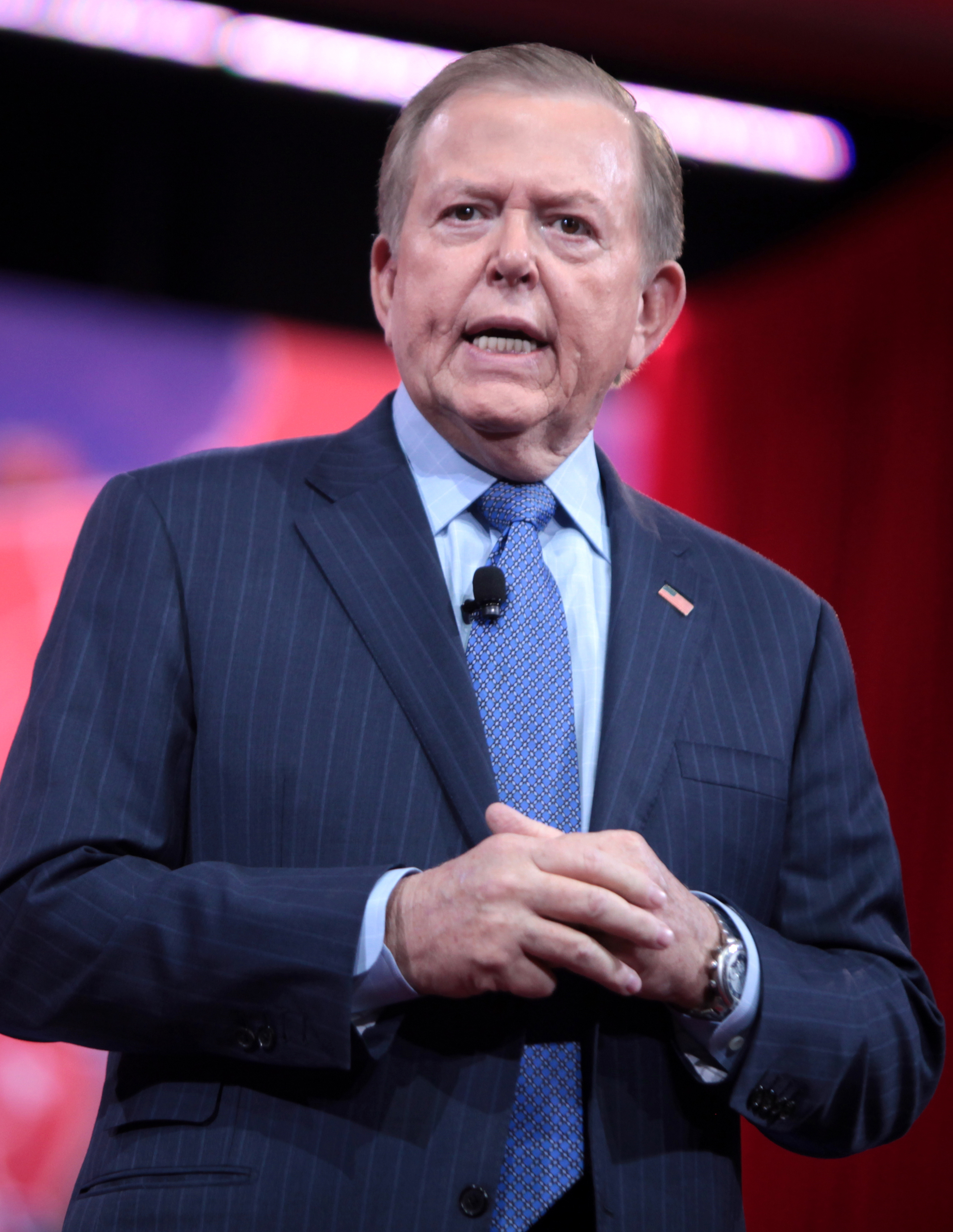
Background and career
Louis Carl Dobbs (September 24, 1945 – July 18, 2024) was an American conservative political commentator, author, and television host who presented Moneyline (later Lou Dobbs Tonight) from 1980 to 2009 and 2011 to 2021. From 2021 until his death, he hosted The Great America Show on iHeartRadio and loudobbs.com. Dobbs started working with CNN at its inception in 1980, serving as a reporter and network vice president. On the air, he served as host and managing editor of the network's business program, Moneyline, which premiered in 1980. Dobbs resigned from CNN in 1999 but rejoined the network in 2001. The show was renamed Lou Dobbs Tonight in 2003. He resigned once again in November 2009. He was the former talk radio host of Lou Dobbs Radio. From 2011, he hosted Lou Dobbs Tonight on the Fox Business Network until the network cancelled it in February 2021. Dobbs was an early promoter of birtherism, the unfounded accusation that former U.S. President Barack Obama is not a natural-born U.S. citizen. He was known for anti-illegal immigration views, as well as for opposition to NAFTA and other trade deals. A staunch supporter of Donald Trump, he infused his show with pro-Trump coverage. He was one of three Fox Corporation program hosts named in a $2.7 billion defamation lawsuit by Smartmatic relating to conspiracy theories used in attempts to overturn the 2020 United States presidential election. Dobbs was among the hosts named in the Dominion Voting Systems v. Fox News Network defamation lawsuit for broadcasting false statements about the plaintiff company's voting machines that Fox News settled for $787.5 million and required Fox News to acknowledge that the broadcast statements were false.
Louis Carl Dobbs was born September 24, 1945, in Childress, Texas. He was the son of Frank Dobbs, a co-owner of a propane business, and Lydia Mae (née Hensley), a bookkeeper. When Dobbs was twelve, his father's propane business failed and the family moved to Rupert, Idaho. Although accepted at the University of Idaho and Idaho State University, he was persuaded by the staff at Minico High School to apply to Harvard University, where he was accepted and graduated in 1967 with a Bachelor of Arts degree in economics.
After college, Dobbs worked for federal anti-poverty programs in Boston and Washington, D.C., then returned to Idaho. He briefly attended the University of Idaho College of Law in Moscow, and then worked as a cash-management specialist for Union Bank of California in Los Angeles. He married his high school sweetheart in 1969, and in 1970 their first son was born. Dobbs moved to Yuma, Arizona, and got a job as a police and fire reporter for KBLU. By the mid-1970s, he was a television anchor and reporter in Phoenix, and he later joined Seattle's KING-TV. In 1979, he was contacted by a recruiter for Ted Turner, who was in the process of forming CNN.
Dobbs joined CNN when it launched in 1980, serving as its chief economics correspondent and as host of the business news program Moneyline on CNN. Dobbs also served as a corporate executive for CNN, as its executive vice president and as a member of CNN's executive committee. Dobbs was president of CNNfn (CNN financial news) and anchored the program Business Unusual. His ratings were typically triple that of his former protégé, Maria Bartiromo. Howard Kurtz, in his book on business journalism of the era, wrote that Dobbs "could be arrogant and abrasive" and was controversial within CNN. In 1992, Dobbs admitted to receiving more than $15,000 to act as a spokesman from Shearson Lehman Brothers, PaineWebber, and the Philadelphia Stock Exchange, making promotional videos; he was reprimanded by the network for the conflict of interest and expressed regret in a memo to staff. Dobbs nearly left the network in 1997 over a clash on CNNfn's direction; he ultimately convinced Turner to expand CNNfn from 14 hours per day to 18 hours per day, with a commitment to further increase it to 24 hours per day.
Dobbs repeatedly clashed with Rick Kaplan, who became president of CNN in 1997. Dobbs said Kaplan, a friend of then president Bill Clinton, was "clearly partisan" and "was pushing Clinton stories", while Kaplan said Dobbs was "a very difficult person to work with."
On April 20, 1999, CNN was covering Clinton's speech in Littleton, Colorado, following the Columbine High School massacre. Dobbs ordered the producer to cut away from the speech and return to broadcast Moneyline. Dobbs was countermanded by Kaplan, who ordered CNN to return to the speech. Kaplan later said, "Tell me what journalistic reason there was not to cover the president at Columbine soon after the shootings? Everyone else was doing it". Dobbs announced on the air that "CNN President Rick Kaplan wants us to return to Littleton." A few days later, Dobbs announced that he was leaving the network to start Space.com, a website devoted to astronautical news. Dobbs was subsequently replaced as host of Moneyline by Willow Bay and Stuart Varney.