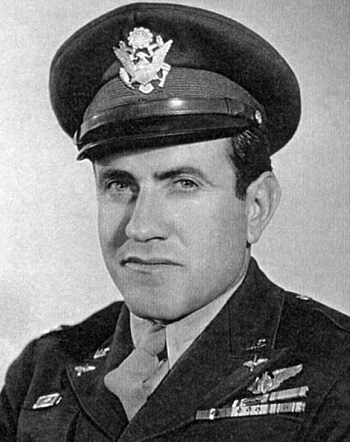
Background and career
Louis Silvie Zamperini (January 26, 1917 – July 2, 2014) was an American World War II veteran, Olympic distance runner, and Christian evangelist. He began running in high school and qualified for the United States in the 5,000 m event at the 1936 Summer Olympics, where he finished eighth and set a new lap record. Zamperini was commissioned in the United States Army Air Forces as a lieutenant. He served as a bombardier on B-24 Liberators in the Pacific. On a search and rescue mission, his plane experienced mechanical difficulties and crashed into the ocean. After drifting at sea on a life raft for 47 days, with two other crewmates, Zamperini landed on the then Japanese Marshall Islands and was captured. He was taken to a total of four different prisoner-of-war camps in Japan, where he was tortured and beaten by Japanese military personnel—including Mutsuhiro Watanabe—because of Zamperini's status as a famous Olympic runner. He was later taken to a new prison camp at a coal factory, and after much hardship, he was finally released. Following the war he initially struggled to overcome his ordeal, afflicted with post-traumatic stress disorder and alcoholism. He later became a Christian evangelist with a strong belief in forgiveness. From 1952 onwards, he devoted himself to at-risk youth. Zamperini is the subject of three biographical films: Unbroken (2014), its sequel Unbroken: Path to Redemption (2018), and Captured by Grace (2015).
Louis Zamperini was born on January 26, 1917, in Olean, New York, to Anthony Zamperini (1889-1975) and Louise Dossi (1898-1993), both native to Verona in northern Italy. He had an older brother named Pete (1915-2008) and two younger sisters, Sylvia (1918-2008) and Virginia (1923-2008). He was raised in a strict, devout Catholic household. Regardless, he took up smoking at age 5 and drinking at age 8. He struggled with bullies and supposedly almost died twice, once due to a house fire, and another from having fallen into an oil rig, almost drowning. In later childhood, his brother Pete was highly supportive of him and encouraged him to start his running career.
The Zamperini family moved from Olean, New York to Long Beach, California when Louis Zamperini was two years old. In 1919, the family moved to nearby Torrance where Louis attended Torrance High School. He and his family spoke no English when they moved to California, making him a target for bullies because of his Italian roots. His father taught him how to box in self-defense. Soon he claimed to be "beating the tar out of every one of them; but I was so good at it that I started relishing the idea of getting even. I was sort of addicted to it."
To stop Zamperini from getting into trouble, his older brother Pete got him involved in the school track team, where Pete was already a star. Before then, in the ninth grade, Zamperini's classmates challenged him to a footrace. Louis came in last, and was humiliated. Pete took Louis on several training runs. Zamperini began winning races, and he was becoming much faster. After Louis found his role model, Glenn Cunningham, he took up distance running. At the end of his freshman year, he finished fifth in the All City C-division 660 yards (600 m) dash.
It was the recognition, nobody in school, except for a few of my buddies, knew my name before I started running. Then, as I started winning races, other kids called me by name. Pete told me I had to quit drinking and smoking if I wanted to do well, and that I had to run, run, run. I decided that summer to go all-out; overnight I became fanatical. I wouldn't even have a milkshake. After a summer of running in 1932, starting with his first cross-country race, and throughout the last three years of high school, he was undefeated. He started beating his brother's records. On May 10, 1934, he set a national high school record for the mile, clocking in at 4 minutes, 21.3 seconds at the preliminary meeting to the California state championships. The following week, he won the CIF California State Meet championships with a time of 4 minutes and 27.8 seconds. That record helped him win a scholarship to the University of Southern California. In 1936, Zamperini decided to try out for the Olympics. In those days, athletes had to pay their way to the Olympic trials, but since his father worked for the railroad, Louis could get a train ticket free of charge. A group of Torrance merchants raised enough money for the local hero to live on once he got there. The competition for the 1,500 meters spot was fierce that year, with eventual silver medalist Glenn Cunningham, Archie San Romani, and Gene Venzke all challenging to get on the team. Zamperini did not compete in the 1,500 meters; instead, he ran the 5,000 meters. On one of the hottest days of the year during the 1936 North American heat wave in Randalls Island, New York, the race saw co-favorite Norm Bright and several others collapse during the race. It was reported that 40 people died from the heat in Manhattan alone that week. With a sprint finish at the end, Zamperini finished in a dead-heat tie against American record-holder Don Lash and qualified for the 1936 Summer Olympics in Berlin, Germany. Having qualified at age 19 years, 178 days, he remains the youngest American 5,000 meters qualifier.
Neither Zamperini nor Lash was believed to have much chance of winning the 1936 Olympics 5,000-meter race against world record holder Lauri Lehtinen. Zamperini later related several anecdotes from his Olympic experience, including gorging himself on the boat trip to Europe: "I was a Depression-era kid who had never even been to a drugstore for a sandwich in his life," he said, "and all the food was free. I had not just one sweet roll, but about seven every morning, with bacon and eggs. My eyes were like saucers." By the end of the trip, Louis Zamperini, in common with most athletes on the ship, had gained a good deal of weight: in Zamperini's case, 12 pounds (5 kg). While the weight gain was not advantageous for his running, it was necessary for his health, as he had lost 15 pounds (7 kg) while training in the summer heat in New York for the Olympic Trials. Zamperini finished 8th in the 5,000-meter distance event at that Olympics, in the time of 14 minutes 46.8 seconds, behind Finland's Gunnar Hockert's Olympic record time of 14 minutes 22.2 seconds (world record holder Lehtinen was second, and Zamperini's teammate, Lash, 13th). However, his final lap of 56 seconds was fast enough to catch the attention of Adolf Hitler, who afterwards had Zamperini come to his stand, where as Zamperini told the story, Hitler shook his hand, and said, "Ah, you're the boy with the fast finish."


