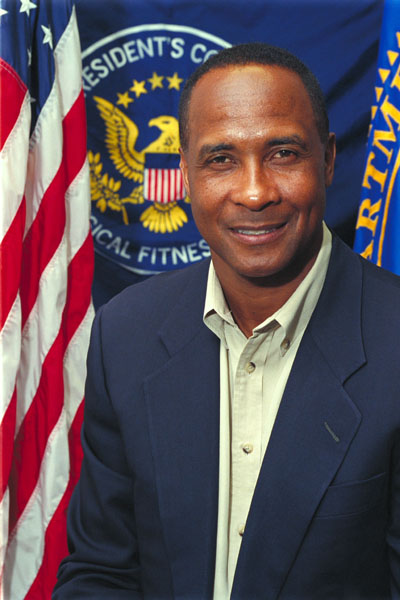
Background and career
Lynn Curtis Swann (born March 7, 1952) is an American former professional football player, broadcaster, politician, and athletic director, best known for his association with the University of Southern California and the Pittsburgh Steelers. He served on the President's Council on Fitness, Sports, and Nutrition from 2002 to 2005. In 2006, he was the Republican nominee for Governor of Pennsylvania. Swann was born in Alcoa, Tennessee. He attended USC and played football as a wide receiver of the USC Trojans, where he was a consensus All-American. He is regarded as one of the most popular and one of the greatest wide receivers of his generation. He was selected by the Steelers in the first round of the 1974 NFL draft. With the Steelers, Swann won four Super Bowls, was selected to three Pro Bowls, and was named MVP of Super Bowl X. Swann was inducted into the Pro Football Hall of Fame in 2001 and the College Football Hall of Fame in 1993.
Swann was born March 7, 1952, in Alcoa, Tennessee, in the foothills of the Great Smoky Mountains near Knoxville. The Swann family moved to San Mateo, California, in the San Francisco Bay Area when Lynn was 2. As a youth, Swann was raised in neighboring Foster City and attended Junípero Serra High School, where in addition to playing football, he was a track star, leaping 24 ft 10 in (7.57 m) in the long jump. Swann had also joined the basketball team and had an interest in ballet. His basketball teammate, Peter Barsocchini was aware of Swann's passion for ballet, which inspired him to write the High School Musical film, with Swann serving as an inspiration for the character of Troy Bolton. At the 1970 CIF California State championship meet, Swann won the state title, defeating future Olympic gold medalist Randy Williams.
Swann attended the University of Southern California in Los Angeles, where he was a consensus All-American on the Trojan football team under head coach John McKay, including the undefeated and national champion 1972 team. McKay said of Swann, "He has speed, soft hands, and grace." He completed a Bachelor of Arts Degree in public relations in 1974. In 1971, Swann had 27 catches for 305 yards and two touchdowns. He led USC in catches and finished second to WR Edesel Garrison in receiving yards. As a junior in 1972, Swann rushed for 117 yards and had 27 catches for 543 yards and three touchdowns. This time, he led USC in receiving yards and finished second to tight end Charle Young in catches. In 1973, Swann rushed for 99 yards while catching 42 passes for 714 yards and six touchdowns.
Swann was selected in the first round of the 1974 NFL draft by the Pittsburgh Steelers with the 21st overall pick. The Steelers draft class of '74 is considered one of the best in NFL history and includes four Hall of Famers: Swann, Jack Lambert (RD2), John Stallworth (RD4), and Mike Webster (RD5). Undrafted 1974 free agent signee Donnie Shell is also a hall of famer. Swann spent his entire NFL career with the Steelers and wore the jersey number 88. As a rookie in 1974, he led the NFL with 577 punt-return yards, a franchise record and the fourth-most in NFL history at the time. He was named to the PFWA All-Rookie Team. He went on to win a championship ring with the Steelers in Super Bowl IX, but did not record any receptions in the tough defensive struggle (Pittsburgh quarterback Terry Bradshaw completed only nine passes in the game). However, he returned three punts for 34 yards.
The following season became the highlight of Swann's career. He caught 49 passes for 781 yards and a league-leading 11 touchdowns. In the AFC title game against the Oakland Raiders, George Atkinson knocked Swann out of the game with a very hard but legal hit. He suffered a severe concussion that forced him to spend two days in a hospital, but surprised many by returning to play for Super Bowl X. Swann recorded four catches for a Super Bowl-record 161 yards and a touchdown in the game, assisting the Steelers to a 21–17 win over the Dallas Cowboys and became the first wide receiver to earn Super Bowl MVP honors.
Three seasons later, in 1978, the Steelers made it to Super Bowl XIII. In the game, Swann caught seven passes for 124 yards and scored the final touchdown for Pittsburgh in their 35–31 win over Dallas. The Steelers made it back to the Super Bowl again in the 1979 season, and Swann caught five passes for 79 yards and a touchdown at the Rose Bowl in Pittsburgh's 31–19 win over the Los Angeles Rams in Super Bowl XIV. Overall, Swann gained 364 receiving yards and 398 all-purpose yards in his four Super Bowls, which were both Super Bowl records at the time. Swann retired after the 1982 season with four Super Bowl rings. In his nine-year career, he amassed 336 career receptions for 5,462 yards and 51 touchdowns, 72 rushing yards on 11 attempts and a touchdown, and 739 punt return yards and a touchdown. He was a Pro Bowl selection three times (1975, 1977, 1978), and was selected to the 1970s All-Decade Team. Swann was unique among football players in that he credited his experiences in dance earlier in life with contributing to his aptitude on the football field. A 1981 interview which aired on Mr. Rogers' Neighborhood showed him on the field, and then in the Pittsburgh dance studio where he later underwrote scholarships. Swann was named to the All-Pro team in 1975, 1977, and 1978, and was elected to the Pro Football Hall of Fame in 2001, a year before his teammate John Stallworth.


