Background and career
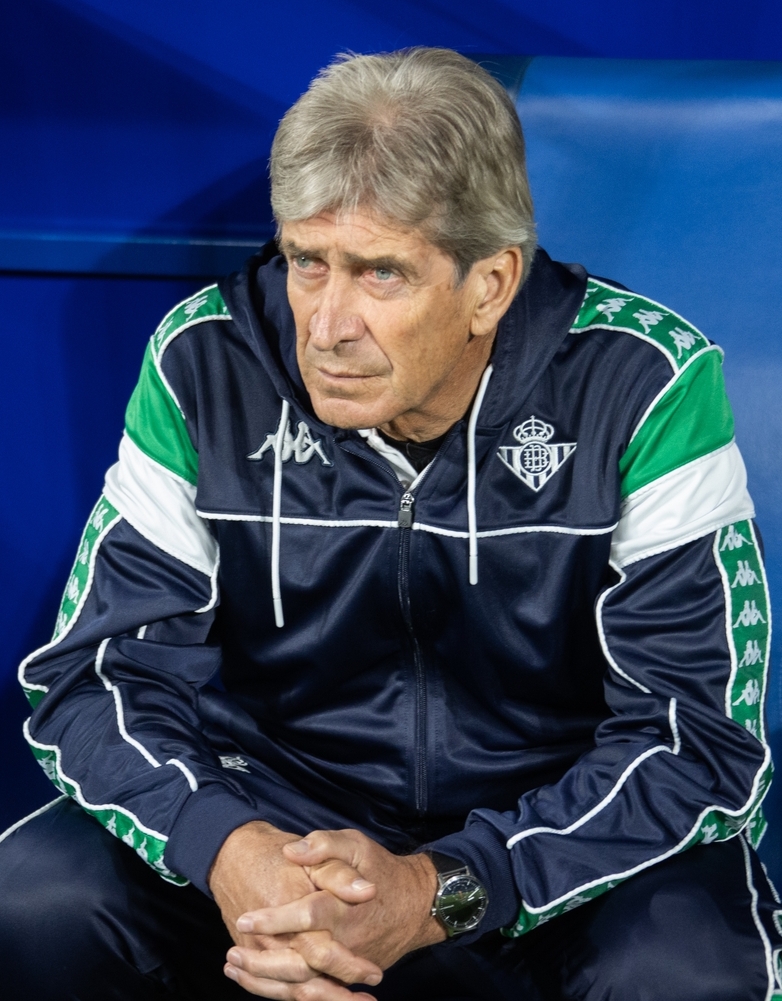
Manuel Luis Pellegrini Ripamonti (Spanish pronunciation: [maˈnwel peleˈɣɾini]; Italian: [pelleˈɡriːni]; born 16 September 1953) is a Chilean professional football manager and former player who is the head coach of La Liga club Real Betis. He has managed clubs in Spain, England, Argentina, Chile, China, and Ecuador, winning league titles in four different countries. Pellegrini first moved to Europe in 2004 to take the manager's post at Spanish side Villarreal. Under Pellegrini, Villarreal achieved a third-place finish in La Liga in 2004–05, a Champions League semi-final in 2005–06, and a historic second-place finish in La Liga in 2007–08. Pellegrini's consistent record at Villarreal attracted the attention of Real Madrid, who appointed him as manager for the 2009–10 season. He amassed a total of 96 points, a club record until it was surpassed by José Mourinho in the 2011–12 season, but lost the title to Barcelona by three points. He was dismissed after one season and later lamented the Galácticos policy employed by Madrid, which prevented him from building a balanced team. Pellegrini took up the manager's role at Málaga in November 2010. He led Málaga to a fourth-place finish in La Liga in his first full season and to qualification for the UEFA Champions League. He made it to the quarter-finals of the 2012–13 Champions League, becoming the only coach to take two different teams to the quarter-finals in their debut seasons in the competition. On 22 May 2013, Pellegrini confirmed he would leave Málaga at the end of the 2012–13 season. On 14 June 2013, he was appointed manager of Manchester City, and won the Football League Cup and Premier League in his first season, becoming the first manager from outside Europe to manage a team to the Premier League title. The title winning season was also noted for goal scoring prowess, with City scoring 151 goals in all competitions – an English football record. Pellegrini also managed to take Manchester City to their first ever Champions League semi-final in 2015–16, which was his last season, after finishing in fourth-place the league, and winning another Football League Cup. He was appointed as manager of West Ham United in May 2018 and lasted 18 months in charge, before he was sacked in December 2019 after a poor run of results. On 9 July 2020, Spanish club Real Betis announced that he would manage the side for the 2020–21 season.
Born in Santiago, to Italian parents, Pellegrini attended the Pontifical Catholic University of Chile in Santiago, where he graduated in civil engineering in 1979. He started his formative years as a footballer in the youth divisions of Audax Italiano. Then he went to Club Universidad de Chile where he would play professionally for them as a defender. He spent his entire playing career with the club, making a total of 451 appearances and scoring seven goals in the Chilean Division 1, including one goal against Colo-Colo, Universidad de Chile's biggest rival. In the 1970s, Club Universidad de Chile was going through one of the most unsuccessful periods in its history, having not won the national Copa Chile championship since 1969. That changed in 1979, when the club managed to win the championship and secure a spot for the 1980 Copa Libertadores, defeating its arch-rival Colo-Colo in both tournaments. Pellegrini was capped once by the Chile national team, starting in a 1–1 friendly draw away to Brazil on 7 May 1986. He retired as a player a year later, in February 1987, after a match against Trasandino, with his reason for retiring being the following: "We were playing in the Copa Chile against Trasandino. Our goalkeeper parried the shot of a rival player, I jumped to clear the ball, and behind me came a 17-year-old boy who jumped half a metre above me, and scored. That day I decided I couldn't keep going". That boy was Iván Zamorano, on loan from Cobresal, who would eventually become Pichichi of La Liga in 1995 with Real Madrid. Pellegrini confessed: "If I had known where that boy would get, I would not have retired. I would have kept playing two more years." Pellegrini wanted to help reconstruction projects in the Chilean central zone after the 1985 Algarrobo earthquake knowing that his experience as a qualified civil engineer would be ideal.
As a coach, Pellegrini has primarily managed teams in Spain, Argentina and Chile. As in his career as a professional player, he also started off coaching Universidad de Chile during the 1988 season, but left the team at the middle of the season to take football coaching courses in Europe. The team's poor performance that year led to a relegation to the Division 2 for the first time in its history, though in 1989 they won the Division 2 championship, bringing them back to Division 1, where they have remained ever since. In 1990, Arturo Salah was appointed as the manager of the Chile national team, and he hired Pellegrini as his assistant coach and manager of the under-20 team. In 1990, Pellegrini was appointed manager of Palestino, where he stayed until 1992. Then, in 1992, he took on managership of O'Higgins for a year, before moving in 1993 to become coach of Universidad Católica, one of the most popular clubs in Chile. There he managed well-known players such as Alberto Acosta and Nestor Gorosito and took the team to victory in the prestigious Copa Interamericana in 1994 and the 1995 Copa Chile, though he could only finish as runner-up in 1994 and 1995 of the local Campeonato Nacional championship, a competition organized by the Chilean Football Federation in parallel to the Primera Division. In 1998, Pellegrini had a brief spell back at Palestino before he was bought by Ecuadorian club LDU Quito. He managed the club to a national title in 1999, starting a tradition of coaches that followed him to the Ecuadorian team. Pellegrini also gave the club a good run in the Copa Libertadores, catching the eye of other South American managers.
Pellegrini joined Argentine club San Lorenzo in 2001 and led them to their first international title in the Copa Mercosur. He was recommended to the club by San Lorenzo icon Nestor Gorosito, who had worked with Pellegrini at Universidad Católica. The recommendation paid dividends, as Pellegrini led San Lorenzo to victory in the Argentine Clausura and the Copa Mercosur, South America's UEFA Cup equivalent.
Pellegrini managed Argentine club River Plate from 2002 to 2003 and secured the Clausura championships in 2003. He resigned his post at the end of the campaign.
Pellegrini took over the managerial duties of Villarreal on 1 July 2004. In his first season in charge of the club, Villarreal qualified for the UEFA Champions League after finishing third in the league and reached the quarter-finals of the UEFA Cup. The following season, Villarreal reached the semi-finals of the 2005–06 UEFA Champions League, losing to Arsenal. Villarreal eventually finished seventh in La Liga that year. The following two seasons featured Villarreal finishing in both fifth and second place in the league, the latter being historic for the club. Pellegrini led El Submarino Amarillo to the Champions League knockout stages, where they drew Arsenal once again in the quarter-finals, losing 4–1 on aggregate. At the end of 2007, Villarreal offered Pellegrini an extended contract until 2011. On 31 May 2009, after the last La Liga match for Villarreal, Pellegrini said: "Nobody from Real Madrid has spoken with me. I have a contract with Villarreal, we finished the league today, and tomorrow we go on holiday", after being questioned by the press on rumours that he was in talks with Madrid. On 1 June 2009, a Villarreal executive announced that Pellegrini would no longer continue at the club. The Valencian club executive specified that if Real Madrid wanted to sign the Chilean coach, they would have to pay Pellegrini's €4 million termination clause.


