Background and career
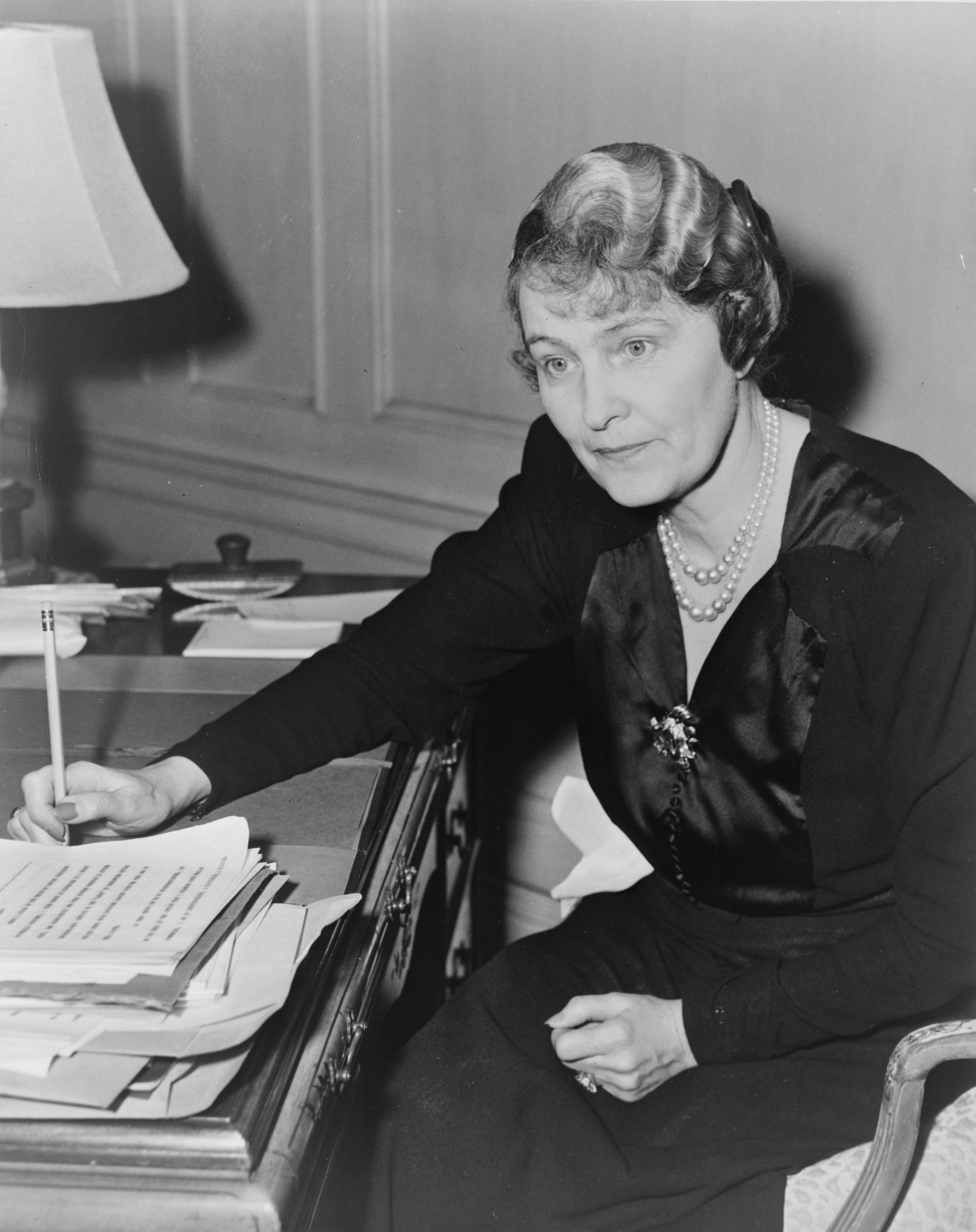
Marjorie Merriweather Post (March 15, 1887 – September 12, 1973) was an American businesswoman, socialite, and philanthropist. She was the daughter of C. W. Post and the owner of General Foods Corporation. For much of Post's life, she was known as the wealthiest woman in the United States. Post used much of her fortune to collect art, particularly Imperial-era Russian art, much of which is now on display at Hillwood, the museum which was her estate in Washington, D.C. She is also known for her mansion, Mar-a-Lago, in Palm Beach, Florida.
Marjorie Merriweather Post was born in Springfield, Illinois, the only child of C. W. Post and Ella Letitia Merriweather. At age 27, following her father's death in 1914, she became the owner of the rapidly growing Postum Cereal Company, founded in 1895. She inherited a $20 million fortune. Post lived in Battle Creek, Michigan from ages 3 to 14. She then moved to Washington, D.C. to attend the Mount Vernon Seminary and College (now the George Washington University's Mount Vernon Campus). She maintained a close lifelong relationship with her alma mater and served as its first alumna trustee. Today, a collection of her correspondence with Mount Vernon administrators is maintained by GWU's Special Collections Research Center. Post's complete collection of personal papers, as well as those of her father, are held by the University of Michigan's Bentley Historical Library.
Post became the owner of the Postum Cereal Company in 1914, after the death of her father, and was a director of the company until 1958. She, along with her second husband, E. F. Hutton, began growing the business by acquiring other American food companies such as Hellmann's Mayonnaise, Jell-O, Baker's Chocolate, and Maxwell House. In 1929, Postum Cereal Company was renamed General Foods Corporation. While taking a voyage on her yacht, the Hussar, Post came across the innovation of Clarence Birdseye in Gloucester, Massachusetts by dining on a whole turkey that was previously frozen. Birdseye had invented a technology to preserve fresh food by the flash freezing process that prevented water crystals from forming and diluting the product. Post foresaw the future advantages of Birdseye's invention, bought the company, made him vice president and pioneered the frozen fresh food market for wholesalers and retailers by providing the first commercial freezers.
Post funded a U.S. Army hospital in France during World War I, and, decades later, the French government awarded her the Legion of Honour, in the degree of Commander. Starting in 1929 and throughout the Great Depression, she financed and personally supervised a Salvation Army feeding station in New York. She also donated the cost of the Boy Scouts of America headquarters in Washington. Years later in 1971, she was among the first three recipients of the Silver Fawn Award, presented by the Boy Scouts of America. The 425-acre (0.7 sq mi) Lake Merriweather on Goshen Scout Reservation in Goshen, Virginia, was named in her honor. Camp Post is named for her. In 1966, at Long Island University's C.W. Post College, located on her former Long Island estate, she became honorary housemother of Zeta Beta Tau's Gamma Delta chapter, often hosting the fraternity brothers for brunches. Post served as the honorary house mother of the college's first local fraternity, Sigma Beta Epsilon, which, in 1969, became the New York Beta chapter of Sigma Alpha Epsilon. Since Post had borne only girls, she referred to the fraternity of sons-in-law as her "boys", while they called her "Mother Marjorie". Post was honored by Sigma Alpha Epsilon fraternity as a "Golden Daughter of Minerva". She donated $100,000 to the National Cultural Center in Washington that would later become the John F. Kennedy Center for the Performing Arts. In 1955, she contributed $100,000 to the National Symphony for free concerts that led to the beginning of the Music for Young America Concerts, which she financed annually. The Merriweather Post Pavilion, an outdoor concert venue in Columbia, Maryland, is named for her.
Some of Post's jewelry, bequeathed to the Smithsonian Institution in Washington, D.C., is displayed in the Harry Winston exhibit. Pieces in the collection include the Napoleon Diamond Necklace and the Marie Louise Diadem, a 275-ct (55 g) diamond-and-turquoise necklace and tiara set that Napoleon I gave to his second wife, Empress Marie Louise; the Marie Antoinette Diamond Earrings, a pair of diamond earrings set with pear shapes, weighing 14 ct (2.8 g) and 20 ct (4 g), once belonging to Marie Antoinette; the Blue Heart Diamond, a 30.82-ct (6.164 g) heart-shaped blue diamond ring; and an emerald-and-diamond necklace and ring, once belonging to Habsburg aristocrat and one time emperor of Mexico, Maximilian.
According to the Hermitage Museum Foundation, Post was a Russophile. During the 1930s, the Soviet government under Joseph Stalin began selling art treasures and other valuables seized from the Romanov family and former Russian aristocrats after the Russian Revolution to earn hard currency for its industrialization and military armament programs. Critics have claimed that these items were expropriated; however, the transactions by Post and her third husband, Joseph E. Davies, were from the recognized governmental authority. Neither Post nor Davies were involved with the original seizing of the items. Allegations later surfaced that many works of art from the Tretyakov Gallery and other collections were either donated or offered at nominal prices to the couple, who were both art collectors. Davies is also alleged to have purchased art expropriated from Soviet citizens well after the Russian Revolution, including victims of Stalin's Terror at discount prices from Soviet authorities. Many of the items, which remain under the control of the Post estate or its agents, can be viewed at Hillwood, her former estate. Hillwood has operated as a private museum since Post's death and displays her French and Russian art collection, featuring the work of Fabergé, Sèvres porcelain, French furniture, tapestries, and paintings.


