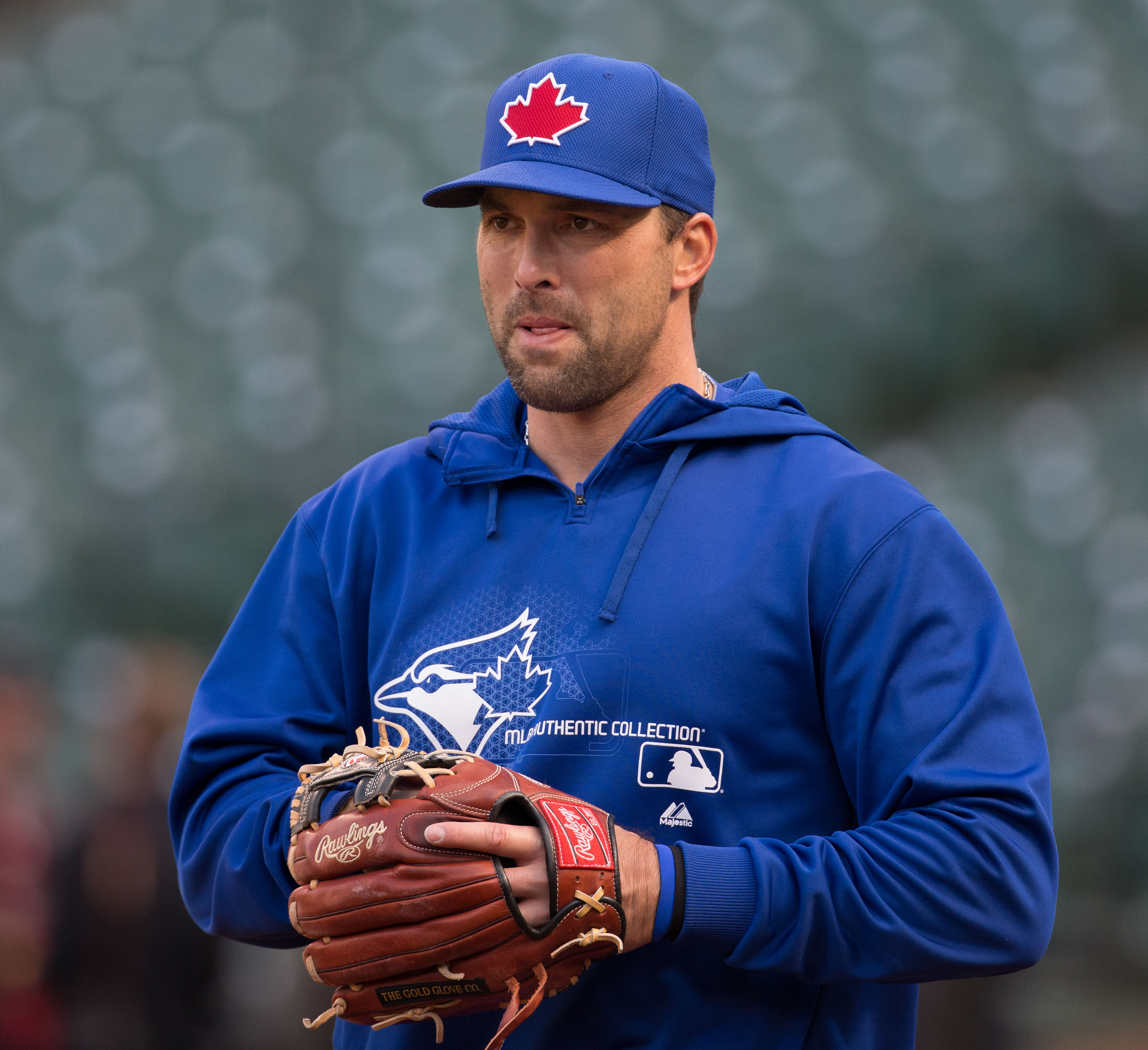
Background and career
Mark Thomas DeRosa (born February 26, 1975) is an American former professional baseball player who played in Major League Baseball (MLB) from 1998 to 2013. He played for the Atlanta Braves (1998–2004), Texas Rangers (2005–2006), Chicago Cubs (2007–2008), Cleveland Indians (2009), St. Louis Cardinals (2009), San Francisco Giants (2010–2011), Washington Nationals (2012), and Toronto Blue Jays (2013). DeRosa primarily played third base and second base, but he started at every position other than center field, pitcher, and catcher. He currently works for MLB Network as a studio analyst. He managed the United States national team at the 2023 and 2026 World Baseball Classics, leading both teams to silver medals. A Carlstadt, New Jersey, native, DeRosa attended the University of Pennsylvania, where he led the football team to consecutive Ivy League championships as their quarterback in 1994 and 1995. He also played baseball for the Quakers, and he chose to sign when the Braves selected him in the seventh round (212th overall) of the 1996 MLB draft. Originally a shortstop, DeRosa debuted with the Braves briefly in 1998. He gradually got more playing time over the next few seasons, especially after transitioning to a utility player in 2001. In 2004, the Braves tried using him as their starting third baseman, but he was benched in June after struggling. Not offered a contract after the season, he signed with the Rangers. After playing just 66 games with them in 2005, he became an everyday player in 2006, batting .296 and setting career highs in several offensive categories. Prior to the 2007 season, DeRosa signed a three-year contract with the Cubs. He set a career high with 149 games played in 2007, then equaled that total in 2008, hitting over 20 home runs (21) for the first time in his career. DeRosa was traded to the Indians in 2009, then to the Cardinals in midseason. He hit a career-high 23 home runs but injured his left wrist during the year. Offseason surgery was unsuccessful, and left wrist issues severely limited his playing time with the Giants in 2010 and 2011. DeRosa appeared in 48 games with the Nationals in 2012, then hit his 100th career home run with the Blue Jays in 2013 before retiring after the season.
DeRosa was born on February 26, 1975, in Passaic, New Jersey. His parents, father Jack and mother Mickey, were descended from Italian immigrants. Jack played college baseball as a pitcher for the Fairleigh Dickinson Knights, for whom he once threw a no hitter. Growing up in Carlstadt, New Jersey. Mark regularly watched the New York Yankees on television. His favorite player was Don Mattingly. His early playing experience came with Carlstadt's Little League team, which was sponsored by General Tire and coached by his father. He attended Bergen Catholic High School in Oradell, New Jersey, where he earned all-state honors in baseball and in football. Offered football scholarships to the College of William & Mary as well as Rutgers University, DeRosa instead attended the University of Pennsylvania (Penn), preferring its academic reputation and the opportunity to play baseball as well. After redshirting as a freshman, he became the starting quarterback for the Quakers in 1994, leading them to an undefeated season and an Ivy League championship. He led them to another Ivy League championship in 1995. Passing for 3,895 yards and 25 touchdowns during his career, he became one of the top quarterbacks in school history. Meanwhile, DeRosa played shortstop on the baseball team. In 1995, he played collegiate summer baseball in the Cape Cod Baseball League for the Bourne Braves. Originally expected to be a reserve, he became the team's starting third baseman when Troy Glaus departed to play for a national team. Batting over .300, he was selected to the league's All-Star team. At Penn, DeRosa was a member of the Sigma Chi fraternity. Drafted by the Atlanta Braves in the seventh round (212th overall) of the 1996 Major League Baseball (MLB) draft, DeRosa chose to forego participating in college sports as a senior to instead pursue a professional baseball career. However, he continued to take classes in management and marketing, graduating from Penn's Wharton School in 1997.
DeRosa made his professional debut in 1996 with the Eugene Emeralds of the Class A short season Northwest League. Progressing through Atlanta's minor league system, he joined the Braves for the first time as a September callup in 1998. He made his MLB debut on September 2, pinch-hitting for Greg Maddux and striking out against Randy Johnson in a 4–1 loss to the Houston Astros. On September 20, he had his first MLB hit, a pinch-hit single against Vladimir Núñez in a 10–0 win over the Arizona Diamondbacks. He appeared in five games for the Braves in 1998, serving as a shortstop, pinch hitter, and pinch runner. In 1999, DeRosa spent most of the season as the starting shortstop for the Class AAA Richmond Braves of the International League. From June 9 through July 1, he served as a pinch hitter for Atlanta, going hitless in eight at bats while Walt Weiss was on the disabled list (DL). He was called up again on May 5, 2000, when Weiss was again placed on the DL. On May 14, he recorded his only three RBI of the season with a pinch-hit, bases-loaded double against Trever Miller in an 11–2 win over the Philadelphia Phillies. After appearing in five games, he was sent back to Richmond on May 21 when Weiss returned from the DL. He was with Atlanta again from June 13 through 29 while Rafael Furcal was on the DL, then was called up for the remainder of the season in September. In 22 games (13 at bats) for Atlanta in 2000, he batted .308 with nine runs scored and four hits. After starting 2001 with Richmond, DeRosa was recalled on June 1, replacing pitcher Chris Seelbach on Atlanta's roster. He filled in for Furcal for 10 games, batting .300 while Atlanta's starting shortstop recovered from a minor injury. Then, he took over the starting role again on July 6 after Furcal suffered a season-ending shoulder injury. On July 21, he hit his first major league home run, a 10th-inning walkoff one against Graeme Lloyd that gave the Braves a 2–1 victory over the Montreal Expos. DeRosa hit well, batting .342 with 14 RBIs, but defensively he committed five errors. Wanting a better defender with more experience, the Braves acquired Rey Sánchez to be their starting shortstop at the July 31 trade deadline. However, DeRosa started a few more games at shortstop that August when Sánchez was recovering from a left hamstring injury. In 66 games (164 at bats), DeRosa batted .287 with 47 hits, three home runs, and 24 RBI. DeRosa was part of a playoff roster for the first time as the Braves won the National League (NL) East division. He had a single against Mike Williams Game 1 of the NL Division Series (NLDS), his only appearance of the series as the Braves swept the Astros in three games. In four games (four at bats) in the NL Championship Series (NLCS), he was hitless as the Braves were defeated by Arizona in five games.
In 2002, DeRosa began the year as a backup player for the Braves. He had started five games in a row at shortstop for the Braves from May 13 through 17 when, in the last of those, he tore a tendon sheath in his right ankle. The injury required surgery and kept him out until July 17. Upon his return, he split time with Keith Lockhart at second base, though he also saw occasional playing time at shortstop and in left field and right field. In 72 games (212 at bats), he batted .297 with 63 hits, five home runs, and 23 RBI. He returned to the playoffs as the Braves again won the NL East. Starting at second base in Game 2 of the NLDS against the San Francisco Giants, he had two hits and two RBI in a 7–3 victory. His pinch-hit RBI single against Aaron Fultz in Game 5 provided the only Atlanta run in a 3–1 defeat that eliminated the Braves from the playoffs. Healthy all year in 2003, DeRosa again played a number of positions: every infield spot, as well as left field and designated hitter. Of his six home runs, four came in back-to-back games: May 28 and 30 against the Cincinnati Reds and New York Mets, and September 8 and 9 against Philadelphia. On July 17, he had a walkoff bases-loaded single in the ninth inning against John Franco, giving Atlanta a 3–2 win over the Mets. In the September 8 game, he started the scoring for the Braves with a two-run home run in the first inning, then scored the go-ahead run in the fifth inning of a 6–4 win over the Phillies. In 103 games (266 at bats), he batted .263 with 70 hits, six home runs, and 22 RBI. DeRosa made the playoffs for the third year in a row as the Braves again won the NL East championship. Starting at second base in Game 2 of the NLDS in place of Marcus Giles, who was recovering from a left leg bruise, DeRosa had an eighth-inning, two-RBI double against Dave Veres, driving in the go-ahead runs in a 5–3 victory over the Chicago Cubs. He pinch hit in three other games in the series, but the Cubs defeated the Braves in five games. When Vinny Castilla signed with the Colorado Rockies after the 2003 season, the Braves decided to make DeRosa the starting third baseman in 2004, despite him batting just .231 with no extra-base hits in spring training. On May 2, he committed four errors, tying a team record amidst a 13–4 loss to the Rockies. DeRosa said later that the poor defensive performance distracted him from his hitting for about a week. His batting average was a mere .178 in May. On June 15, DeRosa lost his starting job, as Chipper Jones moved from left field to third base, his position from 1995 through 2001. "It was terrible," DeRosa said of his performance. Watching videotapes of himself and adjusting his approach to hitting, he performed better as a backup, but he remained a reserve player for the rest of the season. His season came to an end on September 25, when he tore his right anterior cruciate ligament (ACL). In 118 games (309 at bats), he batted .239 with 74 hits, three home runs, and 31 RBI. After the season, the Braves declined to offer DeRosa a contract for 2005, making him a free agent.
On January 19, 2005, the Texas Rangers signed DeRosa to a contract, but it was only a minor league one, as the Rangers had some concerns about his health. Making it through the spring, he had his contract purchased before the start of the season, as the Rangers wanted an experienced utility infielder on their roster. The last member of the Opening Day roster to appear in a game, not making his Ranger debut until the 11th game of the season, DeRosa played only six games a month in April, May, and July, though he appeared in 12 games in June. In August and September, he saw more action in right field, as Richard Hidalgo was battling a left wrist injury. In 66 games (148 at bats), he batted .243 with 36 hits and 20 RBI. Despite appearing in his fewest games since 2001, his eight home runs represented a new career high. Still under team control at the end of the year, he avoided arbitration on December 12 by agreeing to a one-year, $675,000 contract. After playing only two of the Rangers' first 11 games in 2006, DeRosa was on the disabled list from April 15 to 30 with a sprained left foot. With starting second baseman Ian Kinsler injured and fill-in D'Angelo Jiménez batting .208, DeRosa took over the position upon his return. He responded to the increased playing time by hitting .343, leading the Rangers in hitting in the first half of the season. On May 3, he hit a 12th-inning walkoff home run against John Halama, giving the Rangers a 2–1 victory over the Baltimore Orioles. "He means a lot to our team," said manager Buck Showalter. Once Kinsler became healthy, DeRosa returned to being a utility player, but he remained a regular in Texas's lineup, even though his position changed frequently. On August 4, DeRosa hit his first career grand slam, coming against John Lackey in a 7–3 victory over the Los Angeles Angels of Anaheim. Though his average fell to .296 by season's end, he was still one of Texas's best players in 2006. He set career highs with 136 games played, 40 doubles, 13 home runs, and 74 RBI. After the season, he became a free agent.
On November 14, 2006, he signed a three-year, $13 million contract with the Chicago Cubs. DeRosa was one of several acquisitions by the Cubs in their off-season spending spree. Though the Rangers had been interested in retaining him, Chicago offered DeRosa the chance to start regularly at second base, an option that he preferred. Despite this, he again played multiple positions, though he was in the lineup regularly and second base was his most frequent position. On June 3, he hit a grand slam against Lance Cormier to open the scoring in a 10–1 victory over the Braves. Against the Reds on August 16 and September 17, he had a career-high five hits. In a career-high 149 games, DeRosa batted .293 with 147 hits, 10 home runs, and 72 RBI. Winners of the NL Central, the Cubs faced the Diamondbacks in the NLDS. Playing second base, DeRosa batted .333 with two runs scored in the series. However, the Cubs were swept by the Diamondbacks in three games. On February 23, 2008, DeRosa was hospitalized with breathing difficulties and a rapid heartbeat. On February 28, he had a successful catheter ablation at Northwestern Memorial Hospital to correct an irregular heartbeat, a problem which had plagued him since high school. His heart procedure earned him the nickname of "the Pulse", which also became the name of his blog on the Cubs' website. On June 30, he hit a two-run home run against Barry Zito and a grand slam against Billy Sadler as the Cubs defeated the Giants 9–2. After having three RBI against the Astros on August 4, he hit a grand slam and recorded five RBI against them on August 5 in an 11–4 victory. He hit home runs in four consecutive games from August 20 through 23, becoming the first Cub to do so since Fred McGriff in 2001. In 2008, DeRosa primarily played second base, but he also filled in at third base, left field, and right field when the Cubs starters at those positions were hurt. He was the only MLB player with at least 20 appearances at four positions in 2008. Manager Lou Piniella said, "The amazing part about it is he’s very adroit defensively at every position he plays". Playing 149 games for the second year in a row, he batted .285 with 143 hits, setting career highs in runs with 103, home runs with 21, and RBI with 87. Paul Hoynes of The Plain Dealer called it his finest season in a January 15, 2009, article. For the second year in a row, the Cubs won the NL Central. DeRosa's two-run home run against Derek Lowe in Game 1 of the NLDS opened the scoring but wound up providing the only Cubs runs in a 7–2 loss to the Los Angeles Dodgers. He had two hits and two RBI in Game 2 but also committed an error that contributed to a five-run second inning by the Dodgers as they defeated Chicago 10–3. DeRosa hit .333 in the series, but the Cubs were swept by Los Angeles in three games, a loss that DeRosa found more disappointing than the previous year's.
Sources
Net-worth figure: Celebrity Net Worth (October 2026), in USD. Biography and career facts: the person's Wikipedia article and linked reporting. Snapshot date for all StarWorth figures: 28 October 2026.


