Background and career
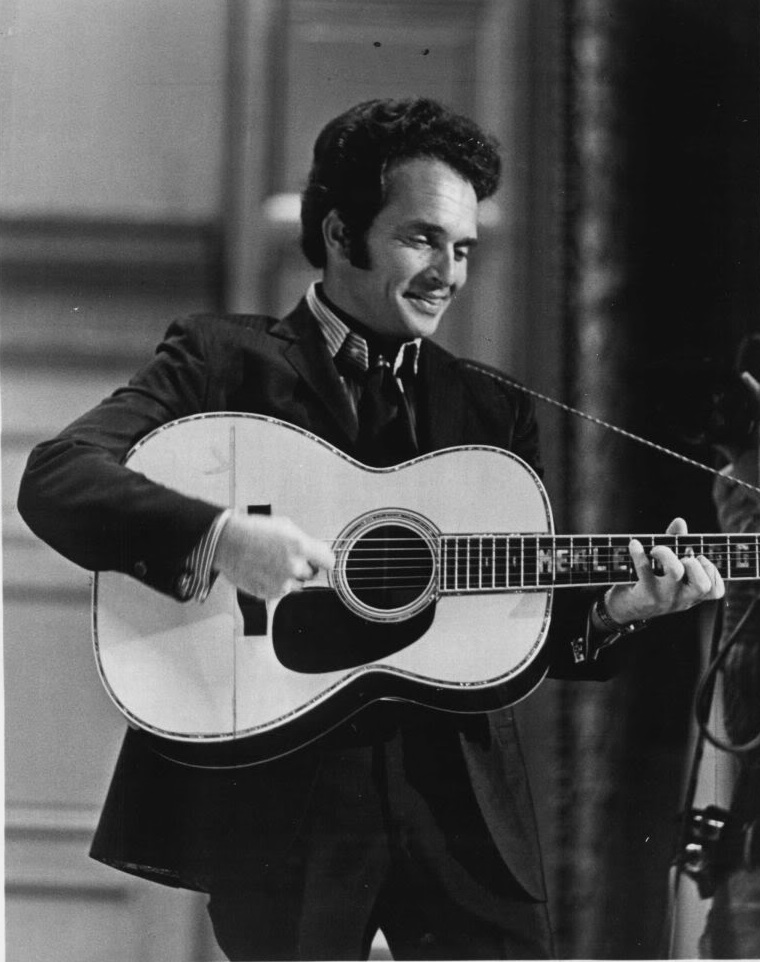
Merle Ronald Haggard (April 6, 1937 – April 6, 2016) was an American country music singer, songwriter, guitarist, and fiddler. Widely regarded as one of the greatest and most influential figures in country music, he was a central pioneer of the Bakersfield sound. With a career spanning over five decades, Haggard had 38 number-one hits on the US country charts, several of which also made the Billboard all-genre singles chart. His song "Mama Tried" has become a country staple. Haggard overcame a troubled childhood, criminal convictions and time in prison to launch a successful country music career. He gained popularity with his songs about the working class; these occasionally contained themes contrary to the anti–Vietnam War sentiment of some popular music of the time, most notably "Okie From Muskogee", and "The Fightin' Side of Me". Haggard received many honors and awards, including a Kennedy Center Honor (2010); a Grammy Lifetime Achievement Award (2006); a BMI Icon Award (2006); and induction into the Nashville Songwriters Hall of Fame (1977); Country Music Hall of Fame (1994) and Oklahoma Music Hall of Fame (1997). In 2017, he earned the number one spot in Rolling Stone's list of "The 100 Greatest Country Artists of All Time", surpassing Johnny Cash and Hank Williams.
Haggard was born in Oildale, California, the son of Flossie Mae (née Harp; 1902–1984) and James Francis Haggard (1899–1946), who, in 1934, had moved to California after their farm in Checotah, Oklahoma, burned down. They settled with their two elder children, James "Lowell" (1922–1996) and Lillian, in an apartment in Bakersfield, while James started working for the Santa Fe Railroad. A woman who owned a boxcar in nearby Oildale asked Haggard's father about the possibility of converting it into a house. He remodeled and expanded the boxcar, and soon after moved in, also purchasing the lot, where Merle Ronald Haggard was born on April 6, 1937. In 1946, James Haggard died of a brain hemorrhage. Nine-year-old Merle was deeply affected by the loss, and it remained a pivotal event to him for the rest of his life. To support the family, Haggard's mother took a job as a bookkeeper. Older brother Lowell gave his guitar to Merle when Merle was 12. Haggard taught himself to play, with the records he had at home, influenced by Bob Wills, Lefty Frizzell, and Hank Williams. While his mother was at work, Haggard started getting into trouble. She sent him to a juvenile detention center for a weekend but his behavior worsened. By age 13, Haggard was stealing and writing bad checks. In 1950 he was caught shoplifting and sent to a juvenile detention center. The following year, he ran away to Texas with his friend Bob Teague. The two rode freight trains and hitchhiked throughout the state. When they returned later that year, they were accused of robbery and sent to jail; they were released when the real robbers were found. Merle was sent to Fred C. Nelles Youth Correctional Facility in Whittier, California, a juvenile detention center later that year, from which he and his friend escaped and headed to Modesto, California. There, he worked as a potato truck driver, short order cook, hay pitcher and oil well shooter. During this time, he made his musical debut performance, with Teague, in a Modesto bar named "Fun Center", for which he was paid US$5 and given free beer. In 1951, Haggard returned to Bakersfield, where he was arrested for truancy and petty larceny and sent to a juvenile detention center. After another escape, he was sent to the high-security Preston School of Industry. He was released 15 months later but was sent back after beating a local boy during a burglary attempt. After his release, he and Teague saw Lefty Frizzell in concert. The two sat backstage, where Haggard began to sing along. Hearing the young man from the stage, Frizzell insisted that Haggard come on stage and sing. He was well received by the audience and decided to pursue a career in music. At night he would sing and play in local bars, while working as a farmhand or in the oil fields during the day. In 1956, Haggard got married but he was plagued by financial issues. In 1957, he tried to rob a Bakersfield roadhouse, but was caught, convicted and sent to the Bakersfield Jail. After an escape attempt he was transferred to San Quentin Prison on February 21, 1958. There he was prisoner number A45200. While in prison, Haggard learned that his wife was expecting another man's child, which stressed him psychologically. He was fired from a series of prison jobs, and planned to escape along with another inmate nicknamed "Rabbit" (James Kendrick) but was dissuaded by fellow inmates. While in San Quentin, Haggard started a gambling and brewing racket with his cellmate. After he was caught drinking, he spent a week in solitary confinement, where he encountered Caryl Chessman, an author and death-row inmate. Meanwhile, "Rabbit" had successfully escaped, only to shoot a police officer and be returned to San Quentin for execution. Chessman's predicament, along with the execution of "Rabbit", inspired Haggard to change his life. He earned a high school equivalency diploma and kept a steady job in the prison's textile plant. He also played for the prison's country music band. In 1960, he attended a Johnny Cash concert at the prison, where Cash sang "Folsom Prison Blues". This had a profound influence on Haggard who, upon his release in 1960, set out to forge a career as a singer-songwriter. In 1972, after Haggard had become a country music star, then-California governor Ronald Reagan granted him a full and unconditional pardon for his past crimes.
Upon his release from San Quentin in 1960, Haggard began digging ditches for his brother's electrical contracting company. Soon, he was performing again and later began recording with Tally Records. The Bakersfield sound was developing in the area as a reaction against the overproduced Nashville sound. Haggard's first record for Tally was "Singing My Heart Out" backed by "Skid Row"; it was not a success, and only 200 copies were pressed. In 1962, Haggard wound up performing at a Wynn Stewart show in Las Vegas and heard Wynn's "Sing a Sad Song". He asked for permission to record it, and the resulting single was a national hit in 1964. The following year, he had his first national top-10 record with "(My Friends Are Gonna Be) Strangers", written by Liz Anderson, mother of country singer Lynn Anderson, and his career was off and running. Haggard recalls having been talked into visiting Anderson—a woman he did not know—at her house to hear her sing some songs she had written. "If there was anything I didn't wanna do, it was sit around some danged woman's house and listen to her cute little songs. But I went anyway. She was a pleasant enough lady, pretty, with a nice smile, but I was all set to be bored to death, even more so when she got out a whole bunch of songs and went over to an old pump organ... There they were. My God, one hit right after another. There must have been four or five number one songs there..." In 1967, Haggard recorded "I'm a Lonesome Fugitive" with the Strangers, also written by Liz Anderson, with her husband Casey Anderson, which became his first number-one single. When the Andersons presented the song to Haggard, they were unaware of his prison stretch. Bonnie Owens, Haggard's backup singer and then-wife, is quoted by music journalist Daniel Cooper in the liner notes to the 1994 retrospective Down Every Road: "I guess I didn't realize how much the experience at San Quentin did to him, 'cause he never talked about it all that much ... I could tell he was in a dark mood ... and I said, 'Is everything okay?' And he said, 'I'm really scared.' And I said, 'Why?' And he said, 'Cause I'm afraid someday I'm gonna be out there ... and there's gonna be ... some prisoner ... in there the same time I was in, stand up—and they're gonna be about the third row down—and say, 'What do you think you're doing, 45200?'" Cooper notes that the news had little effect on Haggard's career: "It's unclear when or where Merle first acknowledged to the public that his prison songs were rooted in personal history, for to his credit, he doesn't seem to have made some big splash announcement. In a May 1967 profile in Music City News, his prison record is never mentioned, but in July 1968, in the very same publication, it's spoken of as if it were common knowledge." The 1967 album Branded Man with the Strangers kicked off an artistically and commercially successful run for Haggard. In 2013, Haggard biographer David Cantwell stated, "The immediate successors to I'm a Lonesome Fugitive—Branded Man in 1967 and, in '68, Sing Me Back Home and The Legend of Bonnie and Clyde—were among the finest albums of their respective years." Haggard's new recordings showcased his band the Strangers, specifically Roy Nichols's Telecaster, Ralph Mooney's steel guitar, and the harmony vocals provided by Bonnie Owens. At the time of Haggard's first top-10 hit "(My Friends Are Gonna Be) Strangers" in 1965, Owens, who had been married to Buck Owens, was known as a solo performer, a fixture on the Bakersfield club scene and someone who had appeared on television. She won the new Academy of Country Music's first ever award for Female Vocalist after her 1965 debut album, Don't Take Advantage of Me, hit the top five on the country albums chart. However, Bonnie Owens had no further hit singles, and although she recorded six solo albums on Capitol between 1965 and 1970, she became mainly known for her background harmonies on Haggard hits such as "Sing Me Back Home" and "Branded Man". Producer Ken Nelson took a hands-off approach to produce Haggard. In the episode of American Masters dedicated to him, Haggard remembers: "The producer I had at that time, Ken Nelson, was an exception to the rule. He called me 'Mr. Haggard' and I was a little twenty-four, twenty-five-year-old punk from Oildale... He gave me complete responsibility. I think if he'd jumped in and said, 'Oh, you can't do that', it would've destroyed me." In the documentary series Lost Highway, Nelson recalls, "When I first started recording Merle, I became so enamored with his singing that I would forget what else was going on, and I suddenly realized, 'Wait a minute, there's musicians here you've got to worry about!' But his songs—he was a great writer." Towards the end of the decade, Haggard composed several number-one hits, including "Mama Tried", "The Legend of Bonnie and Clyde", "Hungry Eyes", and "Sing Me Back Home". Daniel Cooper calls "Sing Me Back Home" "a ballad that works on so many different levels of the soul it defies one's every attempt to analyze it". In a 1977 interview in Billboard with Bob Eubanks, Haggard reflected, "Even though the crime was brutal and the guy was an incorrigible criminal, it's a feeling you never forget when you see someone you know make that last walk. They bring him through the yard, and there's a guard in front and a guard behind—that's how you know a death prisoner. They brought Rabbit out ... taking him to see the Father, ... prior to his execution. That was a strong picture that was left in my mind." In 1969, Haggard's first tribute LP Same Train, Different Time: A Tribute to Jimmie Rodgers, was also released to acclaim. In the 1969 Rolling Stone review for Haggard and the Strangers 1968 album Mama Tried, Andy Wickham wrote, "His songs romanticize the hardships and tragedies of America's transient proletarian and his success is resultant of his inherent ability to relate to his audience a commonplace experience with precisely the right emotional pitch... Merle Haggard looks the part and sounds the part because he is the part. He's great."
In 1969, Haggard and the Strangers released "Okie From Muskogee", with lyrics ostensibly reflecting the singer's pride in being from Middle America, where people are conventionally patriotic and traditionally conservative. American president Richard Nixon wrote an appreciative letter to Haggard upon his hearing of the song, and would go on to invite Haggard to perform at the White House several times. In the ensuing years, Haggard gave varying statements regarding whether he intended the song as a humorous satire or a serious political statement in support of conservative values. In a 2001 interview, Haggard called the song a "documentation of the uneducated that lived in America at the time". However, he made several other statements suggesting that he meant the song seriously. On the Bob Edwards Show, he said, "I wrote it when I recently got out of the joint. I knew what it was like to lose my freedom, and I was getting really mad at these protesters. They didn't know anything more about the war in Vietnam than I did. I thought how my dad, who was from Oklahoma, would have felt. I felt I knew how those boys fighting in Vietnam felt." In the country music documentary series Lost Highway, he elaborated: "My dad passed away when I was nine, and I don't know if you've ever thought about somebody you've lost and you say, 'I wonder what so-and-so would think about this?' I was drivin' on Interstate 40 and I saw a sign that said '19 Miles to Muskogee', while at the same time listening to radio shows of The World Tomorrow hosted by Garner Ted Armstrong. Muskogee was always referred to in my childhood as 'back home.' So I saw that sign and my whole childhood flashed before my eyes and I thought, 'I wonder what dad would think about the youthful uprising that was occurring at the time, the Janis Joplins... I understood 'em, I got along with it, but what if he was to come alive at this moment? And I thought, what a way to describe the kind of people in America that are still sittin' in the center of the country sayin', 'What is goin' on on these campuses?'", as it was the subject of this Garner Ted Armstrong radio program. "And a week or so later, I was listening to Garner Ted Armstrong, and Armstrong was saying how the smaller colleges in smaller towns don't seem to have any problems. And I wondered if Muskogee had a college, and it did, and they hadn't had any trouble - no racial problems and no dope problems. The whole thing hit me in two minutes, and I did one line after another and got the whole thing done in 20 minutes." In the American Masters documentary about him, he said, "That's how I got into it with the hippies... I thought they were unqualified to judge America, and I thought they were lookin' down their noses at something that I cherished very much, and it pissed me off. And I thought, 'You sons of bitches, you've never been restricted away from this great, wonderful country, and yet here you are in the streets bitchin' about things, protesting about a war that they didn't know any more about than I did. They weren't over there fightin' that war any more than I was." Haggard began performing the song in concert in 1969 and was astounded at the reaction it received:
The Haggard camp knew they were on to something. Everywhere they went, every show, "Okie" did more than prompt enthusiastic applause. There was an unanticipated adulation racing through the crowds now, standing ovations that went on and on and sometimes left the audience and the band members alike teary-eyed. Merle had somehow stumbled upon a song that expressed previously inchoate fears, spoke out loud gripes and anxieties otherwise only whispered, and now people were using his song, were using him, to connect themselves to these larger concerns and to one another. The studio version, which was mellower than the usually raucous live-concert versions, topped the country charts in 1969 and remained there for a month. It also hit number 41 on the Billboard all-genre singles chart, becoming Haggard's biggest hit up to that time, surpassed only by his 1973 crossover Christmas hit, "If We Make It Through December", which peaked at number 28. "Okie from Muskogee" is also generally described as Haggard's signature song. On his next single, "The Fightin' Side of Me", released by his record company in 1970 over Haggard's objections, Haggard's lyrics stated that he did not mind the counterculture "switchin' sides and standin' up for what they believe in", but resolutely declared, "If you don't love it, leave it!" In May 1970, Haggard explained to John Grissom of Rolling Stone, "I don't like their views on life, their filth, their visible self-disrespect, y'know. They don't give a shit what they look like or what they smell like... What do they have to offer humanity?" In a 2003 interview with No Depression magazine, Haggard said, "I had different views in the '70s. As a human being, I've learned [more]. I have more culture now. I was dumb as a rock when I wrote 'Okie From Muskogee'. That's being honest with you at the moment, and a lot of things that I said [then] I sing with a different intention now. My views on marijuana have totally changed. I think we were brainwashed and I think anybody that doesn't know that needs to get up and read and look around, get their own information. It's a cooperative government project to make us think marijuana should be outlawed." Haggard had wanted to follow "Okie from Muskogee" with "Irma Jackson", a song that dealt with an interracial romance between a white man and an African American woman. His producer, Ken Nelson, discouraged him from releasing it as a single. Jonathan Bernstein recounts, "Hoping to distance himself from the harshly right-wing image he had accrued in the wake of the hippie-bashing "Muskogee", Haggard wanted to take a different direction and release "Irma Jackson" as his next single... When the Bakersfield, California, native brought the song to his record label, executives were reportedly appalled. In the wake of "Okie", Capitol Records was not interested in complicating Haggard's conservative, blue-collar image." After "The Fightin' Side of Me" was released instead, Haggard later commented to The Wall Street Journal, "People are narrow-minded. Down South they might have called me a nigger lover." In a 2001 interview, Haggard stated that Nelson, who was also head of the country division at Capitol at the time, never interfered with his music, but "this one time he came out and said, 'Merle, I don't believe the world is ready for this yet.' ... And he might have been right. I might've canceled out where I was headed in my career." "Okie From Muskogee", "The Fightin' Side of Me", and "I Wonder If They Think of Me" (Haggard's 1973 song about an American POW in Vietnam) were hailed as anthems of the silent majority, and have been recognized as part of a recurring patriotic trend in American country music that also includes Charlie Daniels' "In America" and Lee Greenwood's "God Bless the USA". Although Gordon Friesen of Broadside magazine criticized Haggard for his "[John] Birch–type songs against war dissenters", Haggard was popular with college students in the early 1970s, not only because of the ironic use of his songs by counterculture members, but also because his music was recognized as coming from an early country-folk tradition. Both "Okie from Muskogee" and "The Fightin' Side of Me" received extensive airplay on underground radio stations, and "Okie" was performed in concert by protest singers Arlo Guthrie and Phil Ochs.
Haggard's 1970 LP A Tribute to the Best Damn Fiddle Player in the World, dedicated to Bob Wills, helped spark a permanent revival and expanded the audience for western swing. By this point, Haggard was one of the most famous country singers in the world, having enjoyed an immensely successful artistic and commercial run with Capitol, accumulating 24 number-one country singles since 1966. In 1972, Let Me Tell You about A Song, the first TV special starring Haggard, was nationally syndicated by Capital Cities TV Productions. It was a semi-autobiographical musical profile of Haggard, akin to the contemporary Behind the Music, produced and directed by Michael Davis. The 1973 recession anthem, "If We Make It Through December", furthered Haggard's status as a champion of the working class. "If We Make It Through December" turned out to be Haggard and the Strangers' final crossover pop hit. Haggard appeared on the cover of Time on May 6, 1974. He also wrote and performed the theme song to the television series Movin' On, which in 1975 gave him and the Strangers another number-one country hit. During the early-to-mid-1970s, Haggard and the Strangers country chart domination continued with songs such as "Someday We'll Look Back", "Grandma Harp", "Always Wanting You", and "The Roots of My Raising". Between 1973 and 1976, he and the Strangers scored nine consecutive number-one country hits. Haggard appeared in an episode of The Waltons titled "The Comeback", season five, episode three, original air-date October 10, 1976. He played a bandleader named Red, who had been depressed since the death of his son (Ron Howard). In 1977, he switched to MCA Records and began exploring the themes of depression, alcoholism, and middle age on albums such as Serving 190 Proof and The Way I Am. Haggard sang a duet cover of Billy Burnette's "What's A Little Love Between Friends" with Lynda Carter in her 1980 television music special, Lynda Carter: Encore! In 1980, Haggard headlined the Bronco Billy soundtrack alongside Ronnie Milsap, which saw Haggard score a number-one hit with "Bar Room Buddies", a duet with actor Clint Eastwood. In 1981, Haggard published an autobiography, Sing Me Back Home. The same year, he provided the narration and theme for the movie The Legend of the Lone Ranger. The movie did not perform as well as expected attributing its commercial failure to the Wrather/Moore dispute which generated negative publicity. Haggard also changed record labels again in 1981, moving to Epic and releasing one of his most critically acclaimed albums, Big City, on which he was backed by the Strangers. Between 1981 and 1985, Haggard scored 12 more top-10 country hits, with nine of them reaching number one, including "My Favorite Memory", "Going Where the Lonely Go", "Someday When Things Are Good", and "Natural High". In addition, Haggard recorded two chart-topping duets with George Jones—"Yesterdays' Wine" in 1982—and with Willie Nelson—"Pancho and Lefty" in 1983. Nelson believed the 1983 Academy Award-winning film Tender Mercies, about the life of fictional singer Mac Sledge, was based on the life of Merle Haggard. Actor Robert Duvall and other filmmakers denied this and claimed the character was based on nobody in particular. Duvall, however, said he was a big fan of Haggard's. In 1983, Haggard and his third wife Leona Williams divorced after five stormy years of marriage. The split served as a license to party for Haggard, who spent much of the next decade becoming mired in alcohol and drug problems. Haggard has stated that he was in his own mid-life crisis, or "male menopause", around this time. He said in an interview from this period: "Things that you've enjoyed for years don't seem nearly as important, and you're at war with yourself as to what's happening. 'Why don't I like that anymore? Why do I like this now?' And finally, I think you actually go through a biological change, you just, you become another... Your body is getting ready to die and your mind doesn't agree." He was briefly a heavy user of cocaine but was able to quit. Despite these issues, he won a Grammy Award for Best Male Country Vocal Performance for his 1984 remake of "That's the Way Love Goes". Haggard was hampered by financial woes well into the 1990s, as his presence on the charts diminished in favor of newer country singers, such as George Strait and Randy Travis. Haggard's last number-one hit was "Twinkle, Twinkle Lucky Star" from his smash album Chill Factor in 1988. In 1989, Haggard recorded a song, "Me and Crippled Soldiers Give a Damn", in response to the Supreme Court's decision not to allow banning flag burning, considering it to be "speech" and therefore protected under the First Amendment. After CBS Records Nashville avoided releasing the song, Haggard bought his way out of the contract and signed with Curb Records, which was willing to release the song. Haggard commented about the situation, "I've never been a guy that can do what people told me... It's always been my nature to fight the system."


