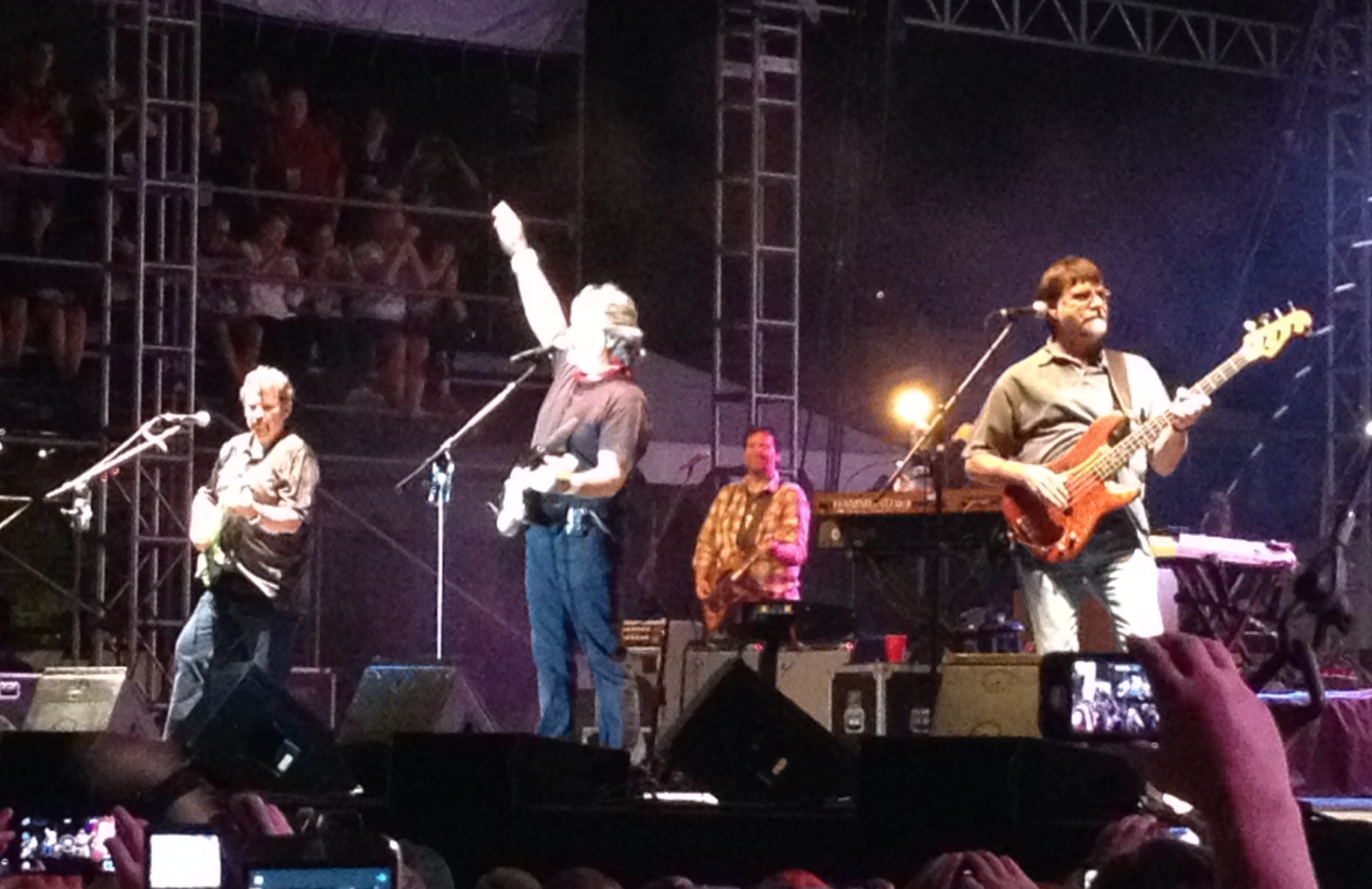
Background and career
Michael Kevin Taylor (born 17 January 1949) is an English guitarist, best known as a former member of John Mayall's Bluesbreakers (1967–1969) and the Rolling Stones (1969–1974). As a member of the Stones, he appeared on Let It Bleed (1969), Get Yer Ya-Ya's Out! (1970), Sticky Fingers (1971), Exile on Main St. (1972), Goats Head Soup (1973), It's Only Rock 'n Roll (1974), and Tattoo You (1981). Since leaving the Rolling Stones in December 1974, Taylor has worked with numerous other artists and released several solo albums. From November 2012 onwards, he participated in the Stones' 50th-Anniversary shows in London and Newark, and in the band's 50 & Counting tour, which included North America, Glastonbury Festival and Hyde Park in 2013. Taylor was ranked 37th in Rolling Stone magazine's 2011 list of the 100 greatest guitarists of all time. Guns N' Roses guitarist Slash states that Taylor has had the biggest influence on him.
Taylor was born to a working-class family in Welwyn Garden City, then raised in Hatfield, Hertfordshire, England, where his father worked as a fitter for the De Havilland aircraft company. He began playing guitar at age nine, learning from his mother's younger brother. As a teenager, he formed bands with schoolmates and started performing concerts under names such as the Juniors and the Strangers. They also appeared on television and put out a single. Part of the band was recruited for a new group called the Gods, which included Ken Hensley (later of Uriah Heep fame). In 1966, the Gods opened for Cream at the Starlite Ballroom in Wembley. On 18 April 1966, at age 17, Taylor went to see a John Mayall's Bluesbreakers performance at The Hop, Woodhall Community Centre, Welwyn Garden City, and since Eric Clapton was absent, Taylor got to play instead. After playing the second set, and garnering Mayall's respect, Taylor left the stage, joined his friends and exited the venue before Mayall could speak with him. Still, this encounter proved pivotal in Taylor's career, when Mayall needed someone to fill Peter Green's vacancy the following year when Green quit to form Fleetwood Mac. Mayall placed a 'Guitarist Wanted' advert in the weekly Melody Maker music paper, and got a response from Taylor, whom he readily invited to join. Taylor made his debut with the Bluesbreakers at the Manor House, an old blues club in north London. For those in the music scene the night was an event ... "Let's go and see this 17-year-old kid try and replace Eric". Taylor toured and recorded the album Crusade with John Mayall's Bluesbreakers. From 1966 to 1969, Taylor developed a guitar style that is blues-based with Latin and jazz influences. He is the guitarist on the Bluesbreaker albums Crusade, Diary of a Band, Bare Wires, and Blues from Laurel Canyon. Later in his career, he further developed his skills as a slide guitarist.
After Brian Jones and the Rolling Stones parted ways in June 1969, John Mayall and Ian Stewart recommended Taylor to Mick Jagger. Taylor believed he was being called in to be a session musician at his first studio session with the Rolling Stones. An impressed Jagger and Keith Richards invited Taylor back the following day to continue rehearsing and recording with the band. He overdubbed guitar on "Country Honk" and "Live With Me" for the album Let It Bleed, and on the single "Honky Tonk Women" released in the UK on 4 July 1969. Taylor's onstage debut as a Rolling Stone, at the age of 20, was the free concert in Hyde Park, London, on 5 July 1969. An estimated quarter of a million people attended for a show that turned into a tribute to Brian Jones, who had died two days before the concert. During their 1972 American Tour, Truman Capote profiled members of the band for an ultimately unfinished article for Rolling Stone; he would later describe Taylor to Johnny Carson on The Tonight Show as "pretty, a little Jean Harlow blond-type, but dumb, and totally uninteresting". Between recording sessions, the band members were living in various countries as UK income tax exiles, with Taylor himself owing the Inland Revenue £22,000 after having spent less than a year and a half in the band. Taylor took the opportunity to work on various side projects during his tenure with the Rolling Stones. In June 1973, he joined Mike Oldfield onstage at the Queen Elizabeth Hall in a performance of Oldfield's Tubular Bells. Taylor was asked to take part in this project by Richard Branson, as he felt Oldfield was a relative unknown, having just been signed to Branson's fledgling label, Virgin Records. Taylor joined Oldfield once more for a BBC television broadcast in November 1973. Taylor would also perform on the Herbie Mann albums London Underground and Reggae, both recorded in 1973.
After the 1973 European tour (during which Taylor had taken to playing alongside opening act Billy Preston), Richards's drug problems had worsened, and began to compromise the band's ability to function. In November 1973, Taylor underwent surgery for acute sinusitis and missed some of the sessions when the band began working on the LP It's Only Rock 'n Roll at Musicland Studios in Munich. Tony Sanchez, a photographer and acquaintance, would later allege that this was related to Taylor's "ever-increasing" use of cocaine, although Taylor would later dismiss this as "complete rubbish". Not much was achieved during the first ten days at Musicland, but most of the actual recordings were made there in January 1974, and in April at Stargroves, Jagger's estate in Hampshire. When Taylor resumed work with the band, he found it difficult to get along with Richards, who was reportedly abusive, discouraging him from playing and surreptitiously erasing riffs which he had already recorded. Bill Wyman recalled that Taylor began to "get very, very moody and frustrated". According to Rolling Stones producer Andy Johns, Taylor complained that Jagger and Richards "won't let me write any songs. Any time I have an idea I'm blocked out." Johns stated that he encouraged Taylor to leave the band, and that although Taylor "would have left anyway", he blamed himself for instigating it. "It was the worst thing I ever did. It wasn't a smart move ... though they were jolly surprised when he quit. 'What is he, insane? No one's ever left us before!'" Not long after those recording sessions, Taylor went on a six-week expedition to Brazil, travelling down the Amazon River in a boat and exploring Latin music. Just before the release of the album in October 1974, Taylor told music journalist Nick Kent from the NME about the new LP and that he had co-written "Till the Next Goodbye" and "Time Waits for No One" with Jagger. Kent told Taylor he had seen the finished artwork for the sleeve, which revealed the absence of any songwriting credits for Taylor, who "went silent for a second before muttering a curt 'We'll see about that!' almost under his breath. Actually, he sounded more resigned that anything else". Kent claimed that Taylor's wife had encouraged him to leave the band, and dismissively stated that Taylor "felt he should get songwriting credits because Keith hadn't turned up to a few sessions and he'd done a few riffs with Jagger", while Richards claimed that Taylor "never really wrote things, in spite of what he said", and that he could have resolved his creative frustrations and engaged in solo projects while still remaining a part of the band.
I was a bit peeved about not getting credit for a couple of songs, but that wasn't the whole reason [I left the band]. I guess I just felt like I had enough. I decided to leave and start a group with Jack Bruce. I never really felt, and I don't know why, but I never felt I was gonna stay with the Stones forever, even right from the beginning. We used to fight and argue all the time. And one of the things I got angry about was that Mick had promised to give me some credit for some of the songs – and he didn't. I believed I'd contributed enough. Let's put it this way – without my contribution those songs would not have existed. There's not many but enough, things like "Sway" and "Moonlight Mile" on Sticky Fingers and a couple of others." However, at the time, Taylor, who was apparently "determined to leave with a minimum of fuss", claimed that there "was no personal animosity in the split", and that his decision "had nothing whatsoever to do" with credits and royalties. Taylor's last broadcast appearance with the Rolling Stones before his departure was in the promotional videos for "It's Only Rock 'n Roll (But I Like It)" and "Ain't Too Proud to Beg". In December 1974, Taylor announced he was leaving the Rolling Stones. He was attending a party hosted by Eric Clapton in London with Mick Jagger, Ronnie Wood and record producer Marshall Chess. At some point, Taylor allegedly told Jagger he was quitting the band and walked out. Taylor's decision came as a shock to many. The Rolling Stones were due to start recording a new album in Munich, and the entire band was reportedly angry at Taylor for leaving at such short notice. Jagger claimed that he "received a call from the office that Mick Taylor wasn't coming to the Munich sessions. Then I received a call saying Mick Taylor wasn't going anywhere anymore with the Stones." In response to questions about who would replace Taylor, Jagger spitefully commented: "No doubt we can find a brilliant six foot, three inch blond guitarist who can do his own makeup." Jagger later stated that "I suppose it was a bit inconsiderate of him to inform us a day before we were about to enter the studios ... but maybe he hadn't made up his mind until that point". Bill Wyman claimed that "It was a very inconvenient time [...] I didn't think he did it very politely." Richards allegedly sent Taylor a telegram the day after he left the band, stating: "Really enjoyed playing with you for the last five years. Thanks for all the turn-ons. Best wishes and love." According to his wife, Rose, "Mick just read it and started crying." Taylor's departure was officially announced on 12 and 16 December 1974: "After five and a half years Mick [Taylor] wishes a change of scene—wants the opportunity to try out new ventures, new endeavours. While we are all most sorry that he is going, we wish him great success and much happiness". Taylor made a statement to the press:
The last five-and-a-half years with the Stones have been very exciting and proved to be a most inspiring period. And as far as my attitude to the other four members in concerned, it is one of respect for them, both as musicians and as people. I have nothing but admiration for the group, but I feel now is the time to move on and do something new. However, Taylor would later reveal that behind the scenes, things were more complicated:
Sources
Net-worth figure: Celebrity Net Worth (October 2026), in USD. Biography and career facts: the person's Wikipedia article and linked reporting. Snapshot date for all StarWorth figures: 28 October 2026.