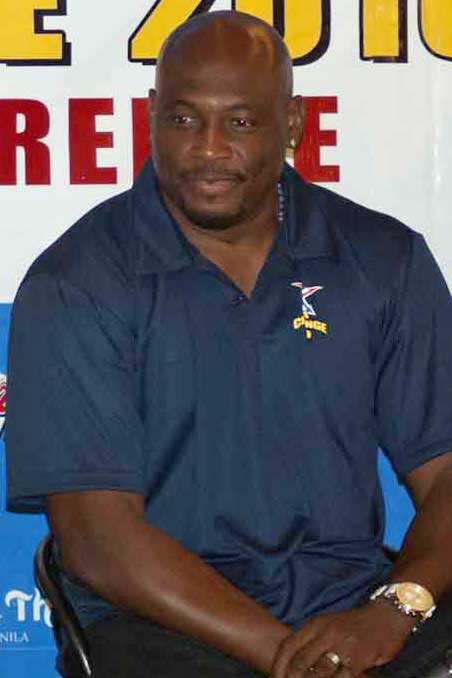
Background and career
Mitchell James Richmond III (born June 30, 1965) is an American former professional basketball player. He played collegiately at Moberly Area Community College and Kansas State University. He was a six-time NBA All-Star, a five-time All-NBA Team member, and a former NBA Rookie of the Year. In 976 NBA games, Richmond averaged 21.0 points per game and 3.5 assists per game. Richmond was voted into the Naismith Memorial Basketball Hall of Fame in 2014. His jersey No. 2 was retired in his honor by the Sacramento Kings, for whom he played seven seasons.
Mitchell James Richmond III was born on June 30, 1965, in Fort Lauderdale, Florida. He attended Boyd H. Anderson High School in Lauderdale Lakes, Florida, where he excelled in basketball.
Richmond began his college career playing for the Moberly Area Community College Greyhounds. He scored 1,023 points from 1984 to 1986, before joining the Kansas State Wildcats. One of the most recognizable players in Kansas State history, Mitch Richmond was a two-year letterman for head coach Lon Kruger from 1986 to 1988. He helped guide the Wildcats to a 45–20 (.692) record, including a pair of NCAA Tournament appearances and a trip to the 1988 NCAA Midwest Regional Final. His 1,327 points are the most by a player in a two-year career.
Richmond was drafted 5th overall in the 1988 NBA draft by the Golden State Warriors, following two years at Kansas State, where he averaged 20 points per game, and two years at Moberly Area Community College. Richmond captured the NBA Rookie of the Year Award in the 1988–89 season, after averaging 22 points per game for the Warriors. He was a key part of Don Nelson's fast-paced offense, focusing on Richmond and teammates Tim Hardaway and Chris Mullin which was dubbed "Run TMC" (the initials of the players' first names and a play on the name of the popular rap group Run-DMC). In addition to the shooting he provided, he complemented Hardaway's passing and fast break skills and Mullin's shooting skills by slashing to the hoop as part of the Warriors' attack.
Richmond averaged over 22 points a game his first three NBA seasons with Golden State, On November 1, 1991, he was traded (along with Les Jepsen) to the Sacramento Kings during the 1991–92 season in exchange for the rights to Billy Owens. Staying with the Kings until 1998, Richmond was the team's leading scorer in each of his seven seasons there, averaging no fewer than 21.9 points a game each season. Between 1993 and 1998, Richmond was a fixture on the Western Conference's All-Star team, and he won MVP honors at the All-Star Game in Phoenix, in 1995. In the middle of his prime, Richmond was selected to the United States' Olympic team (Dream Team III), earning a gold medal in Atlanta. During his prime, Richmond was recognized as one of basketball's all-time best pure shooters.
Richmond was traded by the Kings, along with Otis Thorpe, to the Washington Wizards for Chris Webber in May 1998, a move that keyed the Kings' transformation from perennial doormat to an elite title contender. However, things did not work out as well for Richmond. In three years with the Wizards, he lost a lot of the shooting touch he displayed as a King, and his days as a regular were numbered after missing half of the 2000–01 season. Richmond's departure from Washington coincided with the Wizards signing Richmond's perennial rival at the shooting guard position, Michael Jordan.
Sources
Net-worth figure: Celebrity Net Worth (October 2026), in USD. Biography and career facts: the person's Wikipedia article and linked reporting. Snapshot date for all StarWorth figures: 28 October 2026.


