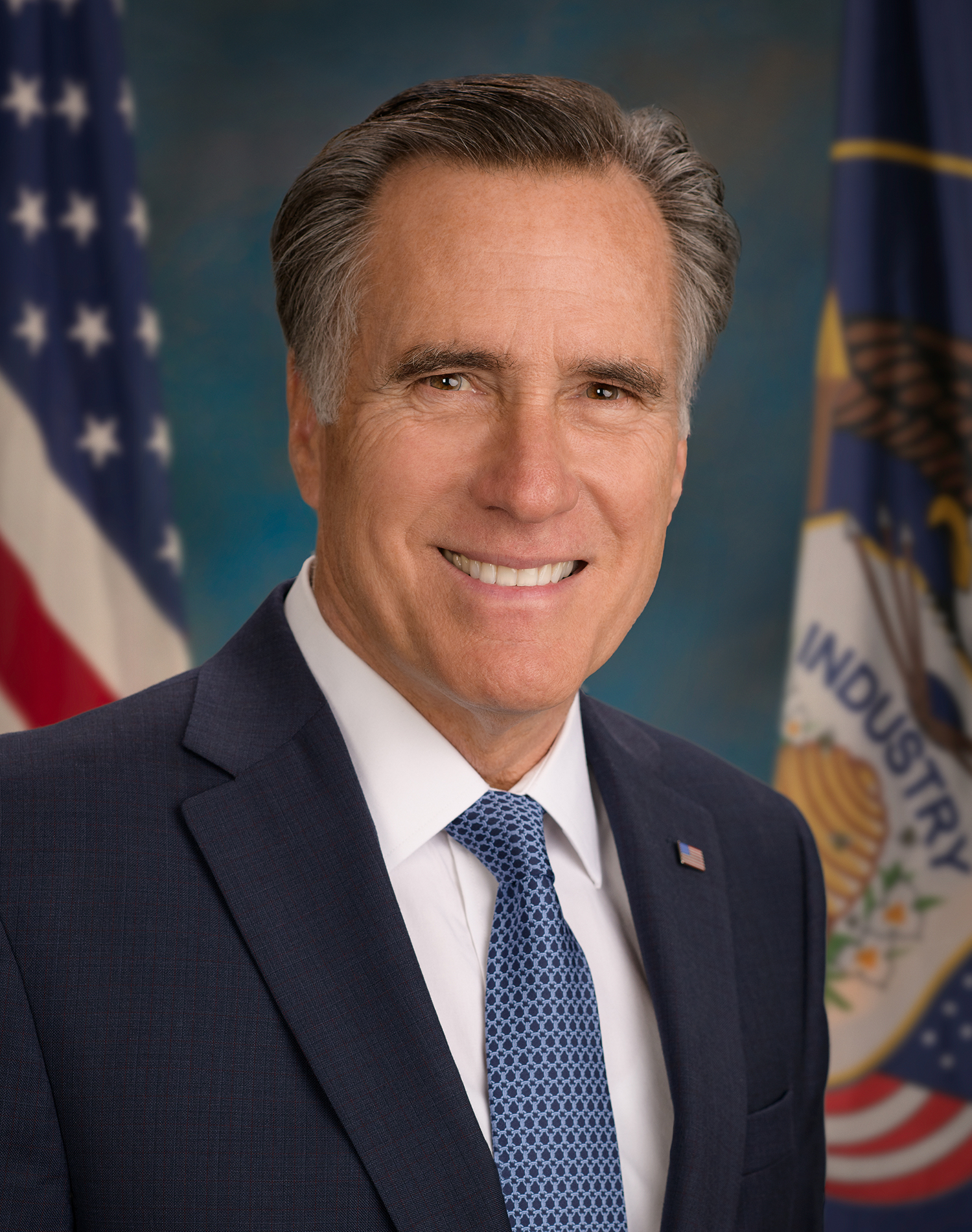
Background and career
Willard Mitt Romney (born March 12, 1947) is an American businessman and retired politician who served as a United States senator from Utah from 2019 to 2025 and as the 70th governor of Massachusetts from 2003 to 2007. A member of the Republican Party, he was the party's nominee in the 2012 presidential election. The youngest child of former Michigan governor and U.S. Housing and Urban Development Secretary George W. Romney, Romney served as a missionary in France for the Church of Jesus Christ of Latter-day Saints (LDS Church). After earning joint JD–MBA degrees from Harvard University in 1975, Romney moved to Boston and joined Bain & Company in 1977, later becoming its chief executive officer. In 1984 he co-founded Bain Capital, which grew into one of the nation's largest private equity firms. Romney ran as the Republican nominee in the 1994 United States Senate election in Massachusetts, losing to Democratic incumbent Ted Kennedy. Subsequently, he resumed his position at Bain Capital and later moved to Utah, where a successful stint as president and CEO of the then-struggling 2002 Winter Olympics led to the relaunch of Romney's political career. He subsequently won the 2002 Massachusetts gubernatorial election. As governor, Romney helped develop and later signed a health care reform law (commonly referred to as "Romneycare") that provided near-universal health insurance access and presided over the prevention of a projected $1.2–1.5 billion deficit through a combination of spending cuts and the cessation of corporate tax loopholes. Romney did not seek reelection as governor in 2006 and instead sought the 2008 Republican presidential nomination, which he lost to Senator John McCain. He won the nomination for the next presidential election, choosing Paul Ryan as his running mate. He lost the general election to incumbent President Barack Obama. After reestablishing residency in Utah, Romney successfully ran for the U.S. Senate in 2018, becoming the first person in modern U.S. history to be elected governor and U.S. senator of different states. During his term in the Senate, he marched alongside Black Lives Matter protesters, voted to confirm Ketanji Brown Jackson to the U.S. Supreme Court, supported gun control measures, and became the first senator in U.S. history to vote to convict a president of his own party in an impeachment trial when he voted to convict Donald Trump during his first impeachment trial in 2020; he also voted to convict in Trump's second trial in 2021. He has long been hawkish on relations with Iran, China, and Russia, and is a staunch supporter of Israel and Ukraine. In 2023, he announced he would not seek reelection and retired from the Senate when his term expired in 2025.
Willard Mitt Romney was born on March 12, 1947, at Harper University Hospital in Detroit, Michigan, one of four children of automobile executive George W. Romney and actress and homemaker Lenore Romney (née LaFount). His mother was from Logan, Utah, and his father was born to American parents in a Mormon colony in Chihuahua, Mexico. A fifth-generation member of the LDS Church, he is a great-grandson of Miles Park Romney and a great-great-grandson of Miles Romney, who converted to Mormonism in its first decade. Another great-great-grandfather, Parley P. Pratt, helped lead the early church.
Romney has three older siblings: Margo, Jane, and Scott. He was named after a family friend, businessman J. Willard Marriott, and his father's cousin, Milton "Mitt" Romney. Romney was called "Billy" until kindergarten, when he expressed a preference for "Mitt". In 1953, the family moved from Detroit to the affluent suburb of Bloomfield Hills and his father became the chairman and CEO of American Motors the following year and helped the company return to profitability. By 1959, his father had become a nationally known figure, and Mitt idolized him. Romney attended public elementary schools until seventh grade, when he enrolled as one of only a few Mormon students at Cranbrook School, a private upscale boys' preparatory school. Many students there came from backgrounds even more privileged than his. While not particularly athletic, he also did not distinguish himself academically. He participated in his father's successful 1962 gubernatorial campaign, and later worked as an intern in the governor's office. Romney took up residence at Cranbrook when his newly elected father began spending most of his time at the state capitol. At Cranbrook, Romney helped manage the ice hockey team, and joined the pep squad. During his senior year, he joined the cross country running team. He belonged to 11 school organizations and school clubs, including the Blue Key Club, a booster group he had started. Romney was involved in several pranks while attending Cranbrook. He has since apologized for them, stating that some of them may have gone too far. In March of his senior year, he began dating Ann Davies. The two became informally engaged around the time he graduated from high school in June 1965.
Romney attended Stanford University during the 1965–66 academic year but was largely removed from the emerging counterculture of the 1960s. Romney joined a counterprotest against a sit-in at Stanford's administration building, itself opposing draft status tests in 1966. He continued to enjoy occasional pranks. In July 1966, he began a 30-month stint in France as an LDS Church missionary, a traditional rite of passage in his family. Living under strict missionary rules and modest conditions, Romney found the work challenging and later recalled periods of discouragement as many of his efforts were rejected. He initially became demoralized and later recalled it as the only time when "most of what I was trying to do was rejected." He later estimated 10 to 20 converts for his entire mission. Despite these difficulties, Romney rose steadily through the mission's leadership ranks. He became a zone leader in Bordeaux and later an assistant to the mission president in Paris. He frequently debated French critics of American involvement in the Vietnam War, and their opposition often strengthened his resolve. In June 1968, Romney was seriously injured in an automobile accident that killed the wife of the mission president. After the unrest caused by the May 1968 general strike and student uprisings, he helped restore morale and organization within the mission. By the end of his service in December 1968, he was overseeing 175 missionaries, had helped the mission achieve its highest annual baptism total in a decade, and had developed a lifelong affection for France and its people while becoming fluent in French. Upon returning to the United States, Romney reunited with Ann Davies, and the two decided to marry. They wed in March 1969 and settled in Utah; Romney enrolled at Brigham Young University (BYU), where Ann had been studying. Having missed much of the anti-Vietnam War movement while abroad, Romney expressed the view that American involvement in Vietnam had been misguided, though he supported the Cambodian Incursion by the administration of Richard Nixon as a sincere attempt to end the war. During the military draft for the war, Romney sought and received two student deferments, then a ministerial deferment while living in France. He later sought and received two additional student deferments. When those ran out, he drew number 300 in the December 1969 draft lottery, ensuring he would not be drafted. At culturally conservative BYU, Romney remained separated from much of the upheaval of the era,, became president of the Cougar Club booster organization, and excelled academically. He also took a leave of absence during his senior year to serve as a driver and advance man for the unsuccessful U.S. Senate campaign of his mother. Romney graduated in 1971 with a Bachelor of Arts degree in English, a 3.97 GPA, and the distinction of delivering commencement addresses to both his college and the university as a whole. The Romneys' first son, Taggart, was born in 1970 while they were undergraduates at BYU and living in a basement apartment. Their son Matthew was born in 1971 and Joshua in 1975. Benjamin (1978) and Craig (1981) were born after Romney had begun his career. Intending to pursue a business career, he followed his father's advice that legal training would be valuable and enrolled in the joint Juris Doctor and Master of Business Administration program offered by Harvard Law School and Harvard Business School. Living in Belmont, Massachusetts, with Ann and their children, Romney focused on academics rather than politics and adapted readily to the business school's case-study method. He graduated in 1975 as a Baker Scholar for placing in the top 5 percent of his business school class. He also earned his law degree cum laude.
During his business career, Romney held several positions in the church's local lay clergy. In the early 1970s, he served in a ward bishopric. He then served for a time as a seminary teacher and then as a member of the high council of the Boston stake while Richard L. Bushman was stake president. In 1977, he became a counselor to the president of the Boston Stake. He served as bishop of the ward at Belmont, Massachusetts, from 1981 to 1986. As such, in addition to home teaching, he also formulated Sunday services and classes using LDS scriptures to guide the congregation. After the destruction of the Belmont meetinghouse by a fire of suspicious origins in 1984, he forged links with other religious institutions, allowing the congregation to rotate its meetings to other houses of worship during the reconstruction of the Belmont building. From 1986 to 1994, Romney was president of the Boston Stake, which included more than a dozen wards in eastern Massachusetts and almost 4,000 church members. He organized a team to handle financial and management issues, sought to counter anti-Mormon sentiment, and tried to solve social problems among poor Southeast Asian converts. An unpaid position, his local church leadership often took 30 or more hours a week of his time, and he became known for his considerable energy in the role. He also earned a reputation for avoiding any overnight travel that might interfere with his church responsibilities. Romney took a hands-on role in the Boston Stake's matters, helping in domestic maintenance efforts, visiting the sick, and counseling burdened church members. A number of local church members later credited him with turning their lives around or helping them through difficult times. Others, rankled by his leadership style, desired a more consensus-based approach. Romney tried to balance the conservative directives from church leadership in Utah with the desire of some Massachusetts members to have a more flexible application of religious doctrine. He agreed with some requests from a liberal women's group that published Exponent II calling for changes in the way the church dealt with women, but he clashed with women he felt were departing too much from doctrine. In particular, he counseled women not to have abortions except in the rare cases allowed by LDS doctrine and encouraged unmarried women facing unplanned pregnancies to give their babies up for adoption. Romney later said that the years spent as an LDS minister gave him direct exposure to people struggling financially and empathy for those with family problems.
Romney was treated for prostate cancer in the summer of 2017. In 2024, Romney admitted he was worried about being at risk of Alzheimer's disease due to years of working in high-stress jobs.


