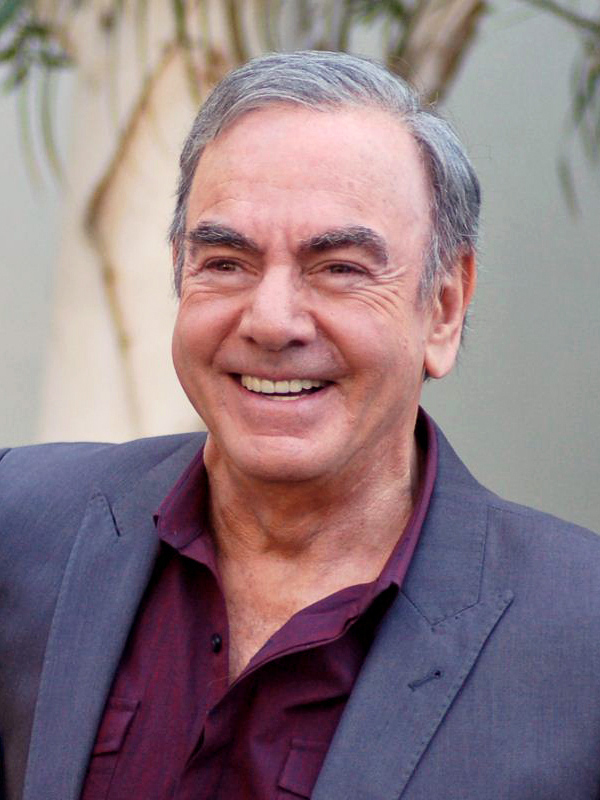
Background and career
Neil Leslie Diamond (born January 24, 1941) is an American singer-songwriter. He has sold more than 56.5 million records in the US alone, making him one of the best-selling musicians in history. Diamond has written and recorded ten singles that reached No. 1 on the U.S. Billboard Hot 100 and Adult Contemporary charts: "Cracklin' Rosie", "Song Sung Blue", "Longfellow Serenade", "I've Been This Way Before", "If You Know What I Mean", "Desirée", "You Don't Bring Me Flowers" (co-written with Alan and Marilyn Bergman, performed with Barbra Streisand), "America", "Yesterday's Songs", and "Heartlight (co-written with Carole Bayer Sager and Burt Bacharach). Thirty-eight songs by Diamond have reached the top 10 on the Billboard Adult Contemporary chart, including "Sweet Caroline". On screen, he starred in the 1980 musical drama The Jazz Singer. Diamond was inducted into the Songwriters Hall of Fame in 1984 and into the Rock and Roll Hall of Fame in 2011. He received a Sammy Cahn Lifetime Achievement Award in 2000. In 2011, he was an honoree at the Kennedy Center Honors, and he received the Grammy Lifetime Achievement Award in 2018.
Diamond was born in Brooklyn, New York City, to a Jewish family. All four of his grandparents were immigrants: his father's side came from Poland, while his mother's side were born in Kyiv, modern-day Ukraine, which was then part of the Russian Empire. His parents were Rose (née Rapoport; 1918–2019) and Akeeba "Kieve" Diamond (1917–1985), a dry-goods merchant. Diamond grew up in several homes in Brooklyn, and also spent four years in Cheyenne, Wyoming, while his father was stationed there in the army from 1945 until 1949. In Brooklyn, he attended Erasmus Hall High School for two years, where he was a member of the Freshman Chorus and Choral Club, alongside his classmate Barbra Streisand. Diamond recalled that they were not close friends at the time, saying, "We were two poor kids in Brooklyn. We hung out in the front of Erasmus High and smoked cigarettes." Their class also included chess grandmaster Bobby Fischer. After his family moved to Brighton Beach in 1956, Diamond attended Abraham Lincoln High School where he joined the fencing team. Also on the team was his best friend, future Olympic fencer Herb Cohen. For his 16th birthday, Diamond received his first guitar. While still in high school at the age of 16, he spent several weeks at Surprise Lake Camp, a camp for Jewish children in upstate New York. During his time there, folk singer Pete Seeger performed a small concert. Witnessing Seeger perform and seeing the other children sing their own songs for him had a profound impact on Diamond. It made him realize that he could write his own songs too. He recalled, "And the next thing, I got a guitar when we got back to Brooklyn, started to take lessons and almost immediately began to write songs". He noted that his passion for songwriting became his "first real interest" while growing up, as it allowed him to express his youthful "frustrations". Diamond found that composing poems for the girls to whom he was attracted in school often won their hearts. His male classmates noticed this and started asking him to write poems for them as well, which they would sing to similar success. After graduating from high school, he spent the summer working as a waiter in the Catskills resort area, where he first met Jaye Posner, who would later become his wife. Diamond then attended New York University as a pre-med major on a fencing scholarship, again on the fencing team with Herb Cohen. He was a member of the 1960 NCAA men's championship fencing team. Often bored in class, he found writing song lyrics more to his liking. He began cutting classes and taking the train up to Tin Pan Alley, where he tried to get some of his songs heard by local music publishers. In his senior year, when he was ten units short of graduation, Sunbeam Music Publishing offered him a 16-week job writing songs for $50 a week (equivalent to about $540 per week in 2025), and he dropped out of college to accept it.
Diamond was not rehired after his sixteen weeks with Sunbeam, and he began writing and singing his own songs for demos. "I never really chose songwriting", he says. "It just absorbed me and became more and more important in my life." His first recording contract was billed as "Neil and Jack", an Everly Brothers-type duet with high school friend Jack Packer. They recorded the unsuccessful singles "You Are My Love at Last" with "What Will I Do", and "I'm Afraid" with "Till You've Tried Love", both records released in 1962. Cashbox and Billboard magazines gave all four sides positive reviews, and Diamond signed with Columbia Records as a solo performer later in 1962. In July 1963, Columbia released the single "Clown Town" / "At Night"; Billboard gave a laudatory review to "Clown Town", and Cashbox was complimentary to both sides, but it still failed to make the charts. Columbia dropped him from their label, and he went back to writing songs in and out of publishing houses for the next seven years. Diamond wrote wherever he could, including on buses, and used an upright piano above the Birdland Club in New York City. One of the causes of this early nomadic life as a songwriter was his songs' wordiness: "I'd spent a lot of time on lyrics, and they were looking for hooks, and I didn't really understand the nature of that", he says. He was able to sell only about one song a week during those years, barely enough to survive. He found himself only earning enough to spend 35 cents a day on food, equivalent to $4 in 2025. The privacy that he had above the Birdland Club allowed him to focus on writing without distractions. "Something new began to happen. I wasn't under the gun, and suddenly interesting songs began to happen, songs that had things none of the others did." Among them were "Cherry, Cherry" and "Solitary Man". "Solitary Man" was the first record that Diamond recorded under his own name which made the charts. It remains one of his personal favorites, as it was about his early years as a songwriter, even though he failed to realize it at the time. He describes the song as "an outgrowth of my despair". Diamond spent his early career in the Brill Building. His first success as a songwriter came in November 1965 with "Sunday and Me", a Top 20 hit for Jay and the Americans. Greater success followed with "I'm a Believer"; "A Little Bit Me, a Little Bit You"; "Look Out (Here Comes Tomorrow)"; and "Love to Love", all performed by the Monkees. He wrote and recorded the songs for himself, but the other versions were released before his own. The unintended consequence was that Diamond began to gain fame as a songwriter. "I'm a Believer" became a gold record within two days of its release and stayed at the top of the charts for seven weeks, making it the Popular Music Song of the Year in 1966. "And the Grass Won't Pay No Mind" brought renditions from Elvis Presley (who also interpreted "Sweet Caroline") and Mark Lindsay, former lead singer for Paul Revere & the Raiders. Other notable artists who recorded his early songs were Lulu, Cliff Richard and the English hard-rock band Deep Purple. In 1966, Diamond signed a deal with Bert Berns's Bang Records, then a subsidiary of Atlantic. His first release on that label was "Solitary Man", which was his first true hit as a solo artist. Diamond followed with "Cherry, Cherry" and "Kentucky Woman". His early concerts featured him opening for bands such as Herman's Hermits and the Who. He was shocked to see Pete Townshend swinging his guitar like a club and then throwing it against walls and off the stage until the instrument's neck broke. Diamond began to feel restricted by Bang Records because he wanted to record more ambitious, introspective music, such as "Brooklyn Roads", starting in 1968. Berns wanted to release "Kentucky Woman" as a single, but Diamond was no longer satisfied writing simple pop songs, so he proposed "Shilo" about an imaginary childhood friend. Bang believed that the song was not commercial enough, so it was relegated to being an LP track on Just for You. Diamond was also dissatisfied with his royalties and tried to sign with another record label after discovering a loophole in his contract that did not bind him exclusively to either WEB IV or Tallyrand. The result was a series of lawsuits that coincided with a slump in his record sales and professional success. A magistrate refused WEB IV's request for a temporary injunction to prevent Diamond from joining another record company while his contract dispute continued in court. The lawsuits persisted until February 1977, when he triumphed in court and purchased the rights to his Bang-era master tapes. In March 1968, Diamond signed a deal with Uni Records; the label was named after Universal Pictures, the owner of which, MCA Inc., later consolidated its labels into MCA Records (now called Universal Music after merging with PolyGram in 1999). His debut album for Uni/MCA was in late 1968 with Velvet Gloves and Spit, produced by Tom Catalano, which did not chart, and he recorded the early 1969 follow-up Brother Love's Traveling Salvation Show at American Sound Studios in Memphis with Tommy Cogbill and Chips Moman producing.
In mid 1969, Diamond moved to Los Angeles. His sound mellowed with such songs as "Sweet Caroline" (1969), "Holly Holy" (1969), "Cracklin' Rosie" (1970) and "Song Sung Blue" (1972), the last two reaching No. 1 on the Hot 100. "Sweet Caroline" was Diamond's first major hit after his slump. In 2007, Diamond said he had written "Sweet Caroline" for Caroline Kennedy after seeing her on the cover of Life in an equestrian riding outfit, but in 2014 he said in an interview on the Today show that it was written for his then wife, Marcia. He could not find a good rhyme with the name "Marcia" and so used the name Caroline. It took him just one hour in a Memphis hotel to write it. The 1971 release "I Am...I Said" was a Top 5 hit in both the US and UK and was his most intensely personal effort to date, taking over four months to complete. In 1971, Diamond played seven sold-out concerts at the Greek Theater in Los Angeles. The outdoor theater, which was noted for showcasing the best of current entertainers, added a stereo sound system for the first time. Diamond was also backed by a 35-piece string orchestra and six backing singers. After the first night, one leading newspaper called it "the finest concert in Greek Theater history."
In August 1972, he played again at the Greek, this time doing ten shows. When the show was first announced, tickets at the 5000-seat theater sold out rapidly. He added a quadraphonic sound system for his performance to create full surround sound. The performance of August 24, 1972, was recorded and released as the live double album Hot August Night. Diamond recalled: "Hot August Night captures a very special show for me. We went all out to really knock 'em dead in LA." Many consider it his best work; critic Stephen Thomas Erlewine called Hot August Night "the ultimate Neil Diamond record... [showing] Diamond the icon in full glory." The album became a classic, and was remastered in 2000 with additional selections. In Australia, which at the time was said to have the most Neil Diamond fans per capita of any country, the album ranked No. 1 for 29 weeks and stayed in their top 20 bestsellers for two years. In the fall of 1972, Diamond performed for 20 consecutive nights at the Winter Garden Theater in New York City. That theater had not staged a one-man show since Al Jolson in the 1930s. The approximately 1,600-seat Broadway venue provided an intimate concert setting not common at the time, with every performance reportedly sold out. It also made Diamond the first rock-era star to headline on Broadway. The review in The New York Times stated:
Neil Diamond's one-man show seemed, on the face of it, to be a brash idea. One-man shows have traditionally been associated with talents like Judy Garland and Danny Kaye. But Mr. Diamond is clearly a brash young man and one with both the musical track record and the performance macho to bring it off...He needn't worry about comparisons with the likes of Garland and Kaye. After the Winter Garden shows, Diamond announced that he needed a break, and he engaged in no live performances until 1976. He used those four years to work on the score for Hall Bartlett's film version of Richard Bach's Jonathan Livingston Seagull and to record two albums, Serenade and Beautiful Noise. He said years later, "I knew I'd come back, but I wasn't sure when. I spent one year on each of those albums...I'd been on the road six years. I had a son 2½ and I felt he needed me more than the audience did. So for four years I devoted myself to my son Jesse." He also said he needed to get back to having a private life, one where he could be anonymous. In 1973, Diamond switched labels again, returning to Columbia Records for a million-dollar-advance-per-album contract, about $7.3 million per album in 2025. His first project, released as a solo album, was the soundtrack to Jonathan Livingston Seagull. The film received hostile reviews and did poorly at the box office, and the album grossed more than the film did. Richard Bach, author of the best-selling source story, disowned the film. He and Diamond sued Bartlett for different reasons. Bach felt the film omitted too much from the original novella, whereas Diamond believed the film had butchered his score. "After 'Jonathan,'" Diamond declared, "I vowed never to get involved in a movie again unless I had complete control." Bartlett angrily responded to Diamond's lawsuit by criticizing his music as having become "too slick...and it's not as much from his heart as it used to be." Bartlett also added, "Neil is extraordinarily talented. Often his arrogance is just a cover for the lonely and insecure person underneath." Despite the controversy surrounding the film, the soundtrack was a success, peaking at No. 2 on the Billboard albums chart. Diamond also won a Golden Globe Award for Best Original Score and a Grammy Award for Best Score Soundtrack Album for a Motion Picture. Thereafter, Diamond often included a Jonathan Livingston Seagull suite in his live performances, as he did in his 1976 Love at the Greek concert and for his show in Las Vegas that same year. Diamond returned to live shows in 1976 with an Australian tour, "The 'Thank You Australia' Concert", which was broadcast to 36 television outlets nationwide. He also again appeared at the Greek Theater in a 1976 concert, Love at the Greek. An album and accompanying video/DVD of the show includes a version of "Song Sung Blue" with duets with Helen Reddy and Henry Winkler. He began wearing colorful beaded shirts in concert, originally so that everyone in the audience could see him without binoculars. Bill Whitten designed and made the shirts for Diamond from the 1970s until approximately 2007. In 1974, Diamond released the album Serenade, from which "Longfellow Serenade" and "I've Been This Way Before" were issued as singles. The latter had been intended for the Jonathan Livingston Seagull score, but Diamond had completed it too late for inclusion. That same year he appeared on a TV special for Shirley Bassey and sang a duet with her.


