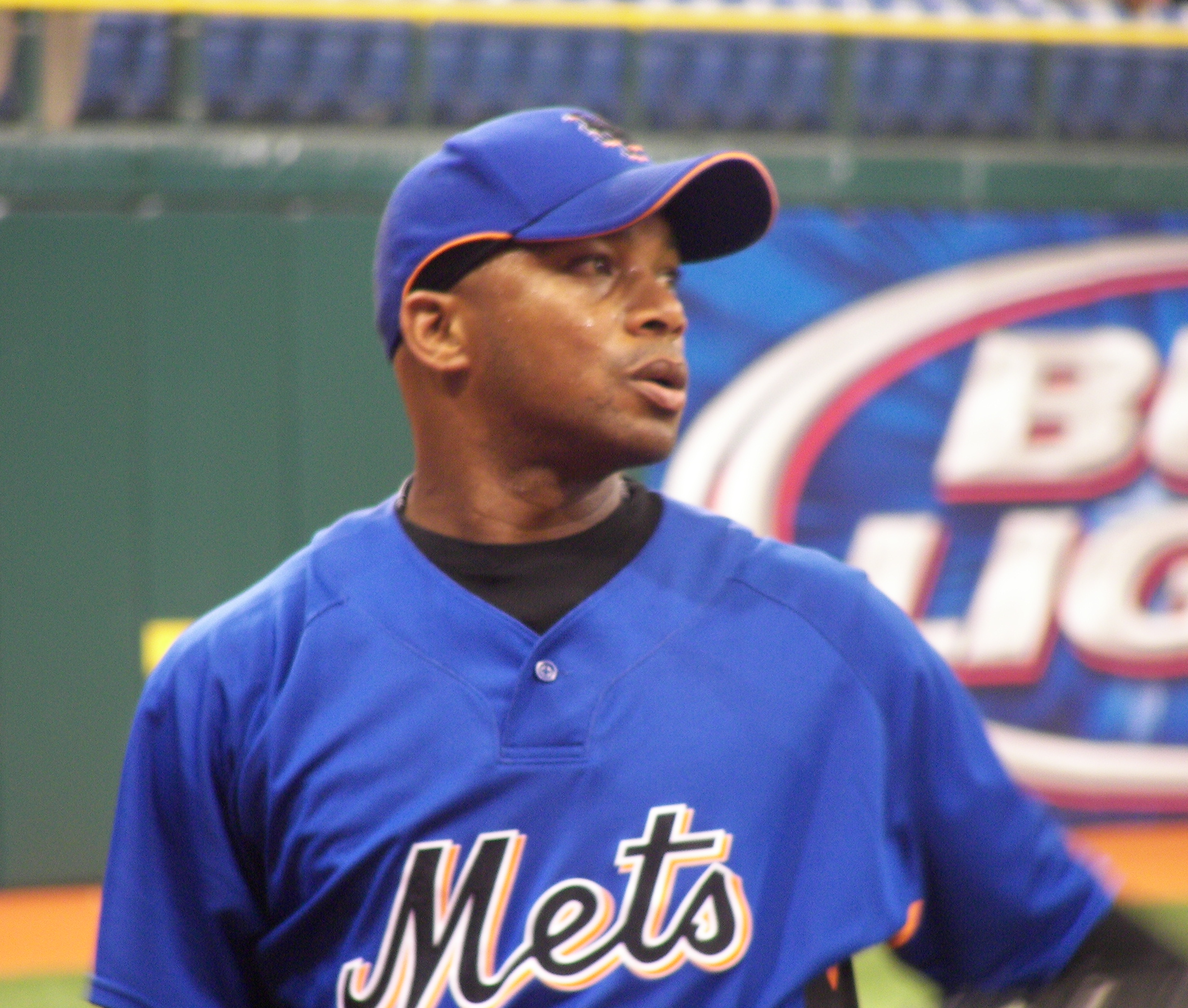
Background and career
Orlando Hernández Pedroso (born October 11, 1965), nicknamed "El Duque" (Spanish for "The Duke"), is a Cuban-born right-handed former professional baseball pitcher. He pitched for the Industriales of the Cuban National Series, the New York Yankees, Chicago White Sox, Arizona Diamondbacks, and New York Mets of Major League Baseball, and the Cuban national baseball team in international play. Hernández's greatest success came as a starting pitcher for the Yankees during that team's run of World Series championships in 1998, 1999, and 2000. He also won a World Series ring in 2005 with the Chicago White Sox. Hernández was the first player to win both an Olympic gold medal and the World Series. Hernández was known for his extremely high leg kick and his frequent use of the Eephus pitch, as well as his success in the playoffs.
Hernández played for Industriales of Havana in the Cuban National Series, helping the team win that title in 1992 and 1996. He also represented Havana in Selective Series, on teams including Ciudad Habana and Habaneros. He was 126–47 with 3.05 ERA over his ten-year career in the National Series. His career winning percentage in National and Selective Series, .728, is the league record. Hernández was also a fixture on the Cuba national baseball team, and was part of the gold-winning Olympic team at Barcelona in 1992. In September 1995, Hernández's half-brother, Liván Hernández, defected from Cuba. The Cuban national team left Hernández off of their roster in the 1996 Summer Olympics. Then in July 1996, Hernández was detained by Cuban state security and interrogated about his relationship to an American sports agent. Three months later, he was banned from Cuban baseball. On Christmas Day 1997, Hernández defected from Cuba, departing on a boat from the small city of Caibarién. The U.S. Coast Guard interdicted Hernández, his companion Noris Bosch, another baseball player named Alberto Hernández (no relation) and five others in Bahamian waters, delivering the entire party to Bahamian authorities in Freeport, who confined them in a detention center for illegal immigrants pending eventual repatriation to Cuba, the usual outcome of such cases. However, after lobbying by sports agent Joe Cubas and representatives of the Cuban-American National Foundation (CANF), then-Attorney General Janet Reno eventually offered both Hernándezes and Bosch a special status known as "humanitarian parole" that would allow them to enter the U.S., based on (1) what were judged to be realistic fears of persecution should they be returned to Cuba and (2) their status as exceptionally talented athletes, a class of person that — like exceptionally talented people in other professions — can qualify for special admission to the U.S. under State Department rules. However, Hernández declined this offer, eventually accepting an offer of asylum in Costa Rica. If he had immediately become a U.S. resident, he would have been subject to baseball's regular draft and could only have negotiated terms with the team that picked him. As a non-U.S. resident, however, he was able to negotiate as a free agent. After two months in Costa Rica, Hernández entered the U.S. on a visa arranged by the New York Yankees, with whom he had negotiated a four-year, $6.6 million contract.
In his first year in the Major Leagues in 1998, Hernández posted a 12–4 record with a 3.13 ERA. He was part of the Yankees' 1998 World Series-winning team that defeated the San Diego Padres. He finished in fourth place in AL Rookie of the Year voting.
Hernández enjoyed his best year as a major league pitcher in 1999; he had a 17–9 record and set career highs in strikeouts (157) and innings pitched (214.1) as a Yankee. In one comical moment during a game against the New York Mets on June 5, 1999, Hernández fielded a ground ball by Rey Ordóñez and hurled his glove with the ball in it at first base to get the out. In the American League Championship Series, he was the starter in Game 1 and Game 5 against the Boston Red Sox. In fifteen combined innings over the two games, he allowed four runs (three earned) and was named ALCS MVP when the Yankees won the series in five games. In the 1999 World Series against the Atlanta Braves, he started Game 1 against Greg Maddux and allowed just one run on seven innings to earn the win in a series the Yankees won in a sweep.
Hernández went 12–13 with a 4.51 ERA during the 2000 regular season. The Yankees then won their third straight World Series title, defeating the New York Mets. Over his first three postseasons from 1998 to 2000, Hernández performed well, going 8–1 with a 2.23 ERA.
Hernández went 4–7 with a 4.85 ERA in 17 games (16 starts). The Yankees played in the World Series for the fourth year in a row, but were defeated by the Arizona Diamondbacks.
Sources
Net-worth figure: Celebrity Net Worth (October 2026), in USD. Biography and career facts: the person's Wikipedia article and linked reporting. Snapshot date for all StarWorth figures: 28 October 2026.


