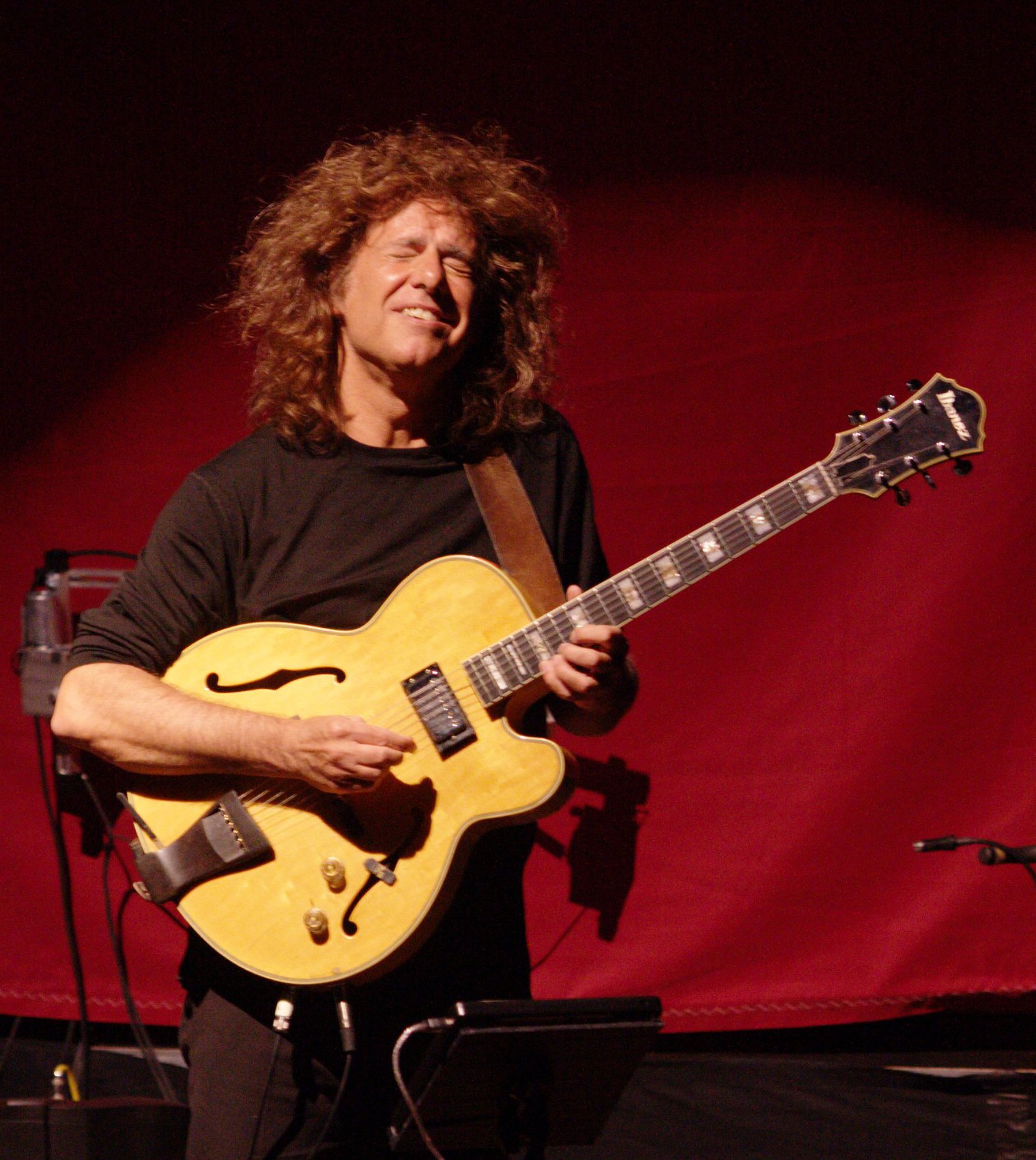
Background and career
Patrick Bruce Metheny ( məth-EE-nee; born August 12, 1954) is an American jazz guitarist and composer. He was the leader of the Pat Metheny Group (1977–2010) and continues to work in various small-combo, duet, and solo settings, as well as other side projects. His style incorporates elements of progressive and contemporary jazz, Latin jazz, and jazz fusion. He has three gold albums and 20 Grammy Awards, and is the only person to have won Grammys in 10 categories.
Metheny was born in Lee's Summit, Missouri. His father Dave played trumpet, his mother Lois sang, and his maternal grandfather Delmar was a professional trumpeter. Metheny's first instrument was the trumpet, which he was taught by his brother, Mike. Pat's brother, father, and grandfather played trios together at home. His parents were fans of Glenn Miller and swing music. They took Pat to concerts to hear Clark Terry and Doc Severinsen, but they had little respect for guitar. Pat's interest in guitar increased around 1964 when he saw the Beatles perform on TV. For his 12th birthday, his parents allowed him to buy a guitar, which was a Gibson ES-140 3/4. Pat Metheny's life changed after hearing the album Four & More by Miles Davis. Soon after, he was captivated by Wes Montgomery's album Smokin' at the Half Note which was released in 1965. He cites the Beatles, Miles Davis, and Montgomery as having the biggest impact on his music. When he was 15, Metheny won a scholarship from Down Beat magazine to a one-week jazz camp where he was mentored by guitarist Attila Zoller, who then invited him to New York City to meet guitarist Jim Hall and bassist Ron Carter. While playing at a club in Kansas City, Metheny was approached by Bill Lee, a dean at the University of Miami, and offered a scholarship. After less than a week at college, Metheny realized that playing guitar all day during his teens had left him unprepared for classes. He admitted this to Lee, who offered him a job to teach as a professor, as the school had recently introduced electric guitar as a course of study. He moved to Boston in the early 1970s to teach at the Berklee College of Music under the supervision of jazz vibraphonist Gary Burton and established a reputation as a prodigy.
In 1974, Metheny joined Burton's band alongside fellow guitarist Mick Goodrick, Steve Swallow and Eberhard Weber on bass, and percussionist Bob Moses. While Goodrick played 6-string electric guitar, Metheny introduced the electric 12-string guitar to the sound palette. He immediately appeared on Burton's studio recordings, from the 1974 Ring, Dreams So Real (1976), and Passengers in 1977. With Moses he had also a working trio that included their friend Jaco Pastorius on bass guitar. In June 1974, he and Pastorius were in New York and took part in a session with pianist Paul Bley and Bruce Ditmas on drums, unaware that they were in an actual studio and were being recorded. An album with the material was released two years later on Bley's Improvising Artists label, unofficially titled Jaco. For his debut album, Bright Size Life (1976), in December 1975 the trio flew to Europe and recorded the album during two days in Ludwigsburg (Germany) in one of the preferred studios of producer Manfred Eicher. Metheny and Moses had already been there in July for Gary Burton's Ring, also released through Eicher's label ECM. Initially they rehearsed the material for the recording with Dave Holland on bass, because Eicher refused to have an electric bass on the recording; but in the end he accepted Pastorius to play. According to Metheny, it was Burton, who was present in the studio for the trio recording and acted informally as their actual producer (without being credited). His next album, Watercolors (ECM, 1977), was recorded with Eberhard Weber on bass and Danny Gottlieb on drums, and significantly marked Metheny's first outing with pianist Lyle Mays, who would become his key collaborator in forming the Pat Metheny Group later that year. With Mark Egan on bass, the lineup was set for the group's self-titled debut album, Pat Metheny Group (ECM, 1978).
When Pat Metheny Group (ECM, 1978) was released, the group was a quartet comprising Metheny, Danny Gottlieb on drums, Mark Egan on bass, and Lyle Mays on piano, autoharp, and synthesizer. All but Egan had played on Metheny's album Watercolors (ECM, 1977), recorded the year before. The second group album, American Garage (ECM, 1979), reached number 1 on the Billboard jazz chart and crossed over onto the pop charts. From 1982 to 1985, the Pat Metheny Group released Offramp (ECM, 1982), a live album, Travels (ECM, 1983), First Circle (ECM, 1984), and The Falcon and the Snowman a soundtrack album for the movie of the same name for which they collaborated on the single "This Is Not America" with David Bowie. The song reached number 14 in the British Top 40 in 1985 and number 32 in the U.S. Offramp marked the first appearance of bassist Steve Rodby (replacing Egan) and a Brazilian guest artist, Nana Vasconcelos, on percussion and wordless vocals. On First Circle, Argentinian singer and multi-instrumentalist Pedro Aznar joined the group; as drummer, Paul Wertico replaced Gottlieb. First Circle was Metheny's last album with ECM; he had been a key artist for the European record label but left following disagreements with the label's founder, Manfred Eicher. Still Life (Talking) (Geffen, 1987) featured new group members: trumpeter Mark Ledford, vocalist David Blamires, and percussionist Armando Marçal. Aznar returned for vocals and guitar on Letter from Home (Geffen, 1989). With Metheny working on multiple projects, it was four years before the release of the next group record, a live album titled The Road to You (Geffen, 1993). This release featured live versions of tracks from the two Geffen studio albums as well as previously unreleased tunes. With Speaking of Now (Warner Bros., 2002), new group members were added: drummer Antonio Sánchez from Mexico City, Vietnamese-American trumpeter Cuong Vu, and bassist, vocalist, guitarist, and percussionist Richard Bona from Cameroon. On The Way Up (Nonesuch, 2005), harmonica player Grégoire Maret from Switzerland was introduced as a new group member, while Bona contributed as a guest musician. The album consists of a single 68-minute-long piece—split into four sections—based on a three-note motif: the opening B, A♯, F♯, and its later variation F♯, A, B.
Metheny has recorded albums under his solo artist billing regularly throughout his career. His solo acoustic guitar albums include New Chautauqua (ECM, 1979), One Quiet Night (Warner Bros., 2003), and What's It All About (Nonesuch, 2011). Building on the work of his experimental quartets (see § Side projects), Metheny further explored fringes of the avant-garde on Zero Tolerance for Silence (Geffen, 1994), a solo electric guitar outing. For the album Orchestrion (Nonesuch, 2010) Metheny hand-crafted an array of elaborate, custom mechanical instruments which allowed him to compose and perform as a one-person orchestra. By contrast, his album Secret Story (Geffen, 1992) uses lush orchestral arrangements usually found in movie soundtracks, such as The Falcon and the Snowman (EMI, 1985) (see above) and his own A Map of the World (Warner Bros., 1999) film soundtrack. Recent solo-billed recordings include From This Place (Nonesuch, 2020), recorded with a variety of guest artists, and the all-guitar collaboration Road to the Sun (Modern Recordings, 2021).
In 2012, Metheny formed the Unity Band with Antonio Sánchez on drums, Ben Williams on bass and Chris Potter on saxophone. This quartet released the album Unity Band (Nonesuch, 2012) and toured Europe and the U.S. during the latter half of the year. In 2013, as an extension of the Unity Band project, Metheny announced the formation of the Pat Metheny Unity Group, with the addition of the Italian multi-instrumentalist Giulio Carmassi.
Sources
Net-worth figure: Celebrity Net Worth (October 2026), in USD. Biography and career facts: the person's Wikipedia article and linked reporting. Snapshot date for all StarWorth figures: 28 October 2026.



