Background and career
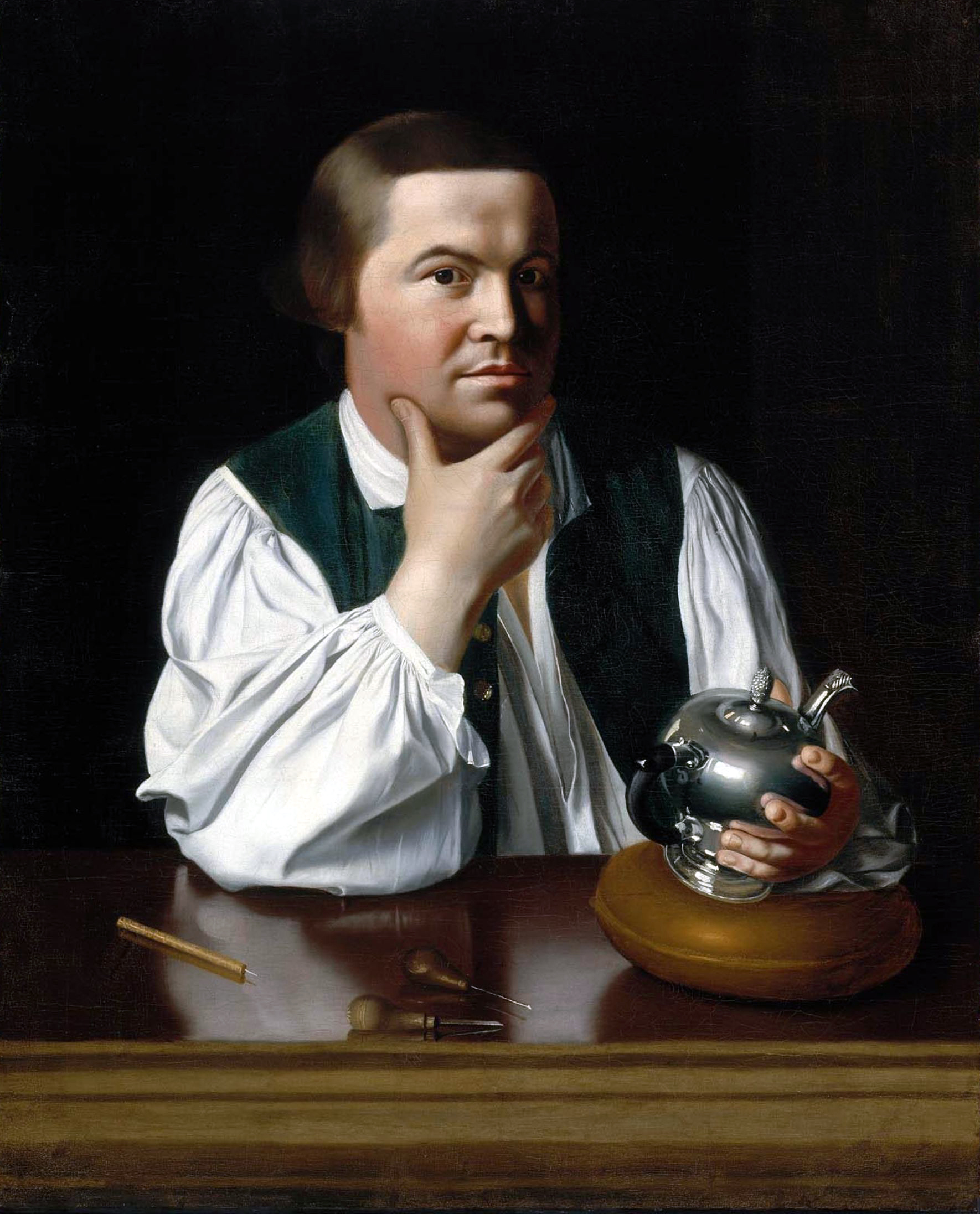
Paul Revere (December 21, 1734 O.S. (January 1, 1735 N.S.) – May 10, 1818) was an American silversmith, military officer and industrialist who played a major role during the opening months of the American Revolutionary War in Massachusetts, engaging in a midnight ride in 1775 to alert nearby minutemen of the approach of British troops prior to the battles of Lexington and Concord. Born in the North End of Boston, Revere eventually became a prosperous and prominent Bostonian, deriving his income from silversmithing and engraving. During the American Revolution, he was a strong supporter of the Patriot cause and joined the Sons of Liberty. His midnight ride transformed him into an American folk hero, being dramatized in Henry Wadsworth Longfellow's 1861 poem "Paul Revere's Ride". He also helped to organize an intelligence and alarm system to keep watch on the movements of British forces. Revere later served as an officer in the Massachusetts Militia, though his service ended after the Penobscot Expedition, one of the most disastrous American campaigns of the American Revolutionary War, for which he was absolved of blame. Following the war, Revere returned to his silversmith trade. He used the profits from his expanding business to finance his work in iron casting, bronze bell and cannon casting, and the forging of copper bolts and spikes. In 1800, he became the first American to successfully roll copper into sheets for use as sheathing on naval vessels.
Revere was born in the North End, Boston, on December 21, 1734, according to the Old Style calendar then in use, or January 1, 1735, in the modern calendar. His father, Apollos Rivoire, a French Huguenot who came to Boston at the age of 13, had been apprenticed to the silversmith John Coney. By the time he married Deborah Hitchborn, a member of a long-standing Boston family that owned a small shipping wharf, in 1729, Rivoire had anglicized his name to Paul Revere. The Hitchborn family was of English origin; Deborah's maternal great-grandparents, David and Catherine Hitchbourn, arrived in Boston, Massachusetts, in 1641 from Boston, England. Their son, Paul Revere, was the third of 12 children and eventually the eldest surviving son. Revere grew up in the environment of the extended Hitchborn family, and never learned his father's native language. At the age of thirteen, Revere finished his classroom schooling and became an apprentice to his father. Silversmithing afforded young Paul connections with a cross-section of Boston society; these would serve him well when he became active in the American Revolution. In 1750, aged 15, Revere was part of the first group of change ringers to ring the new bells (cast in 1744) at Christ Church, in the north of Boston (the Old North Church). Revere eventually began attending the services of the political and provocative Jonathan Mayhew at the West Church. His father, who had raised him in the Calvinist New Brick Church, did not approve. Family tradition states he beat him for his disobedience on one occasion. Revere relented and returned to his father's church, although he did become friends with Mayhew, and returned to the West Church in the late 1760s.
Revere's father died in 1754, when Paul was legally too young to officially be the master of the family silver shop. In February 1756, during the French and Indian War (the North American theater of the Seven Years' War), he enlisted in the provincial army. He may have made this decision because of the weak economy, since army service promised consistent pay. Commissioned a second lieutenant in a provincial artillery regiment, he spent the summer at Fort William Henry at the southern end of Lake George in New York as part of an abortive plan for the capture of Fort St. Frédéric. He did not stay long in the army, but returned to Boston and assumed control of the silver shop in his own name. On August 4, 1757, he married Sarah Orne (1736–1773); their first child was born eight months later. He and Sarah had eight children, but two died young.
Revere's business began to suffer when the British economy entered a recession in the years following the Seven Years' War, and declined further when the Stamp Act of 1765 resulted in a further downturn in the Massachusetts economy. Business was so poor that an attempt was made to seize his property in late 1765. To help make ends meet he even took up dentistry. One client was Joseph Warren, a local physician and political opposition leader with whom Revere formed a close friendship. Revere and Warren, in addition to having common political views, were also both active in the same local Masonic lodges. In 1765, a group of militants who would become known as the Sons of Liberty formed, of which Revere was a member. From 1765 on, in support of the dissident cause, he produced engravings with political themes. Probably most famous is his depiction of the March 1770 Boston Massacre (see illustration), engraved by Revere from Henry Pelham's drawing without permission. It was colored by a third man and printed by a fourth but none was credited. It stated "Engraved, Printed, & Sold by Paul Revere Boston". On March 29, 1770, Pelham wrote "When I heard that you was cutting a plate...I thought it impossible, as I knew you was not capable of doing it unless you coppied it from mine..." He said he thought his drawing entrusted to someone honourable who wouldn't take undue advantage. Further, he felt himself robbed "as truly as if you had plundered me on the highway". His letter to Revere ended with the hope that the World would be aware of Revere's dishonourable actions.
In 1770 Revere purchased a house, now a museum on North Square in Boston's North End. The house provided space for his growing family while he continued to maintain his shop at nearby Clark's Wharf. Sarah died in 1773, and on October 10 of that year, Revere married Rachel Walker (1745–1813). They had eight children, three of whom died young. In November 1773 the merchant ship Dartmouth arrived in Boston harbor carrying the first shipment of tea made under the terms of the Tea Act. This act authorized the British East India Company to ship tea (of which it had huge surpluses due to colonial boycotts organized in response to the Townshend Acts) directly to the colonies, bypassing colonial merchants. Passage of the act prompted calls for renewed protests against the tea shipments, on which Townshend duties were still levied. Revere and Warren, as members of the informal North End Caucus, organized a watch over the Dartmouth to prevent the unloading of the tea. Revere is widely credited with being a participant and possibly a leader in the Boston Tea Party of December 16, when colonists dumped tea from the Dartmouth and two other ships into the harbor. From December 1773 to November 1775, Revere served as a courier for the Boston Committee of Public Safety, traveling to New York and Philadelphia to report on the political unrest in Boston. Research has documented 18 such rides. Notice of some of them was published in Massachusetts newspapers, and British authorities received further intelligence of them from Loyalist Americans. In 1774, his cousin John on the island of Guernsey wrote to Paul that John had seen reports of Paul's role as an "express" (courier) in London newspapers. In 1774, the military governor of Massachusetts, General Thomas Gage, dissolved the provincial assembly on orders from Great Britain. Governor Gage also closed the port of Boston and all over the city forced private citizens to quarter (provide lodging for) soldiers in their homes. During this time, Revere and a group of about 30 other tradesmen began meeting in secret at his favorite haunt, the Green Dragon, to coordinate the gathering and dissemination of intelligence by "watching the Movements of British Soldiers". Around this time Revere regularly contributed politically charged engravings to the recently founded Patriot monthly, Royal American Magazine. He rode to Portsmouth, New Hampshire, in December 1774 upon rumors of an impending landing of British troops there, a journey known in history as the Portsmouth Alarm. Although the rumors were false, his ride sparked a rebel success by provoking locals to raid Fort William and Mary, defended by just six soldiers, for its gunpowder supply.
Because Boston was besieged after the battles of Lexington and Concord, Revere could not return to the city, which was now firmly in British hands. He boarded in Watertown, where he was eventually joined by Rachel and most of his children (Paul Jr., then 15, remained in Boston to mind the family properties). After he was denied a commission in the Continental Army, he tried to find other ways to be useful to the rebel cause. He was retained by the provincial congress as a courier, and he printed local currency which the congress used to pay the troops around Boston.
Sources
Net-worth figure: Celebrity Net Worth (October 2026), in USD. Biography and career facts: the person's Wikipedia article and linked reporting. Snapshot date for all StarWorth figures: 28 October 2026.