Background and career
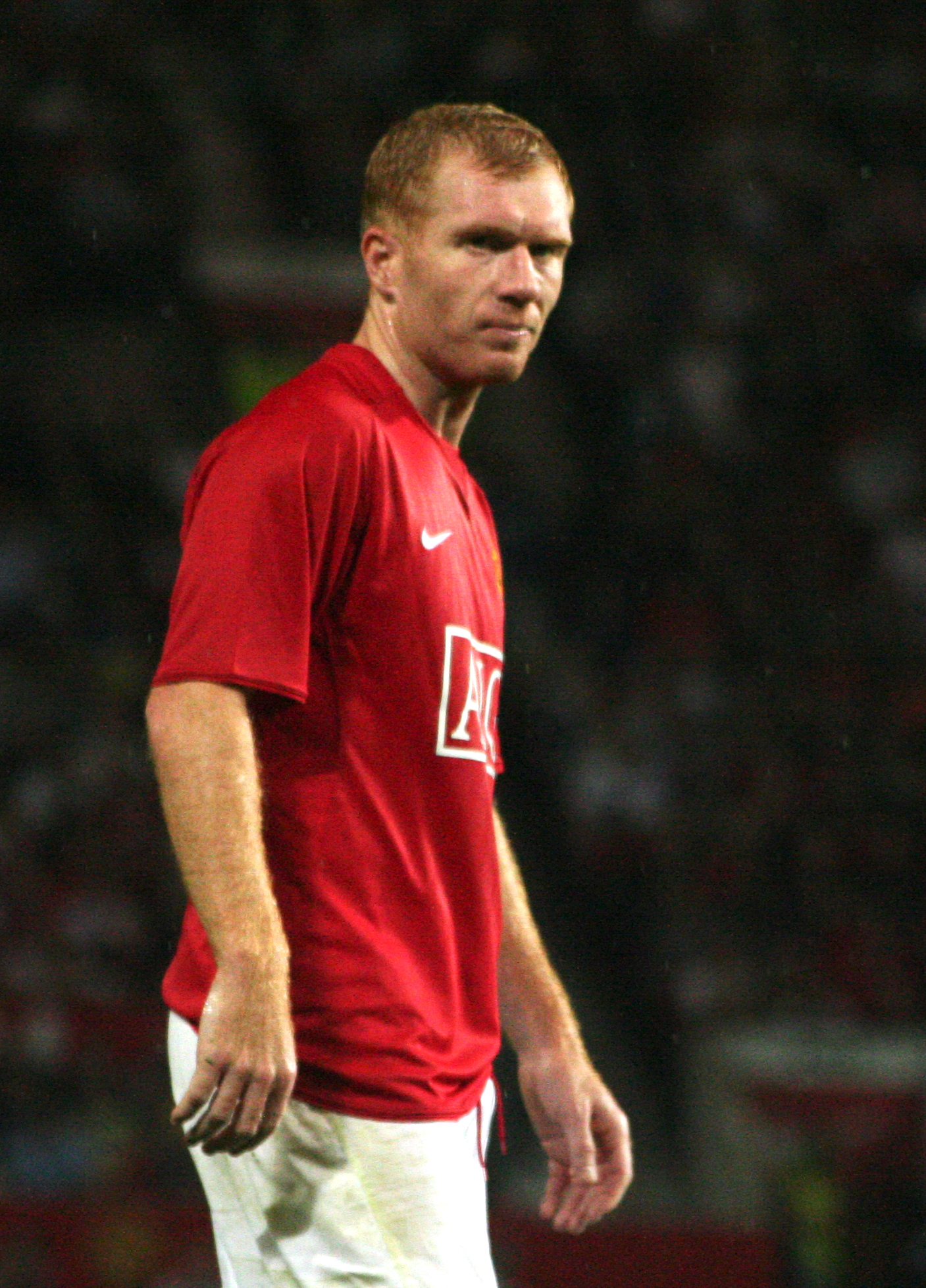
Paul Scholes (born 16 November 1974) is an English former professional footballer, pundit, and coach. Widely regarded as one of the greatest midfielders of his generation, Scholes spent his entire professional playing career with Manchester United, for whom he scored over 150 goals in more than 700 appearances between 1993 and 2013. Scholes won 25 trophies, including 11 Premier League titles (more than any other English player), three FA Cups, and two UEFA Champions League titles. He is renowned for his technical skills, accurate passing, intelligent movement, powerful shooting from long range, and goal-scoring ability. Scholes came through the Manchester United academy as one of Fergie's Fledglings, a group of players recruited by the club under the management of Alex Ferguson. He made his full debut in the 1994–95 season. He went on to make 718 appearances for the club, the third-highest number of appearances by any player. He announced his retirement from playing in May 2011 and was appointed as a coach at Manchester United. He returned to playing in January 2012, and played one more season for the club before retiring again in May 2013. Scholes represented the England national team from 1997 to 2004, gaining 66 caps and participating in the 1998 and 2002 FIFA World Cups, as well as the 2000 and 2004 UEFA European Championships. He announced his retirement from international football in August 2004, citing his family life and his club career with Manchester United as being more important. Scholes' first managerial position was at Oldham Athletic, for 31 days in February and March 2019. In 2020, he had a short spell as interim manager of Salford City.
Scholes was born on 16 November 1974 in Salford, Greater Manchester. He is of part Irish and Northern Irish descent on his mother's side. The family moved to Langley, Greater Manchester, when he was 18 months old, where he lived on Bowness Road and Talkin Drive. Growing up, Scholes supported Oldham Athletic. He attended the St Mary's RC Primary School in Langley. The first team he played for was Langley Furrow. Scholes also excelled at cricket. At age 14, he began training with Manchester United. He later joined as a trainee upon leaving the Cardinal Langley Roman Catholic High School in Middleton during the summer of 1991. In his final term at school, he was selected to represent Great Britain National Schools in football.
Scholes was a member of the Manchester United youth team that reached the final of the FA Youth Cup in the 1992–93 season, alongside Phil Neville. Scholes turned professional on 23 July 1993 but did not make his breakthrough into the senior squad until the 1994–95 season, when he made seventeen league appearances and scored five goals. His debut came on 21 September 1994, where he scored both goals in a 2–1 victory over Port Vale in the League Cup. His league debut came three days later against Ipswich Town at Portman Road, a game which United lost 3–2 and Scholes scored a consolation goal. He scored two league goals when he came on 10 December when United beat Queens Park Rangers 3–2 at Loftus Road. On 3 January 1995, he got onto the scoresheet at Old Trafford for the first time with the opener in a 2–0 league win over Coventry City. He scored once more that season, in a 3–2 away win over Coventry City on 1 May. Scholes came on as a substitute in the 1995 FA Cup final against Everton, which United lost 1–0. In the 1995–96 season, after Mark Hughes moved to Chelsea, Scholes had more first-team opportunities, standing in for the suspended Eric Cantona as Andy Cole's strike partner for the first two months of the season. Scholes scored 14 goals in all competitions as United became the first English team to win the double twice. He picked up another Premier League medal in the 1996–97 season. After Roy Keane suffered a knee injury in late September 1997 and was ruled out for the rest of the season, Scholes was made a central midfielder in the 1997–98 season. United finished the season without a major trophy, only the second time in the 1990s that this happened. In the 1998–99 season, Scholes was a key player in Manchester United's Premier League title, FA Cup, and UEFA Champions League treble success. He scored one of Manchester United's two goals against Newcastle in the FA Cup final. He also scored an away goal against Inter Milan in the Champions League quarter-final. He came on as a substitute in the second leg of the semi-final against Juventus as manager Alex Ferguson opted for Nicky Butt in the starting line-up. He picked up a yellow card which ruled him out of the final victory over Bayern Munich through suspension.
During the 1999–2000 season, Scholes scored one of the finest goals of his career against Bradford City on 25 March 2000. David Beckham took a corner directly to Scholes, who was standing on the edge of the area, who volleyed it in over Dwight Yorke, who was forced to duck. A week later, Scholes scored the first hat-trick of his United career against West Ham United in a 7–1 victory that put United ten points clear. During the 2001–02 transfer window, United completed the signing of Argentine international Juan Sebastián Verón. To accommodate Scholes and Verón, Ferguson persisted with the 4–4–1–1 formation, with Scholes playing at the withdrawn striker role behind Ruud van Nistelrooy, as Roy Keane and Verón played in central midfield. In European away fixtures, Scholes was often played in central midfield alongside Verón as Keane anchored. Scholes netted a career-high 20 goals in all competitions in the 2002–03 season, including a hat-trick in a 6–2 win against Newcastle. a number that dipped to fourteen the next year. This was despite a career-best four FA Cup goals, in comparison to his total of five FA Cup goals scored in his first nine seasons. Scholes scored the winning goal in the 2003–04 FA Cup semi-final against Arsenal, and played in the final which United won 3–0 against Millwall, his last FA Cup medal. He also played in the 2005 FA Cup final, but saw his penalty kick saved by Jens Lehmann as they lost to Arsenal in a penalty shoot-out. Scholes was ruled out for the second half of the 2005–06 season with blurred vision. The cause of this was initially uncertain, sparking fears that it could end his career. He overcame this problem through the beginning of the year and he appeared in United's final game of the season against Charlton Athletic. Scholes and Wayne Rooney were sent off on 4 August 2006 in a pre-season friendly against Porto in the Netherlands. England's Football Association suspended the pair for three games, which United appealed due to the non-competitive nature of the fixture; Ferguson conceded that Scholes should have been sent off for his tackle from behind on Ricardo Quaresma, while defending Rooney. An independent panel upheld the suspensions of both players. On 22 October 2006, in the 2–0 victory over Liverpool, Scholes became the ninth United player to play in 500 matches, joining Bobby Charlton, Bill Foulkes and Ryan Giggs. Scholes experienced one of his finest seasons in 2006–07, and was included in the PFA Team of the Year, and was shortlisted for the PFA Players' Player of the Year. One of his finest performances of the season came in a 4–1 win against Blackburn Rovers, where United were 1–0 down but Scholes "got hold of the game by the scruff of the neck" and scored the equalising goal. On 3 March 2007, in a 1–0 victory over Liverpool at Anfield, Scholes was dismissed for swinging an arm at Xabi Alonso; John O'Shea scored the winning goal in injury time. It marked his first league sending off since April 2005. A month later, he was sent off in the first leg of United's Champions League quarter-final at Roma.
Scholes suffered knee ligament damage during a training session the night before United's Champions League Group F match with Dynamo Kyiv on 23 October 2007, and was out of action until the end of January 2008. He returned as a substitute in United's 3–1 win over Tottenham Hotspur in the fourth round of the FA Cup. On 23 April 2008, Scholes made his 100th Champions League appearance in a 0–0 draw away to Barcelona in the semi-final first leg, and scored the only goal from 25 yards in a 1–0 victory in the second leg that sent United into the final. During the final against Chelsea, he suffered an injury and received a yellow card after a clash with Claude Makélélé. He was substituted in the 87th minute and did not take part in the penalty shoot-out, which United won 6–5 after drawing 1–1 after extra time. In the 2008 UEFA Super Cup against Zenit Saint Petersburg, Scholes was sent off after he received a second yellow card for a deliberate handball. Scholes was inducted into the English Football Hall of Fame in September 2008. On 22 April 2009, he made his 600th appearance for United in a 2–0 win over Portsmouth. On 16 February 2010, Scholes scored his third Champions League goal of the season against AC Milan in a 3–2 win, which was also United's first away goal against Milan. This gave United their first away win over Milan and also made Scholes the first player to score against both Inter Milan and AC Milan at the San Siro in the Champions League. The goal against Milan was Scholes' 25th Champions League goal in total, and, with 25 goals to his name, Scholes is the highest goal-scoring central midfielder in Champions League history. On 6 March 2010, Scholes became the 19th player in Premier League history to score 100 goals, and also the third United player after Ryan Giggs and Wayne Rooney to do so, in the 2009–10 Premier League season, with the only goal in a 1–0 away win over Wolverhampton Wanderers. On 16 April 2010, Scholes signed a new one-year contract with United, keeping him at the club until the end of the 2010–11 season. Scholes began the 2010–11 season strongly, displaying man of the match performances against Chelsea in the 2010 Community Shield on 8 August and eight days later in the opening fixture of the new league campaign against Newcastle United as he assisted two goals in a 3–0 home victory. Scholes scored his 150th goal for United in a 2–2 away draw against Fulham on 22 August, and was also awarded the Premier League Player of the Month for August 2010. In April 2011, Scholes was sent off for a high challenge on Pablo Zabaleta in the FA Cup semi-final against Manchester City, which United went on to lose 1–0.
On 28 May 2011, Scholes came on as a substitute during United's 3–1 defeat to Barcelona in the Champions League final. Three days later, he announced his retirement with immediate effect, and joined the club's coaching staff. On 5 August, United held a testimonial match to honour his 17 years of service to the club. The match was played at Old Trafford against New York Cosmos. United won the match 6–0, with Scholes opening the scoring with a shot from 25 yards, in front of a sell out 74,731 crowd.


