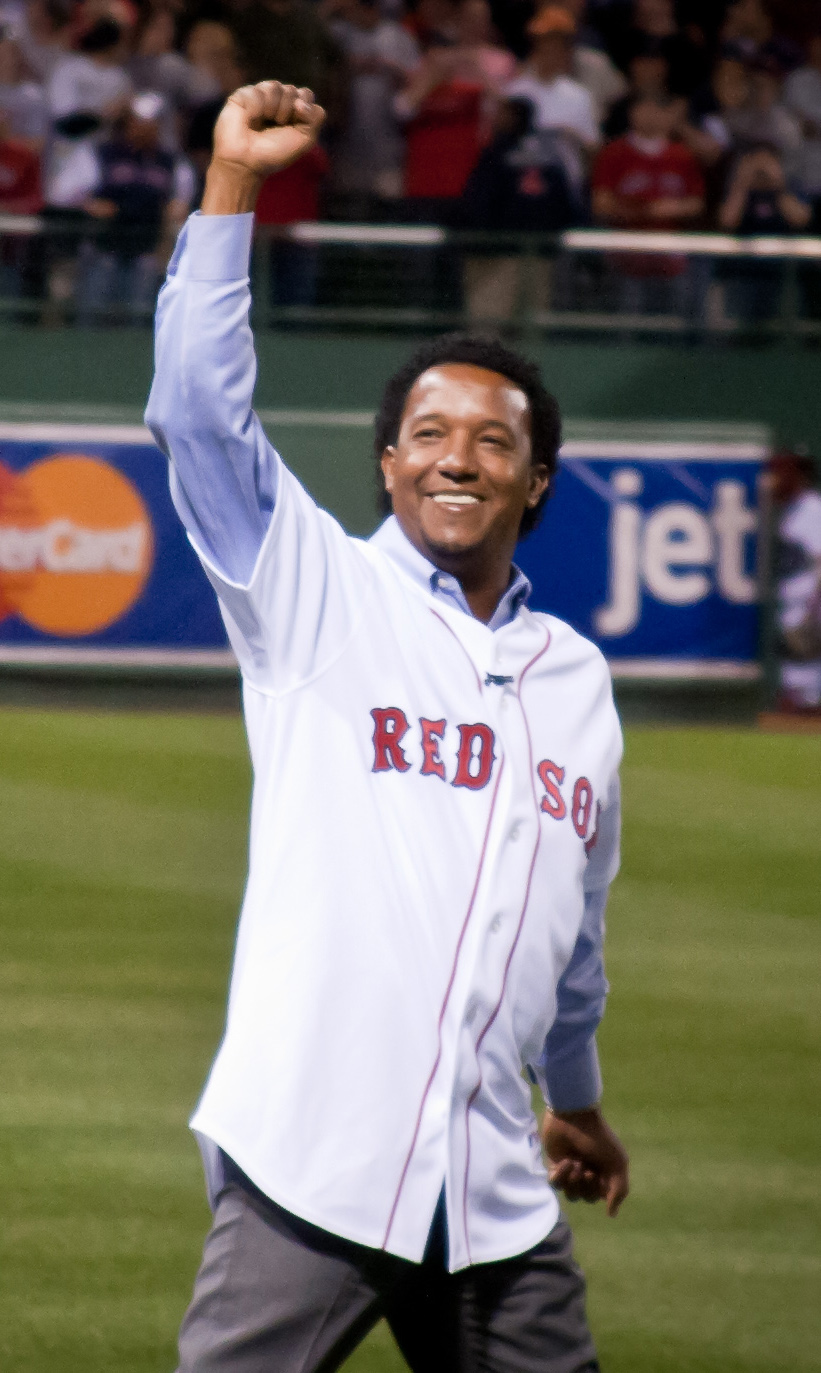
Background and career
Pedro Jaime Martínez (born October 25, 1971) is a Dominican-American former professional baseball starting pitcher who played in Major League Baseball (MLB) from 1992 to 2009 for five teams, most notably the Boston Red Sox from 1998 to 2004. As of 2023, Martínez's record of 219 wins and 100 losses places him tenth-highest in winning percentage in major league history and fifth-highest among pitchers with more than 2,000 career innings pitched. Martínez ended his career with an earned run average (ERA) of 2.93, among the lowest ever by a pitcher with at least 2,500 innings pitched since 1920. He reached the 3,000 strikeout mark in fewer innings than any pitcher except Randy Johnson and Max Scherzer; Martínez is the only pitcher other than Scherzer or Clayton Kershaw to compile over 3,000 career strikeouts with fewer than 3,000 innings pitched in his career. As of 2023, Martínez's career strikeout rate of 10.04 per nine innings ranks sixth all-time among pitchers with over 1,500 innings. An eight-time All-Star, Martínez was at his peak from 1997 to 2003, establishing himself as one of the most dominant pitchers in baseball history. He won three Cy Young Awards (1997, 1999, 2000) and was runner-up twice (1998, 2002), posting a cumulative record of 118–36 (.766) with a 2.20 ERA, while leading his league in ERA five times and in winning percentage and strikeouts three times each. In 1999, Martínez was runner-up for the American League (AL) Most Valuable Player Award, after winning the pitching Triple Crown with a 23–4 record, 2.07 ERA, and 313 strikeouts, and—along with Johnson—joined Gaylord Perry in the rare feat of winning the Cy Young Award in both the American and National Leagues (a feat since accomplished by Randy Johnson, Roger Clemens, Roy Halladay, Max Scherzer, and Blake Snell). He recorded the second-lowest single-season Fielding Independent Pitching (FIP) in the live ball era (1.39 in 1999), the second-lowest single-season WHIP total in major league history (0.737 in 2000), and the highest single-season Adjusted ERA+ in major league history (291, also in 2000). Although his performance suffered a steep decline in 2004, Martínez ended the season memorably by helping the Red Sox end a long drought in winning their first World Series title in 86 years. Officially listed at 5 ft 11 in (1.80 m) and 170 pounds (77 kg), Martínez was unusually small for a modern-day power pitcher, and is believed to have been somewhat smaller than his officially listed height and weight. In his early 30s, injuries began to keep him off the field to an increasing extent, with his appearances and success dropping off sharply in his final seasons. Modern sabermetric analysis has strongly highlighted Martínez's achievements. As of 2023, his career strikeout-to-walk ratio, WHIP, and adjusted ERA+ are among the highest in major league history. Martínez dominated while pitching most often in a hitter-friendly ballpark and facing some of the toughest competition during the steroid era, which is generally thought to have favored batters. Many consider Martínez to be one of the greatest pitchers in major league history. He was elected to the Baseball Hall of Fame in 2015 in his first year of eligibility, joining Juan Marichal as the second Dominican to be enshrined; his number (45) was retired by the Red Sox in a ceremony held two days after his Hall induction.
Pedro Jaime Martínez was born on October 25, 1971, in the Dominican Republic in the Santo Domingo suburb of Manoguayabo. He was the fifth of six siblings living in a palm wood house with a tin roof and dirt floors. His father, Pablo Jaime Abreu, worked odd jobs. His mother, Leopoldina Martínez, worked for traditionally wealthy families, washing their clothes. When Martínez was old enough to work, he held a job as a mechanic. Martínez did not have enough money to afford baseballs, so he improvised with oranges. His older brother Ramón, was pitching at a Los Angeles Dodgers baseball camp in the Dominican Republic. As a young teenager, Martínez carried his brother's bags at the camp. One day at the camp, Ramón Martínez clocked his 14-year-old brother's pitches at between 78 and 80 miles per hour. Martínez debuted professionally with the Tigres del Licey of the Dominican Winter League during the 1989–90 season. He then pitched briefly for the Azucareros del Este, before rejoining Licey in 1991–92 in a nine-player transaction that included George Bell, José Offerman and Julio Solano, among others.
Martínez was originally signed by the Dodgers as an amateur free agent in 1988. In his first season in the minors he was assigned to the Great Falls Dodgers where he worked with coach Guy Conti to develop a circle changeup which Conti had learned from Johnny Podres. Conti also worked with the young pitcher on his English and helped him assimilate to the United States; Martínez later described Conti as his "white daddy." As a minor leaguer in the Dodgers farm system, he was a highly touted prospect although some talent evaluators took issue with his "poise" despite his having a "great fastball and circle-changeup."
Martínez made his MLB debut on September 24, 1992, for the Dodgers against the Cincinnati Reds, working two scoreless innings of relief. He made his first start for the Dodgers on September 30, taking the loss while giving up two runs in a 3–1 loss to the Reds. Although Martínez's brother Ramón, then a star pitcher for the Dodgers, declared that his brother was an even better pitcher than he, the younger Martínez was thought by manager Tommy Lasorda too small to be an effective starting pitcher at the MLB level; Lasorda used Pedro Martínez almost exclusively as a relief pitcher. Lasorda was not the first to question Martínez's stature and durability; at 135 pounds in the minor leagues, the Dodgers were concerned that he might lose weight from burning too many calories and threatened to fine him $500 if he was caught running. Martínez turned in a strong 1993 season as the Dodgers' setup man, going 10–5 with a 2.61 ERA and 119 strikeouts, in 65 games; his 107 innings led all NL relievers.
With the Dodgers in need of a second baseman after a contract dispute with Jody Reed, Martínez was traded to the Montreal Expos for Delino DeShields before the 1994 season. It was with the Expos that Martínez developed into one of the top pitchers in baseball. Despite possessing a live fastball, he had difficulty maintaining control. It was during a bullpen session that manager Felipe Alou encouraged him to modify his primary grip on the fastball from two-seam to four-seam. The transformation was dramatic: the fastball − already among the fastest in the game − now was thrown with near-impeccable control and break that routinely overwhelmed hitters. On April 13, 1994, Martínez took a perfect game through 7+1⁄3 innings until throwing a brushback pitch at Reggie Sanders that led Sanders to immediately charge the mound, starting a bench-clearing brawl. Martínez ended up with a no-decision in the game, which the Expos eventually won 3–2. On June 3, 1995, Martínez pitched nine perfect innings in a game against the San Diego Padres, before giving up a hit in the bottom of the 10th inning. He was immediately removed from the game, and was the winning pitcher in Montreal's 1–0 victory. [See Memorable Games] In 1996, during a game against the Philadelphia Phillies, Mike Williams attempted to hit Martínez with retaliatory pitches for an earlier hit batter but failed with two consecutive attempts. After the second attempt, Martínez charged the mound, and started a bench-clearing fight. In 1997, Martínez posted a 17–8 record for the Expos, and led the league in half a dozen pitching categories, including a 1.90 ERA, 305 strikeouts and 13 complete games pitched, while becoming the only Expo ever to win the National League Cy Young Award. The 13 complete games were tied for the second-highest single-season total in the modern era of baseball since Martínez's career began (Curt Schilling had 15 in 1998; Chuck Finley and Jack McDowell also reached 13 in a year). However, this 1997 total is by far the highest in Martínez's career, as he only completed more than five games in one other season (seven, in 2000). Martínez was the first right-handed pitcher to reach 300 strikeouts with an ERA under 2.00 since Walter Johnson in 1912.
Approaching free agency, Martínez was traded to the Boston Red Sox in November 1997 for Carl Pavano and Tony Armas Jr. Martínez was subsequently signed to a six-year, $75 million contract (with an option for a seventh year at $17 million) by Red Sox general manager Dan Duquette, at the time the largest ever awarded to a pitcher. Martínez paid immediate dividends in 1998, compiling a 19–7 record and finishing second in the American League in ERA, WHIP, strikeouts, and Cy Young Award voting. In 1999, Martínez finished 23–4 with a 2.07 ERA and 313 strikeouts (earning the Pitching Triple Crown) in 213+1⁄3 innings across 31 games (29 starts). He led the entire major leagues with strikeouts per nine innings and strikeout-to-walk ratios of 13.20 and 8.46, respectively. His Fielding Independent Pitching (FIP) (a defense independent pitching statistic measuring a pitcher's effectiveness at limiting walks, home runs, and hits while accumulating strikeouts) of 1.39 was the lowest single-season total in the major leagues since 1910 among pitchers who threw more than 35 innings. The second best FIP in baseball in 1999 was Randy Johnson's 2.76, and that year, no one else in the American League had a FIP below 3.25. Martínez also became just the ninth modern pitcher to record a second 300-strikeout season, along with Randy Johnson (6 times), Nolan Ryan (6 times), Sandy Koufax (3 times), Curt Schilling (3 times), Walter Johnson, Sam McDowell, J. R. Richard, and Rube Waddell. An anomaly among power pitchers, Martínez is the only 20th-century pitcher to notch 300 strikeouts in a season without being at least six feet tall. Martínez unanimously won his second Cy Young Award and finished second in the AL Most Valuable Player (MVP) ballot. The MVP result was controversial, as Martínez received the most first-place votes of any player (8 of 28), but was omitted from the ballots of two sportswriters, New York's George King and Minneapolis' LaVelle Neal. Buster Olney, writing for The New York Times, mused that the sentiment that pitchers should not be considered MVP candidates due to the existence of the pitcher-specific Cy Young Award may have cost Martínez the victory. King later wrote in The New York Post that he left Martínez off of his ballot because he believed that, since they only appear in a fraction of their team's games, starting pitchers should only be considered for the Cy Young Award. "It really made us all look very dumb", Olney later said. "People were operating under different rules. The question of eligibility is a very basic thing. People were determining eligibility for themselves." Texas Rangers catcher Iván Rodríguez narrowly won the award over Martínez, by a margin of 252 points to 239. Rodríguez had been included on all 28 ballots. When asked about the result by WEEI-FM radio in January 2012, Martínez said, "I'm not afraid to say that the way that George King and Mr. LaVelle Neal III went about it was unprofessional."


