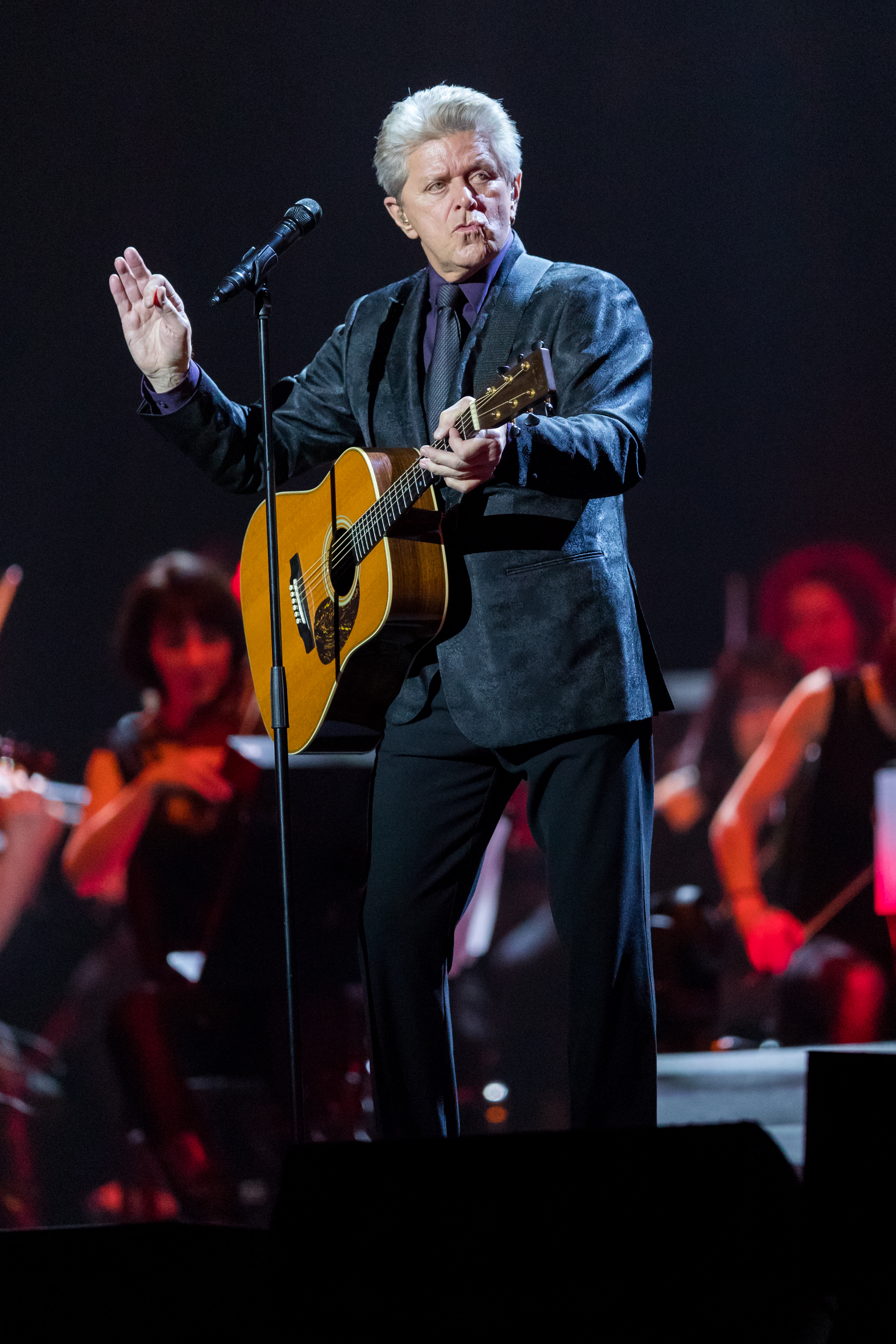
Background and career
Peter Paul Cetera Jr. ( sə-TERR-ə; born September 13, 1944) is an American retired musician best known for being a frontman, vocalist, and bassist for the American rock band Chicago from 1967 until his departure in 1985. His career as a recording artist encompasses 17 albums with Chicago (Chicago Transit Authority through Chicago 17) and eight solo studio albums. As a lead singer/vocal artist he has had four number one songs on the Billboard Hot 100, two during his tenure with Chicago and two during his solo career. Of those four songs he wrote or co-wrote three. As a solo artist, Cetera has scored six Top 40 singles, including two that reached number one on Billboard's Hot 100 chart in 1986, "Glory of Love" and "The Next Time I Fall". The former was the theme song from the film The Karate Kid Part II (1986), was co-written by Cetera, David Foster, and Diane Nini and was nominated for both an Academy Award and a Golden Globe Award for best original song from a motion picture. In 1987, Cetera received an ASCAP award for "Glory of Love" in the category "Most Performed Songs from Motion Pictures". His performance on "Glory of Love" was nominated for a Grammy Award for best pop male vocal. That same year Cetera and Amy Grant, who performed as a duet on "The Next Time I Fall", were nominated for a Grammy Award for best vocal performance by a pop duo or group. Besides Foster and Grant, Cetera has collaborated throughout his career with other recording artists from various genres of music. His songs have been featured in soundtracks for movies and television. With "If You Leave Me Now", a song written and sung by Cetera on the group's tenth album, Chicago received its first Grammy Award. It was also the group's first number one single. Chicago's second number one song, "Hard to Say I'm Sorry", came from the album Chicago 16 in 1982. It was co-written by Cetera and the group's producer, David Foster and Cetera sang the lead vocal. Chicago's first album, Chicago Transit Authority (Columbia, 1969), featuring Cetera on bass and vocals, was inducted into the Grammy Hall of Fame in 2014. Cetera was inducted into the Rock and Roll Hall of Fame as a member of Chicago in April 2016, and he, Robert Lamm, and James Pankow were among the 2017 Songwriters Hall of Fame inductees for their songwriting efforts as members of the group. Cetera, along with other members of Chicago, received a Grammy Lifetime Achievement Award in 2020.
Former Chicago drummer Danny Seraphine wrote, "Peter came from a strong Catholic blue-collar family ...". Cetera was born to Peter Paul Cetera Sr. and Margareta (Bechtold) Cetera in the Morgan Park neighborhood, located on the far South Side of Chicago, Illinois. He was the second of six children and is of Polish and Hungarian descent. His father worked as a machinist. Cetera's siblings include two brothers, Tim Cetera (who recorded an album with Ricky Nelson in the early 1970s) and Kenny Cetera. Both are listed as contributing musicians on some of the recordings Cetera made with Chicago and on some of his solo recordings.
Cetera attended Archbishop Quigley Preparatory Seminary for one year of high school because, he says, "my mother wanted me to be a priest." He transferred to Mendel Catholic Prep High School, graduated from there in 1962, and is listed among the "Notable Alumni".
Cetera says that his mother "was always singing around the house" and taught the children to sing in harmony while they were doing their household chores. His brother Kenny also remembers the family harmonizing together while growing up. Based on the positive responses he got, Cetera realized around the age of 11 or 12 that he had a talent for singing. Cetera's interest in music deepened when, at 11 years of age, his parents bought him an accordion instead of the guitar he wanted. He says he was "kind of a polka prodigy" and aged 12 won a local talent competition for his accordion-playing. However, his family missed his radio debut when the show was broadcast the following week, because they did not own an FM receiver. During high school, he started seriously thinking of pursuing a career as a singer. When he was 15, some older students from his high school took him to a club to see a band called the Rebel Rockers, which led to his purchasing an acoustic guitar at Montgomery Ward. He eventually took up the electric bass, and with some high school friends—a drummer, guitarist, and saxophone player—Cetera began playing the local dance circuit, dividing lead vocals with the guitarist. Cetera's early musical influences include Bo Diddley, Ritchie Valens, Little Richard, Jimmy Reed, and the Ventures. After he embarked on his music career, the Beatles became a prominent influence in his early twenties.
Cetera played in several groups in the Chicago area, including a popular local rock band named the Exceptions, which toured the Midwest in the mid-1960s. Cetera said, "By the time I was 18 I was making more money than my dad." Among Cetera's first recording experiences were several singles and a five-song seven-inch EP titled Rock 'N' Roll Mass with the Exceptions. One of those recorded songs, "Come On Home", also gave Cetera his first songwriting credit. (Kal David and Marty Grebb also are credited on the song.) Adding to his early recording experience, Cetera played electric bass on Chicago folk singer and songwriter Dick Campbell's album Dick Campbell Plays Where It's At, released in 1966 on Mercury Records. When the Exceptions decided to move toward a more psychedelic sound, Cetera left; the band changed its name to Aorta, and became one of the first psychedelic groups on a major label.
In December 1967, Cetera arrived early for a show to watch a band called the Big Thing. Impressed by their use of a horn section combined with rock and roll, Cetera left the Exceptions to join the Big Thing within two weeks. The Big Thing, which soon changed its name to the Chicago Transit Authority (and eventually shortened it to Chicago), released its self-titled debut album Chicago Transit Authority on Columbia Records in 1969. Cetera shared lead vocals on three of the eleven songs on the album: "Questions 67 & 68", "I'm a Man", and "Someday", his tenor voice complementing the baritone voices of the two other lead singers in the group, keyboardist Robert Lamm and guitarist Terry Kath. The follow-up album, Chicago, vaulted the band to popular status throughout the world. The song "25 or 6 to 4" was the first major hit single with Cetera singing lead vocals. Chicago is also notable for featuring Cetera's first songwriting effort with the group, "Where Do We Go From Here?" As the 1970s progressed, Cetera became a more prolific songwriter for the group, contributing the songs "Wishing You Were Here" and "Happy Man" to the 1974 album Chicago VII. "Wishing You Were Here" featured vocals by members of the Beach Boys, and reached number eleven on the charts. "Happy Man" was, according to Chicago producer James Guercio, "a Number 1 record that was never released as a single." Cetera's biggest singing and songwriting accomplishment with Chicago came in 1976 with the ballad "If You Leave Me Now", from Chicago X. It was the group's first number one single in the United States, also reaching number one on charts worldwide and certified Gold and Platinum by the Recording Industry Association of America (RIAA). The song won a Grammy Award for Chicago, the group's only competitive or standard Grammy Award to date, for the 1976 Best Pop Vocal Performance by a Duo, Group or Chorus, at the 19th Annual Grammy Awards, held on February 19, 1977. According to William James Ruhlmann, biographer of the group, "the success of 'If You Leave Me Now' overshadowed the album from which it came, and also consolidated what by now seemed a definitely stated preference on the part of radio, if not Chicago's audience in general, for lush ballads sung by Peter Cetera over any other style the band might care to put forward." Another success in the same vein followed: Cetera's 1977 composition "Baby, What a Big Surprise", from Chicago XI. The song featured him on lead vocals and made it to number four on the record charts. During this time Cetera also worked with other recording artists. He, along with a group of other well-known musicians, appeared on the 1976 self-titled debut album by singer-songwriter Angelo. In 1977 Cetera provided background vocals on Beached, an album by Ricci Martin (son of Dean Martin), produced by Ricci Martin's brother-in-law, Carl Wilson of the Beach Boys. Cetera's bandmates James Pankow, Walter Parazaider, and Lee Loughnane also performed on the album. He is credited as one of the background vocalists on Billy Joel's single "My Life", released in 1978, from the album 52nd Street. The following year he collaborated with Karen Carpenter on her self-titled solo album, providing backing vocals for a song that he had written, "Making Love in the Afternoon". That album was not released until 1996 by A&M Records. By the end of the 1970s, with the rise of disco music, Chicago's popularity declined, culminating in the release of the band's poorest-selling album to that point, Chicago XIV, which peaked at number 71 on the Billboard 200 chart in 1980. Columbia Records subsequently bought out the remainder of Chicago's contract. In 1981, Cetera released his first solo album, Peter Cetera, on Warner Bros. Records, after personally buying the rights from his previous contract with Columbia Records, who would not release the project. The album peaked at number 143 on the Billboard 200 and was considered a commercial failure. Cetera blamed Warner Bros., claiming that the company refused to promote him as a solo artist out of fear that he would leave Chicago, who had only recently signed with the label. Former bandmate Danny Seraphine agrees with Cetera on this point, and says that the album "... sank like a stone due to lack of record company support. Warner Brothers didn't want it to interfere with their plans for Chicago." Although his debut album was a commercial failure, one single from the album reached the Top 10 on the Top Rock Tracks chart: "Livin' in the Limelight". In 1982, David Foster was brought in as producer and the resulting group effort was Chicago 16. The album, which peaked at number nine on the Billboard 200 chart, represented a major comeback for Chicago, and leading the way was the hit single co-written by Cetera and Foster and featuring Cetera on lead vocals, "Hard to Say I'm Sorry". It went to number one on the charts, was certified Gold by the RIAA in September of that year, and was nominated for a Grammy Award for Best Pop Performance by a Duo or Group with Vocal. It was also featured in the movie Summer Lovers, starring Daryl Hannah. The second single, "Love Me Tomorrow", also co-written with Foster and sung by Cetera, reached number 22 on the Billboard Hot 100 chart. The third single, "What You're Missing", was yet again sung by Cetera. Cetera, a member of the American Society of Composers, Authors and Publishers (ASCAP), won ASCAP Pop Music Awards in the category, Most Performed Songs, for both "Hard to Say I'm Sorry" and "Love Me Tomorrow", and was honored by ASCAP as a multiple songwriter winner. In 1983, he took a break from his duties as Chicago frontman to add backing vocals on Paul Anka's final U.S. Top 40 hit, "Hold Me 'Til the Mornin' Comes", which debuted in the summer of that year. When Chicago 17 was released in 1984, it became the veteran band's most successful album in their history, eventually selling over six million copies in the United States alone. All four singles released from the album were sung by Cetera, including three which he co-wrote, and all of them charted in the top 20: "Stay the Night" (number 16), "Hard Habit to Break" (number 3), "You're the Inspiration" (number 3), and "Along Comes a Woman" (number 14). "Hard Habit to Break", written by Steve Kipner and John Lewis Parker, brought three Grammy nominations for Cetera: two nominations as a member of Chicago for Record of the Year and Best Pop Performance by a Duo or Group with Vocal; and outside the group, as a co-nominee with David Foster for Best Vocal Arrangement for Two or More Voices, Cetera's first, and to date only, nomination for vocal arrangement. Cetera won ASCAP honors for most-performed songs for "You're the Inspiration". With the advent of the music video and the growing popularity of MTV, Cetera became the 'face' and public leader of the longtime-faceless band that was Chicago.


