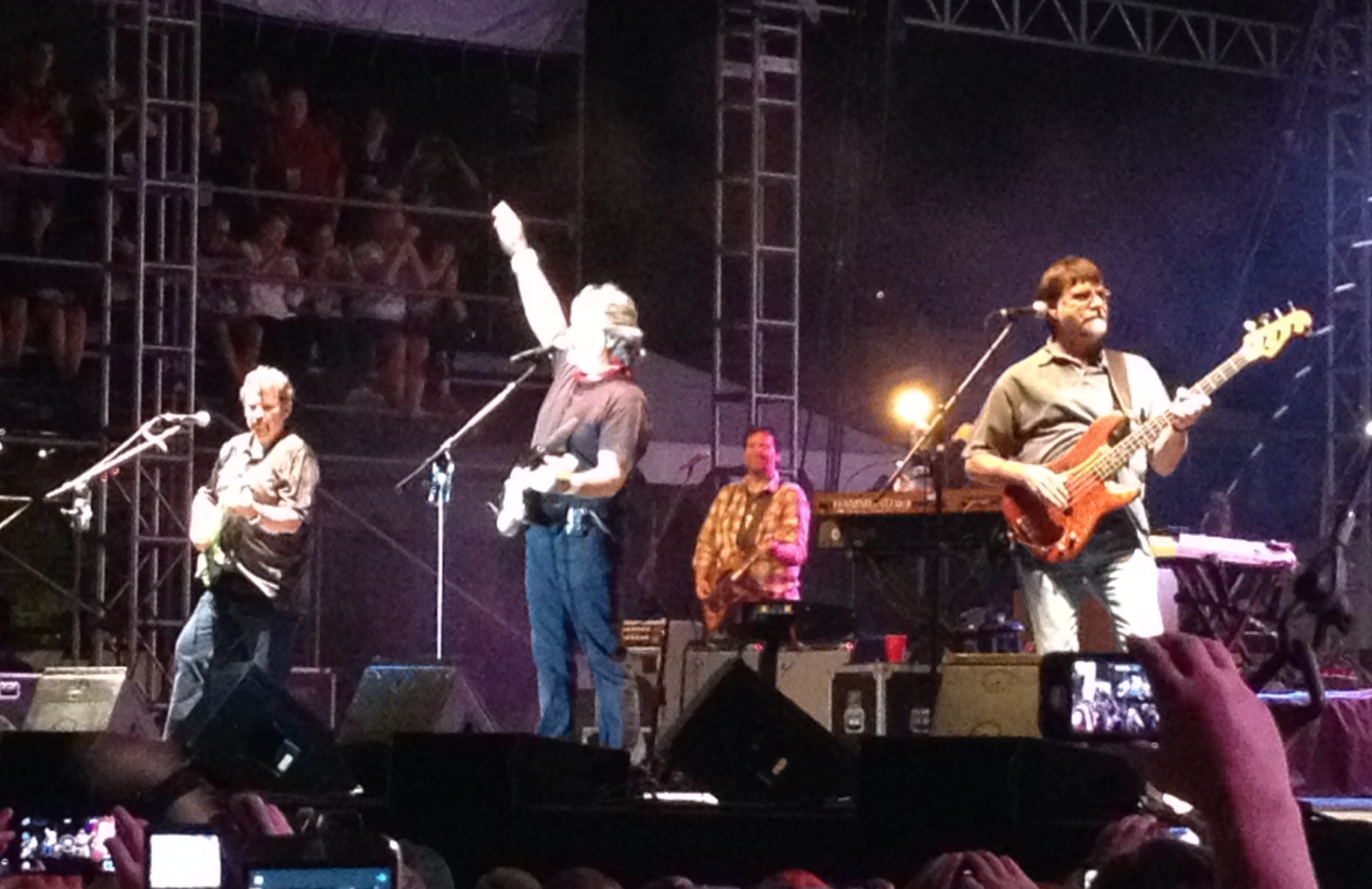
Background and career
Philip Tyler Keaggy (born March 23, 1951) is an American acoustic and electric guitarist and vocalist who has released more than 55 albums and contributed to many more recordings in both the contemporary Christian music and mainstream markets. He is a seven-time recipient of the GMA Dove Award for Instrumental Album of the Year, and he was twice nominated for a Grammy Award for Best Rock Gospel Album. He has frequently been listed as one of the world's top-two "finger-style" and "finger-picking" guitarists by Guitar Player Magazine readers' polls, and due to his complex and virtuosic playing, he has been called one of the greatest guitarists in history.
Keaggy was raised Catholic in a small farmhouse in Hubbard, Ohio, with nine brothers and sisters. He is missing half of the middle finger on his right hand due to an accident at age four involving a water pump. Keaggy reflects on the incident:
We lived on a farm in Hubbard, Ohio which had a big water pump, and I was climbing up on it. As I was kneeling on top of the platform, it broke and the faucets came crashing down on my finger and cut it off. I can remember it very vividly—as if it happened yesterday, and I can see my dad running down the hill, rescuing me, and taking me to the hospital. I can recall having a white cast and bandage; it was gigantic! They tried to sew it on, but it didn't take, so I grew up with nine fingers. As a young kid, I was embarrassed about it a lot, especially when I was beginning to get into guitar. Initially, it was not the guitar that attracted Keaggy to playing music. "I asked my dad for a set of drums for my tenth birthday but he came home with a Sears Silvertone guitar."
Keaggy was a member of a mid-1960s garage rock band called the Squires; one of their songs ("Batmobile"), which he co-wrote, appears on the compilation album Highs in the Mid-Sixties, Volume 9. In 1966 he joined Volume IV, which in 1967 became New Hudson Exit. The band appeared frequently in Youngstown clubs and also released a Keaggy composition, "Come With Me", as a single on the Date label. At one point, New Hudson Exit had considered Joe Walsh as its lead guitarist. Walsh later established himself as the guitarist for The James Gang before embarking on a solo career and work with the Eagles. In 1968, Keaggy and longtime friend drummer John Sferra, along with bassist Steve Markulin, formed the band Glass Harp. The band gigged in and around the Youngstown, Ohio area and found work at school dances and clubs. The incarnation of the band recorded several demos, and released the single "Where Did My World Come From?" on the United Audio label in 1969. Markulin left the group to join his cousin Joe in another successful Youngstown band, The Human Beinz. Keaggy and Sferra then recruited bass player Daniel Pecchio. Pecchio, formerly of the band The Poppy, was also a flute player, a talent which later was showcased on several Glass Harp's songs. After recording a new set of demos and signing with new management, the band set out to polish their live act and shop for a recording deal. A major turning point for the trio was their winning of an Ohio area's "Battle of the Bands", One of the event's judges happened to be an associate of producer Lewis Merenstein, whom he alerted to the threesome. Merenstein was persuaded to fly down from New York to listen to the band in concert. Upon hearing Glass Harp perform, Merenstein's enthusiastic report resulted in Decca Records signing Glass Harp to a multi-record deal.
...the 18th year of my life was very dark; I was into drugs by now....back in '69 I was experimenting with LSD. I had done some trips and it was terrible, I thought it might enhance my creative ability in music, but it didn't. I once heard a tape of me playing when I was high and it was awful. I sang weird and I played badly. I thought I was doing such a great job, but it was a deception. People I was supposedly very close to, who were close to me, were turning on me. It seemed really strange...I was experiencing such fear...it was just...terrible...During these days I would take naps in the afternoon because I'd be so tired playing at night, staying up till 4 in the morning, getting up early and napping again in the afternoon. I'd wake up having nightmares...I had "Peace" written on my wall and I went around giving the peace sign, but I didn't experience peace in my life. I didn't know what peace really meant; it was just a cliché. On Valentine's Day in 1970, Keaggy's mother was seriously injured in an auto accident. After her death a week later and inspired by his sister, Keaggy became a born-again Christian. In September of the same year, Glass Harp was in New York's Greenwich Village recording its first album Glass Harp at Jimi Hendrix's Electric Lady Studios with Lewis Merenstein as producer. At the time of the recording, Keaggy and Sferra were nineteen years old. All three members of Glass Harp wrote the band's songs. Keaggy sang the majority of the songs; Pecchio and Sferra also sang lead on several numbers. One song of Keaggy's in particular, "Can You See Me", reflected his newfound Christian faith, with its reference to Jesus' death. Keaggy recalls, "It was recorded in New York City in about a week. Even though I had bronchitis and had to sing one verse at a time, it worked out... I was even able to get in a witness for the Lord Jesus in "Can You See Me" and "Look in the Sky". As a Decca Records artist, the band began to open for bands including The Kinks, Iron Butterfly, Yes, Traffic, Grand Funk Railroad and Chicago. Contrary to the tight production and song-oriented nature of Glass Harp's studio albums, their live performances demonstrated the band's ability to stretch out and expand the boundaries of their compositions. As a result, they are one of the pioneers of what would later be known as the jam rock genre, with songs many times reaching over 30 minutes in length with extended solo passages and group improvisation. In 1971, Glass Harp released a follow-up album, Synergy. Again, Keaggy's Christian faith surfaced in some of the lyrics. He notes, "That album was a real experience because I was able to sing 'The Answer', a song I wrote right after my conversion to Christ... with...producers and an engineer that didn't care about Jesus, I was surprised that out of 15 songs, one of the ten that got on the album was 'The Answer'. I praise Jesus for that work, because it's just a simple song of testimony." The next year the band released its third album: It Makes Me Glad, which included a version of the old spiritual "Do Lord". "We all worked the best that we could. The group knew that it would be our last album together because I had given notice that I was going to leave... on August 8, I did. It was a really heavy thing for everybody." After recording three albums with Glass Harp, Keaggy left the band in 1972. He said, "We enjoyed playing together and we really got tight musically. But spiritually we were going different directions." In 1973 he released What a Day, his first solo album. The songs were written while Keaggy was still with Glass Harp. He performed all the instruments on the album. The title track is a staple of Keaggy's concerts up to the present day. Keaggy married his wife Bernadette in the summer of 1973. He took a brief hiatus from recording on his own and only toured in support of other artists like Love Song, 2nd Chapter of Acts, Paul Clark, and Nancy Honeytree. Years later, Amboy Dukes guitarist Ted Nugent was quoted as saying "I don't know what happened to that Phil Keaggy. He could have saved the world with his guitar." Keaggy and his wife moved to rural Freeville, New York, to participate in and become immersed in the discipleship program of Love Inn Community led by Scottish-American disc-jockey Scott Ross. Ross affiliated himself and Love Inn Community with the Shepherding Movement, which progressively took on many characteristics of an authoritarian cult. Not until Keaggy extracted himself from the group and the menial labor to which they had largely confined him did he once again begin to record significant music. In late 1974, Keaggy played guitar on Joe Vitale's debut solo album Roller Coaster Weekend produced by The Albert Brothers. The album featured guitarists Joe Walsh and Rick Derringer. Keaggy returned to the studio in 1976 with Love Broke Thru, an album which included his version of a song which has become a classic in Christian music: "Your Love Broke Through". It was written by Keith Green, Todd Fishkind, and Randy Stonehill; the song later became closely identified with Green, yet it was at Green's insistence that Keaggy's rendition be the first released recording. A longtime fan of C. S. Lewis, Keaggy also included an arranged version of the author's poem "As the Ruin Falls". The seven-minute "Time" is considered by some fans to be the first album-oriented rock extended-length "Free Bird" of contemporary Christian music. "Time" featured Keaggy's innovative guitar technique of violin-like swelling, found approximately 3:54 and 5:17 in the song. The effect requires picking the string, then raising and lowering the guitar volume knob for each note in a melody. His album was listed as No. 64 in the 2001 book, CCM Presents: The 100 Greatest Albums in Christian Music. During the summer of 1977 Keaggy went on an eighteen-city tour of the western United States with 2nd Chapter of Acts and "A Band called David". The tour was filmed for the live triple-album How the West Was One, a collection which featured concert renditions of "What a Day" and "Your Love Broke Through". In the same year the Phil Keaggy Band was formed. Composed of Keaggy, guitarist Lynn Nichols, keyboardist Phil Madeira, bassist Dan Cunningham, and drummer Terry Andersen, the Phil Keaggy Band released their only album in 1977, Emerging. The band was featured as Love Inn Company on an album of songs by Ted Sandquist titled Courts of the King, and as the backing band for Nedra Ross on her Full Circle album. The title track was re-recorded by Keaggy in 1981. Song in the Air., a Glass Harp compilation album was released in 1977. In 1978, Keaggy released his first critically acclaimed instrumental album entitled The Master and the Musician. It is the best-selling album of his career. A 1989 reissue of the album included a new track, "Epilogue: Amazing Grace".
The Keaggy family moved to Leawood, Kansas in August 1979; their first daughter, Alicia, was born there in March 1980. They left Leawood in 1983 and lived in Costa Mesa, California. Their second daughter, Olivia, was born on February 14, 1984, and their son Ian was born on June 16, 1987. Keaggy's record label during the early part of the decade was Sparrow Records. 1980's Ph'lip Side features "Sunday School" and the gentle "Little Ones", an early anthem for the pro-life/anti-abortion movement. Town to Town, was released in 1981; it is noted for what has become a concert staple "Let Everything Else Go". It included his arrangement of "Rise Up O Men of God". A trend was begun in which Keaggy frequently featured a hymn on his albums. In 1982, Keaggy released Play Thru Me, known for its upbeat classic, "Morning Light" as well as the slide-guitar instrumental workout, "Happy". In 1984, Keaggy and Randy Stonehill co-wrote and sang the duet "Who Will Save the Children?" for Stonehill's album Celebrate This Heartbeat. The duet became a theme song for Compassion International, a Christian child advocacy ministry. The next year Nissi Records released Keaggy's next studio album, Getting Closer. Keaggy would later re-record two of the album's songs: a rearranged version of "I Will Be There" appears on 1993's Crimson and Blue while "Passport" received an update for the 2009 Christian Progressive Rock compilation album CPR 3. Way Back Home was released in 1986. The album has quieter acoustic numbers including a new rendition of 1981's "Let Everything Else Go" and "Maker of the Universe", a ballad about the incarnation of Christ. The album also emphasized one of the prominent themes in Keaggy's music: family. The next year Phil Keaggy released his second instrumental album, The Wind and the Wheat. The album reflects the "new-age" instrumental sounds of the day. The Wind and the Wheat won the guitarist his first Dove Award, an honor that he received in 1988. Also in 1988, Keaggy and Stonehill would team up with singer Margaret Becker, former Wings drummer Joe English and others as the Compassion All Star Band. The group released a subsequent live album One by One. In 1988, Keaggy collaborated with Randy Stonehill, vocalist Russ Taff, bassist Rick Cua, Derri Daugherty, Mark Heard, Steve Taylor and other musicians to create Phil Keaggy and Sunday's Child. Lynn Nichols, guitarist for the 1977 Keaggy Band, produced the Sunday's Child project. Referring to the Sunday's Child album cover, Keaggy said,