Background and career
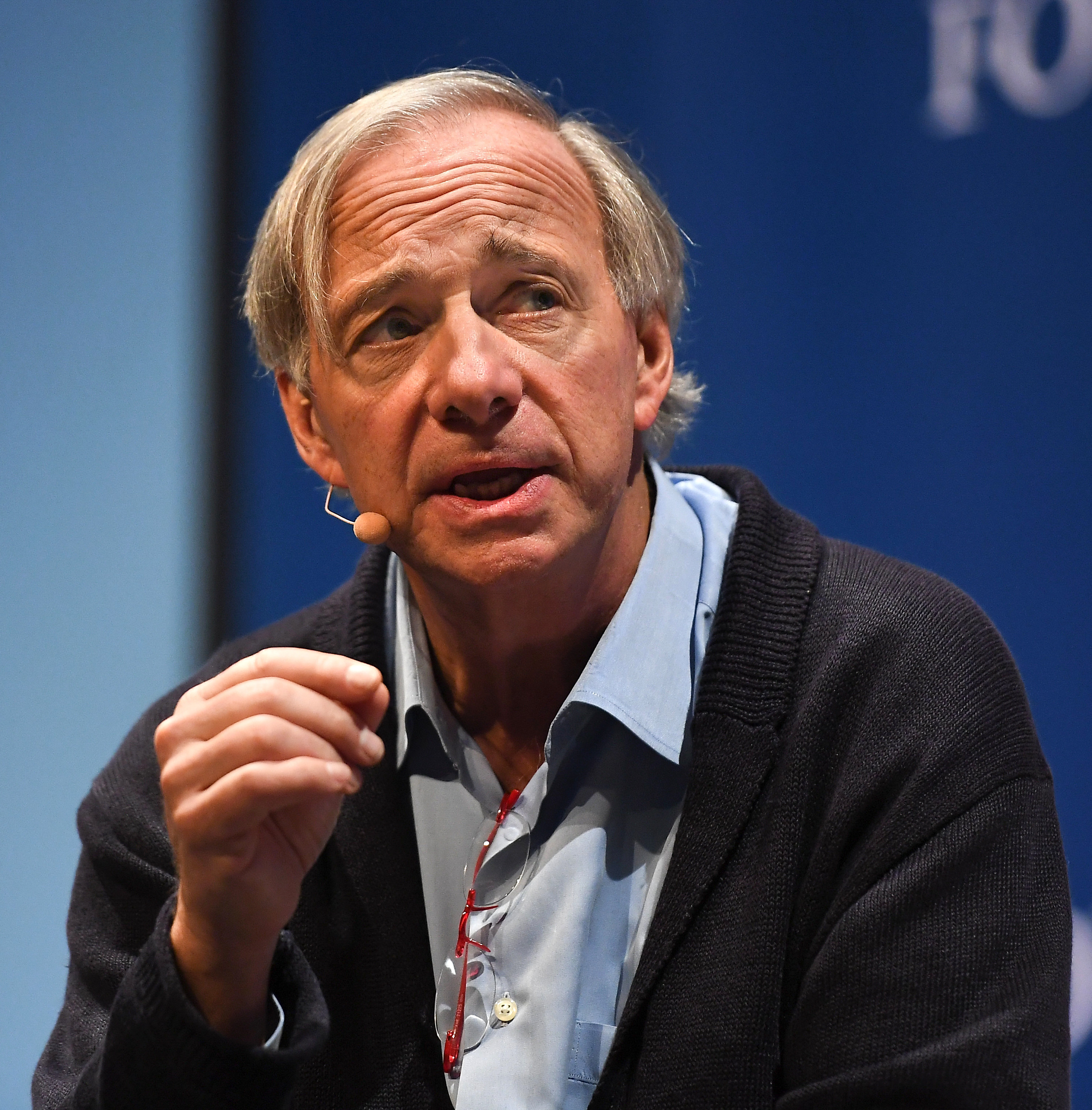
Raymond Thomas Dalio (born August 8, 1949) is an American billionaire investor and founder of Bridgewater Associates, one of the world's largest hedge funds. Dalio is the author of the 2017 book, Principles: Life & Work, about corporate management and investment philosophy and The Changing World Order on why nations succeed and fail. As of June 2026, he has a net worth of $21.5 billion, which ranks 126th on the Bloomberg Billionaire Index.
Dalio was born in the Jackson Heights neighborhood of New York City's Queens Borough. He is the son of the Italian-American parents, jazz musician Marino Dallolio (1911–2002), and Ann, a homemaker. When he was 8, his family moved from Jackson Heights to Manhasset in Nassau County, Long Island, New York. He attended Herricks High School. He then received a bachelor's degree in finance from C.W. Post College of Long Island University. After graduating from C.W. Post College, Dalio worked as a clerk on the New York Stock Exchange. He received an MBA from Harvard Business School in 1973.
During his time at Harvard, Dalio and his friends created the company that later became Bridgewater Associates. Its goal was to trade commodities, but the venture yielded little fruit. Dalio later used the name "Bridgewater" for his hedge fund. After graduating from Harvard, Dalio moved to Wilton, Connecticut, where he traded out of a converted barn. He then worked on the floor of the New York Stock Exchange and traded commodity futures. He later worked as the Director of Commodities at Dominick & Dominick LLC. In 1974, he became a futures trader and broker at Shearson Hayden Stone, a securities firm run by Sandy Weill, who later became famous for building up Citigroup. At the firm, Dalio's job was to advise cattle ranchers, grain producers, and other farmers on how to hedge risks, primarily with futures. Dalio was fired from Shearson Hayden Stone after punching his boss in the face while drunk at a New Year's Eve party in 1974.
In 1975, he founded Bridgewater Associates. Bridgewater started out as a wealth advisory firm, which served numerous corporate clients, mostly retained from Dalio's job at Shearson Hayden Stone. The company began publishing a paid subscription research report, Daily Observations, in which it analyzed global market trends. Dalio's big break came when McDonald's signed on as a client of his firm. Bridgewater then began to grow rapidly. The firm signed on larger clients, including the pension funds for the World Bank and Eastman Kodak. In 1981, the firm opened an office in Westport, Connecticut, which was where Ray and his wife wanted to start a family. Dalio started to become well known outside of Wall Street after turning a profit from the 1987 stock market crash. In 1991, he launched Bridgewater's flagship strategy, "Pure Alpha", a reference to the Greek letter that, in Wall Street terminology, represents the excess returns a money manager can create in addition to market returns when adjusted for risk. In 1996, Dalio launched All Weather, a fund that pioneered a steady, low-risk strategy that later became known as risk parity.
Bridgewater Associates became the world's largest hedge fund in 2005. In 2007, Bridgewater predicted the 2008 financial crisis, and in 2008, Dalio published "How the Economic Machine Works: A Template for Understanding What is Happening Now", an essay assessing the potential of various economies by various criteria. In 2011, Dalio self-published a 123-page volume, Principles, that outlines his philosophy of investment and corporate management. In 2012, he appeared on the annual Time 100 list of the 100 most influential people in the world. In 2011 and 2012, Bloomberg Markets listed him as one of the 50 Most Influential people. The Teacher Retirement System of Texas (TRS) purchased a stake in Bridgewater Associates Intermediate Holdings, LP, for $250 million in February 2012. This stake was non-voting and thus provided the pension fund with very little control of corporate governance. Institutional Investor's Alpha ranked Dalio No. 2 on its 2012 Rich List. Dalio has controlled Bridgewater Associates alongside co-chief investment officers Bob Prince and Greg Jensen since its inception. In 2013, Bridgewater was listed as the largest hedge fund in the world. Dalio was co-CEO of Bridgewater for 10 months before announcing in March 2017 that he would step down as part of a company-wide shakeup by April 15. In September 2022, Dalio handed over his voting rights to Bridgewater's board of directors and stepped down as co-chief investment officer, completing his operational exit from the firm. Dalio sold his last shares in Bridgewater and left its board of directors in 2025, completing his full separation from the firm he had founded nearly five decades earlier. Since late 2025, Dalio has managed his personal investments directly through the Dalio Family Office, assuming the role of de-facto chief investment officer following the unexpected departure of a previous Wall Street executive who had held that position. He subsequently recruited Steven Kryger, a former Bridgewater executive who had led Dalio's research team, as co-chief investment officer for global macro strategy, and appointed Alma DeMetropolis, a former JPMorgan Chase executive, as deputy CEO of the family office. In early 2026, the Dalio Family Office disclosed its U.S. stock portfolio for the first time since the pandemic via a regulatory 13F filing, reporting approximately $503 million in U.S. equities, more than 75 percent of which was allocated to gold-based exchange-traded funds.
According to Dalio, Bridgewater Associates is a "global macro firm", investing around economic trends, such as changes in exchange rates, inflation, and GDP growth. Dalio's strategy mainly focuses on currency and fixed income markets. Dalio also popularized the risk parity approach, which he uses for risk management and diversification within Bridgewater. Dalio began using the term "d-process" in February 2009 to describe the deleveraging and deflationary process of the subprime mortgage industry as distinct from a recession, and subsequently incorporated the term into his investment philosophy.


