Background and career
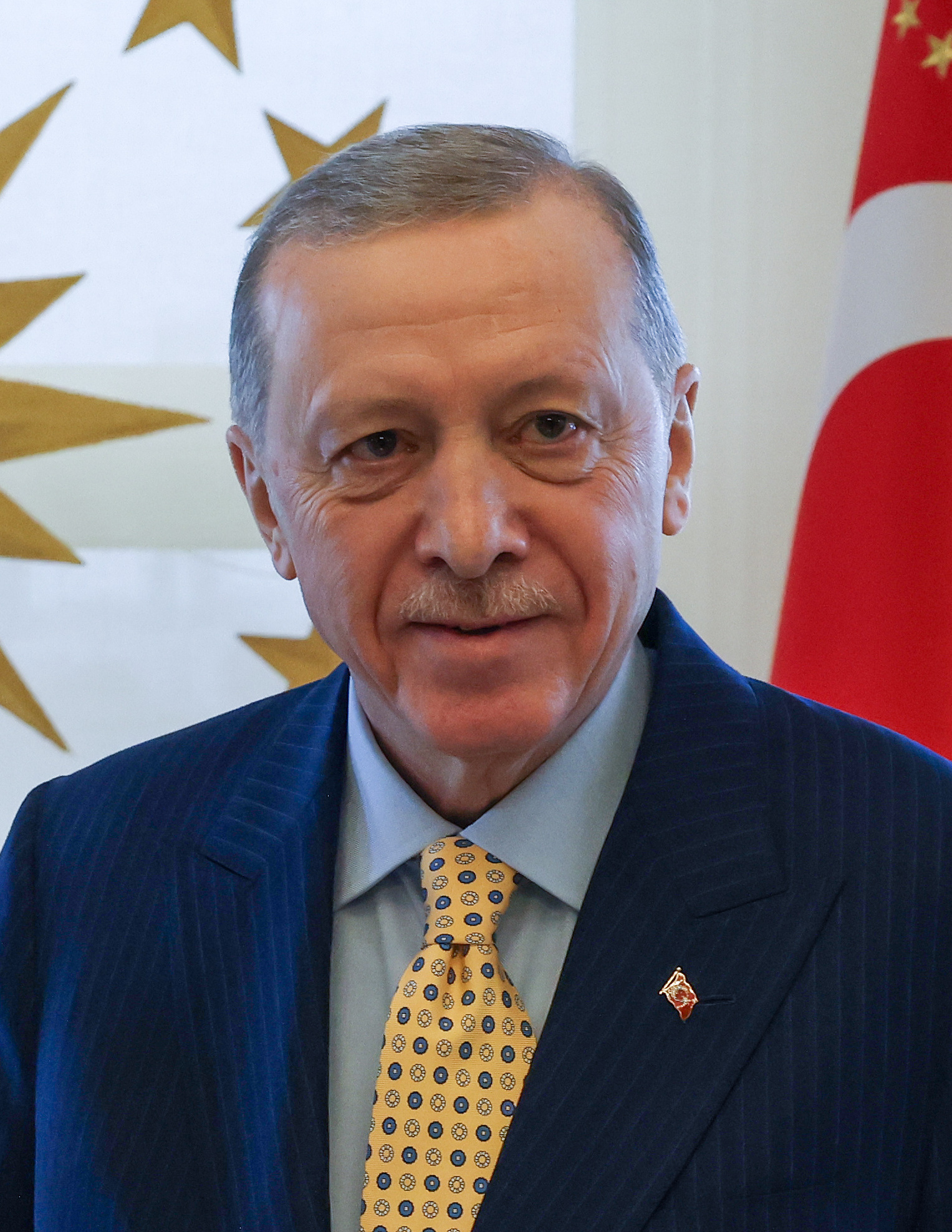
Recep Tayyip Erdoğan (born 26 February 1954) is a Turkish politician who has been the president of Turkey since 2014. He previously served as the 25th prime minister from 2003 to 2014 as part of the Justice and Development Party (AKP), which he co-founded in 2001. He also served as mayor of Istanbul from 1994 to 1998. Coming from an Islamist background and promoting socially conservative policies, Erdoğan has been Turkey's de facto leader since 2003. Turkey has experienced democratic backsliding and suppression of dissent under Erdoğan. Erdoğan was born in Beyoğlu, Istanbul, and studied at the Aksaray Academy of Economic and Commercial Sciences, before working as a consultant and senior manager in the private sector. Becoming active in local politics, he was elected Welfare Party's Beyoğlu district chair in 1984 and Istanbul chair in 1985. Following the 1994 local elections, Erdoğan was elected mayor of Istanbul. In 1998 he was convicted for inciting religious hatred and banned from politics after reciting a poem by Ziya Gökalp that compared mosques to barracks and the faithful to an army. Erdoğan was released from prison in 1999 and formed the AKP, abandoning openly Islamist policies. Erdoğan led the AKP to a landslide victory in the election for the Grand National Assembly in 2002, and became prime minister after winning a by-election in Siirt in 2003. Erdoğan led the AKP to two more election victories in 2007 and 2011. His tenure consisted of economic recovery from the economic crisis of 2001, the start of EU membership negotiations, and the reduction of military influence on politics. In late 2012, his government began peace negotiations with the Kurdistan Workers Party (PKK) to end the Kurdish–Turkish conflict, negotiations which ended three years later. In 2014, Erdoğan became the country's first directly elected president. Erdoğan's presidency has been marked by democratic backsliding and a shift towards authoritarianism. His economic policies have led to high inflation and the depreciation of the Turkish lira. He has intervened in conflicts in Syria and Libya, launched operations against the Islamic State, Syrian Democratic Forces, and Ba'athist Syria, and has made threats against Greece and Israel. He oversaw the transformation of Turkey's parliamentary system into a presidential system, introducing term limits and expanding executive powers, and Turkey's migrant crisis. In May 2022, Erdoğan temporarily blocked Finland and Sweden from joining NATO. Erdoğan responded to the 2022 Russian invasion of Ukraine by closing the Bosphorus to Russian naval reinforcements, brokering a deal between Russia and Ukraine regarding the export of grain, and mediating a prisoner exchange. In 2025, Erdoğan oversaw the arrest of Istanbul mayor Ekrem İmamoğlu and his subsequent disqualification from the upcoming 2028 presidential election, for which he was considered the opposition front-runner, leading to ongoing widespread protests.
Recep Tayyip Erdoğan was born on 26 February 1954 in Kasımpaşa, a neighbourhood in the Beyoğlu district of Istanbul, Turkey, to a modest conservative Muslim family. Erdoğan's family is originally from Adjara, a region in Georgia. Although Erdoğan was reported to have said in 2003 that he was of Georgian origin and that his origins were in Batumi, he later denied this. His parents were Ahmet Erdoğan (1905–1988), a coastguard and sea captain, and Tenzile Erdoğan (née Mutlu; 1924–2011). While Erdoğan attended school in Istanbul, his summer holidays were mostly spent in Güneysu, Rize, where his family originates from. Throughout his life he often returned to this spiritual home, and in 2015 he opened a vast mosque on a mountaintop near this village. The family returned to Istanbul when Erdoğan was 13 years old. As a teenager, Erdoğan's father provided him with a weekly allowance of 2.5 Turkish lira, less than a dollar. With it, Erdoğan bought postcards and resold them on the street. He sold bottles of water to drivers stuck in traffic. Erdoğan also worked as a street vendor selling simit (sesame bread rings), wearing a white gown and selling the simit from a red three-wheel cart with the rolls stacked behind glass. In his youth, Erdoğan played semi-professional football in Camialtıspor FC, a local club. The stadium of the local football club in the district where he grew up, Kasımpaşa S.K. is named after him. Erdoğan is a member of the Community of İskenderpaşa, a Turkish Sufistic community of the Naqshbandi Order.
Erdoğan graduated from Kasımpaşa Piyale Primary School in 1965, and the Istanbul İmam Hatip High School, a religious vocational high school, in 1973. The same educational path was followed by other co-founders of the AK Party. One quarter of the curriculum of İmam Hatip schools involves study of the Quran, the life of the Islamic prophet Muhammad, and the Arabic language. Erdoğan studied the Quran at the İmam Hatip, where his classmates began calling him hoca ("teacher" or "religious official"). Erdoğan attended a meeting of the nationalist student group National Turkish Student Union (Milli Türk Talebe Birliği), who sought to raise a conservative cohort of young people to counter the rising movement of leftists in Turkey. Within the group, Erdoğan was distinguished by his oratorical skills, developing a penchant for public speaking and excelling in front of an audience. He won first place in a poetry-reading competition organized by the Community of Turkish Technical Painters, and began preparing for speeches through reading and research. Erdoğan would later comment on these competitions as "enhancing our courage to speak in front of the masses". Erdoğan wanted to pursue advanced studies at the Ankara University Faculty of Political Science, commonly known as Mülkiye, but only students with regular high school diplomas were eligible to apply, thereby excluding Imam Hatip graduates. Mülkiye was known for its political science department, which trained many statesmen and politicians in Turkey. Erdoğan was then admitted to Eyüp High School, a regular state school. That he eventually received a high school diploma from this school is a subject of debate. According to his official biography, Erdoğan subsequently studied business administration at the Aksaray School of Economics and Commercial Sciences (Turkish: Aksaray İktisat ve Ticaret Yüksekokulu), now known as Marmara University's Faculty of Economics and Administrative Sciences. Both the authenticity and status of his degree have been the subject of disputes and controversy over whether the diploma is legitimate and ought to be considered sufficient to make him eligible as a candidate for the presidency.
In 1976, Erdoğan engaged in politics by joining the National Turkish Student Union, an anti-communist action group. In the same year, he became head of the Beyoğlu youth branch of the Islamist National Salvation Party (MSP), and was later promoted to chair of the Istanbul youth branch. He held this position until the 1980 military coup which dissolved all major political parties. He went on to be a consultant and senior executive in the private sector in the aftermath of the coup. Three years later, in 1983, Erdoğan followed most of Necmettin Erbakan's followers into the newly founded Welfare Party (RP). The new party, like its predecessors subscribed to Erbakan's strain of Islamism, the National view. He became the party's Beyoğlu district chair in 1984, and head of its Istanbul branch in 1985. Erdoğan entered the parliamentary by-elections of 1986 as a candidate in Istanbul's 6th electoral district, but failed to get elected. Three years later, Erdoğan ran for the district mayoralty of Beyoğlu, finishing in second place with 22.8% of the vote. In the 1991 general election, the Welfare Party more than doubled its share of the vote in Istanbul compared to four years prior, reaching 16.7%. At first, Erdoğan, who led his party's district list, was thought to have been elected to parliament. However, as a product of the open-list proportional representation system adopted during the previous term, after all votes expressing a candidate preference were tabulated, it was instead Mustafa Baş who earned the seat allocated to the Welfare Party. A difference of about 4,000 preferential votes separated the two, with Baş's ~13,000 to Erdoğan's ~9,000.
In the local elections of 1994, Erdoğan ran as a candidate for Mayor of Istanbul. He was a young, dark horse candidate in a crowded field. Over the course of the campaign, he was mocked by the mainstream media and treated as a country bumpkin by his opponents. In an upset, he won with 25.19% of the popular vote, making it the first time a mayor of Istanbul got elected from his political party. His win coincided with a wave of Welfare Party victories nationwide, as they won 28 provincial mayoralties - most out of any party - and numerous metropolitan seats, including the capital, Ankara. He said at the time: "Democracy is like a train: when we reach our destination, we get off". Erdoğan governed pragmatically, focusing on bread-and-butter issues. He aimed to tackle the chronic problems plaguing the metropolis, such as water shortage, pollution – waste collection issues in particular – and severely congested traffic. He undertook an infrastructure overhaul: expanding and modernizing the water grid with hundreds of kilometres of new water pipes being laid, and constructing more than fifty bridges, viaducts, and stretches of highway to mitigate traffic. State-of-the-art recycling facilities were built and air pollution was reduced through a plan to switch to natural gas. He changed the public buses to environmentally friendly ones. He took precautions to prevent corruption, using measures to ensure that municipal funds were used prudently. He paid back a major portion of Istanbul Metropolitan Municipality's two-billion-dollar debt and invested four billion dollars in the city. He also opened up City Hall to the people, gave out his e-mail address and established municipal hot lines. Erdoğan initiated the first roundtable of mayors during the Istanbul conference, which led to a global, organized movement of mayors. A seven-member international jury from the United Nations unanimously awarded Erdoğan the UN-Habitat award.
In December 1997 in Siirt, Erdoğan recited a modified version of the "Soldier's prayer" poem written by Ziya Gökalp, a pan-Turkish activist of the early 20th century. This version included an additional stanza in the beginning, its first two verses reading "The mosques are our barracks, the domes our helmets / The minarets our bayonets and the faithful our soldiers...." Under article 312/2 of the Turkish penal code his recitation was regarded by the judge as an incitement to violence and religious or racial hatred. In his defence, Erdoğan said that the poem was published in state-approved books. How this version of the poem ended up in a book published by the Turkish Standards Institution remained a topic of discussion. Erdoğan was given a ten-month prison sentence. He was forced to give up his mayoral position due to his conviction. The conviction also stipulated a political ban, which prevented him from participating in elections. He had appealed for the sentence to be converted to a monetary fine, but it was reduced to four months instead (24 March 1999 to 27 July 1999). He was transferred to Pınarhisar prison in Kırklareli. The day Erdoğan went to prison, he released an album called This Song Doesn't End Here. The album features a tracklist of seven poems and became the best-selling album of Turkey in 1999, selling over one million copies. After his release, Erdoğan sought refuge in Tetovo, Macedonia with an ethnic Albanian family with whom he stayed with for several months. In 2013, Erdoğan visited the Pınarhisar prison again for the first time in fourteen years. After the visit, he said "For me, Pınarhisar is a symbol of rebirth, where we prepared the establishment of the Justice and Development Party".


