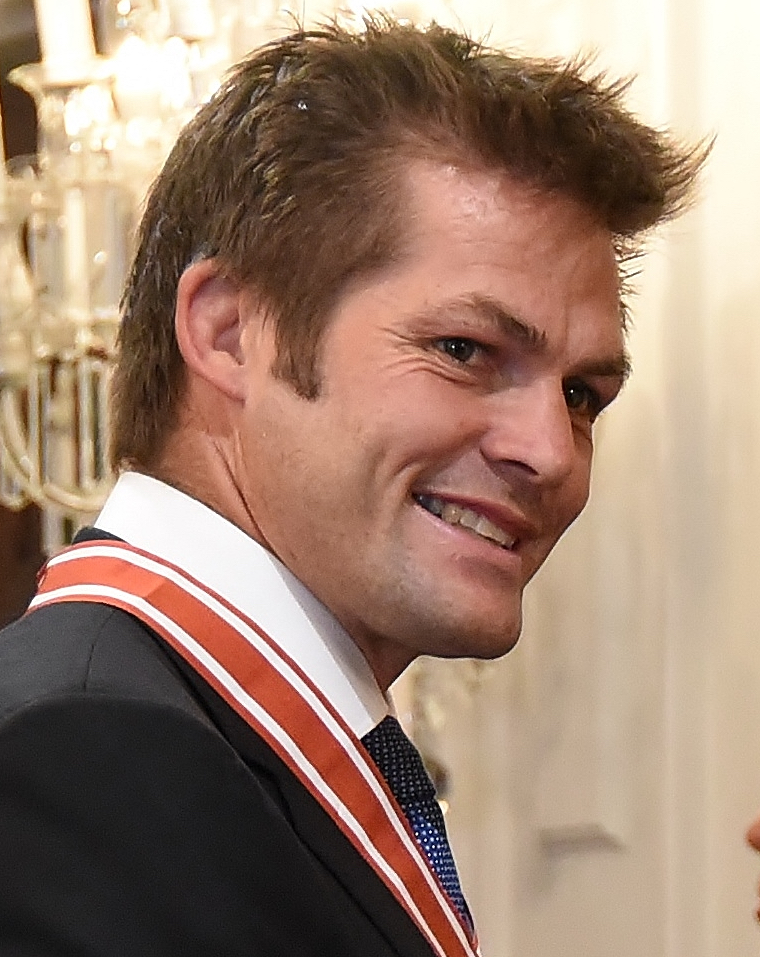
Background and career
Richard Hugh McCaw (born 31 December 1980) is a New Zealand retired professional rugby union player. He captained the New Zealand national team, the All Blacks, in 110 out of his 148 test matches, and won two Rugby World Cups. He has won the World Rugby Player of the Year award a joint record three times and was the most capped test rugby player of all time from August 2015 to October 2020. McCaw was awarded World Rugby player of the decade (2011–2020) in 2021. McCaw is also a winner of the New Zealand sportsman of the decade award. McCaw was the first All Black to reach 100 caps, and the first rugby union player to win 100 tests. He was the most-capped player in rugby union history with 148 caps, having overtaken Brian O'Driscoll's record in 2015 and losing the record to Alun Wyn Jones in 2020. McCaw has also equaled the record for most appearances at the Rugby World Cup, with Jason Leonard. McCaw predominantly played in the openside flanker position for the New Zealand, Crusaders and Canterbury teams, but also played as a blindside flanker and no. 8. During McCaw's career, Canterbury won the NPC (later Mitre10 Cup) five times, and the Crusaders won four Super Rugby titles. In addition to winning two world cups, the All Blacks won seven Tri-Nations titles, completed three successful Grand Slam tours and won the Bledisloe Cup eight times. He made his debut in 2001 for the Crusaders, and was selected for the All Blacks' 2001 end-of-year tour, despite having played only eight minutes of Super 12 rugby. His debut for New Zealand was against Ireland, where he was awarded man-of-the-match. McCaw became a regular selection for New Zealand, only missing a few games due to recurring concussions. In 2004 he was appointed captain of the All Blacks, whom he led at the 2007 Rugby World Cup. After their elimination in the quarter-finals, his captaincy came under criticism, but he was retained and eventually led the team to consecutive Rugby World Cup titles in 2011 and 2015, becoming one of only 43 players who have won the Rugby World Cup on multiple occasions. McCaw is however one of the two only captains to have won two Rugby World Cups, the other one being Siya Kolisi. McCaw holds the international record for most game wins as a player at 131. He also holds the international record for most games as a captain at 110.
His paternal fourth great-grandfather was Seth Smith, who built large proportions of Belgravia & Mayfair in London in the 1830s, related through his great, great-grandmother Sarah Annette Seth-Smith McCaw. McCaw's great-great-grandfather immigrated to New Zealand from the Scottish Borders in 1893, and settled in the Hakataramea Valley, Waimate District, South Canterbury. McCaw's father took over the family farm and his mother was a teacher at Kurow. On New Year's Eve 1980, Richard Hugh McCaw was born in the nearby town of Oamaru. He grew up on his parents' farm along with his sister Joanna. McCaw started flying gliders with his grandfather J H 'Jim' McCaw, a Tempest pilot during World War II credited with shooting down 20 V1 missiles, when he was nine years old. He played rugby for the local Kurow rugby club as a youngster, but it was not until 1994, when he boarded at Otago Boys' High School in Dunedin, that he started to take the game seriously. In his last year at Otago Boys' High, McCaw was head boy, proxime accessit (runner up) to the dux and played in the school's 1st XV. McCaw came to the attention of national selectors during a 5-all draw with Rotorua Boys' High School in the 1998 New Zealand secondary schools rugby final in Christchurch. However, he failed to make the New Zealand Secondary Schools Team, losing out to Sam Harding, Angus McDonald and Hale T-Pole. With Sam Harding moving south to study at the University of Otago, McCaw headed to Christchurch's Lincoln University to study agricultural science and pursue his rugby interests. He achieved all but two papers for his Bachelor of Agricultural Science degree before deciding to pursue his rugby career instead. He received an honorary doctorate in recognition of his sporting achievements in April 2012. In 1999, McCaw was selected in the New Zealand under-19 squad (coached by Mark Shaw), which won the world championship in Wales. During that series, McCaw realised his All Blacks dream could be attainable. The following year he was selected in the New Zealand under-21 squad and debuted for Canterbury in the National Provincial Championship (NPC) against North Harbour. On 31 March 2001, he made his Super Rugby debut with the Crusaders, playing a few minutes in a losing effort against the Hurricanes. That year he only played twice for the Crusaders, both times as a substitute, for a total of just eight minutes playing time. He did however play a full season with NPC champions Canterbury and captained the New Zealand Under 21s.
Although the then 20-year-old McCaw had only played seventeen matches for Canterbury, John Mitchell, the new All Black coach, selected him for the 2001 end of year tour to Ireland, Scotland and Argentina. This led Josh Kronfeld, a former All Black openside flanker, to criticise the selection: "You might as well just give All Black jerseys to everybody. The fact they picked guys off one NPC season is bloody incredible". McCaw's debut international test was against Ireland at Lansdowne Road on 17 November 2001. His first touch of the game resulted in a knock-on when he was hit in a tackle and New Zealand were trailing the Irish 16–7 at half-time. In the second half the All Blacks recovered to win 40–29 and McCaw was named man of the match, receiving a standing ovation at the post-match function. A turning point came in the second half when McCaw was able to steal the ball from Ireland, which led to a try to left wing Jonah Lomu. After the match McCaw recalled the experience: "it was a hell of a stadium to play at, a real rugby stadium, a big crowd – something I'll always remember, very special." McCaw played all three tests on the tour, with the All Blacks beating Scotland 37–6 and winning 24–20 against Argentina. At the end of season rugby awards, McCaw was selected as both the New Zealand Rugby Football Union Under-21 and Air New Zealand NPC Division One Player of the Year.
In the lead-up to the 2003 World Cup McCaw was a regular player for Canterbury, the Crusaders and the All Blacks. In 2002 and 2003 the Crusaders competed in the Super Rugby final, beating the Brumbies in 2002 and losing to the Blues in 2003. The Canterbury provincial rugby team lost the semi-final to the eventual winners Auckland in 2002. McCaw and the other All Blacks were "rested" during the 2003 national provincial championship. In 2002 McCaw played for the All Blacks against the touring Ireland team (15–6 and 40–8 victories) and in the Tri Nations against Australia and South Africa. Of the six 2002 test matches McCaw played in, five were won by New Zealand with the only loss to Australia. The 14–16 loss occurred in New Zealand's third Tri Nations match and ensured the Bledisloe Cup stayed with Australia. During the All Blacks match against South Africa in Durban a pitch invader attacked Irish referee David McHugh as a scrum was being set, dislocating his shoulder in the process. McCaw and A.J. Venter wrestled the assailant off the referee and, according to McHugh, if they had not got involved his shoulder would have been broken. McCaw was rested, along with 20 other members of the Tri Nations squad, from the 2002 end-of-year tour to Europe. In 2002 McCaw was voted as Newcomer of the Year by the International Rugby Players Association. This award is voted on by all international players, with players not allowed to vote for members of their own team. After another successful campaign with the Crusaders in 2003 (reaching the Super 12 finals), McCaw was again selected as first choice openside flanker for the All Blacks. In June he was involved in a narrow 13–15 defeat at home to England, was a non-playing reserve in a 55–3 victory against Wales and played in a 31–23 win over France. The 2003 All Blacks retained the Tri Nations title, regained the Bledisloe Cup for the first time since 1997 and were ranked second behind England leading into the World Cup. McCaw was selected as openside flanker for the 2003 All Blacks World Cup squad and played in every game at the tournament. New Zealand won all their pool games and beat South Africa in the quarter-finals to qualify for a semi-final match-up against Australia. In an upset, the Australians defeated the All Blacks, knocking them out of the tournament. At the end of the season awards McCaw received the Kel Tremain Trophy for the New Zealand Rugby Union player of the year.
The Crusaders finished as runner-ups in the 2004 Super 12 season, losing the final to the Brumbies. Following the World Cup, John Mitchell was dropped as All Black coach and replaced by Graham Henry. McCaw was selected as first choice openside flanker and made vice captain. In the first test against England he was escorted off the field after suffering concussion following a clash of heads with fellow All Black Xavier Rush. He was a late withdrawal from the second England test and then played 70 minutes against Argentina before again leaving the field due to dizziness. Still suffering headaches a month later, he withdrew from the rest of the home campaign and the 2004 Tri Nations to focus on recovery. McCaw returned to captain Canterbury to the finals at the tail end of the NPC season. In November 2004 he returned for the All Blacks' end-of-season tour to Italy, Wales and France. He was made captain at the age of 23 for the first time against Wales as regular captain Tana Umaga was rested. In April 2005, while captaining the Crusaders, McCaw again suffered a concussion. He was stretchered off the field two minutes into the game after attempting a tackle on Bulls prop Richard Bands. After the incident, McCaw visited a young boy in hospital who had broken his neck playing rugby and started to question whether he should be playing the game. Another paraplegic in the ward told him he had broken his neck swimming on holiday in Fiji, convincing McCaw that it could happen anywhere, and you may as well "do what you enjoy". A month later, in May 2005, McCaw returned to training with the Crusaders and led them in their semi-final and final victories. McCaw returned to international rugby in 2005, playing in the 91–0 victory over Fiji before the British and Irish Lions arrived. He then played the first two test against the Lions, including a record 48–18 victory in Wellington. The All Blacks defeated the touring Lions 3–0 in the series. McCaw was part of the successful Tri Nations campaign (losing just one game) and Grand Slam (when victory is achieved against the four home nations) end of year tour. He missed the game against England after suffering his third serious head knock against Ireland. Despite his injury concerns, McCaw was shortlisted for the 2005 IRB International Player of the Year, which was won by All Black teammate Dan Carter.
McCaw led the Crusaders to the Super Rugby title again in 2006. In May 2006, at the age of 25 and after 36 test matches, McCaw was named captain of the All Blacks. His first two games as regular captain were against Ireland in New Zealand, while a separate squad led by Jerry Collins was named to travel to Argentina for a one-off game. McCaw started his captaincy with victory over Ireland and then mentored stand-in captain Jerry Collins in Argentina. New Zealand emerged as 2006 Tri Nations champions (the only loss away to South Africa by one point) and retained the Bledisloe Cup. A successful European tour saw comfortable victories against England, France twice and Wales. McCaw was captain in every match and after being short listed in 2002, 2003 and 2005 was named the 2006 IRB International Player of the Year. Because 2007 was a World Cup year, All Black management decided that a select group of 22 players, including McCaw, would undergo "reconditioning" by not playing in the first seven rounds of the Super 14. McCaw returned to the Crusaders in the eighth round and helped them reach the semi-finals. New Zealand then beat a below-strength France team in two tests and won a one-off test against Canada. McCaw started on the bench for the Canadian match, with Reuben Thorne returning as captain. The Tri Nations was shortened because of the World Cup, with each team playing the other two teams twice (one home and one away game). Led by McCaw, New Zealand again dropped just one game (this time a five-point loss against Australia in Melbourne) retaining the Tri Nations crown and the Bledisloe cup.
Sources
Net-worth figure: Celebrity Net Worth (October 2026), in USD. Biography and career facts: the person's Wikipedia article and linked reporting. Snapshot date for all StarWorth figures: 28 October 2026.


