Background and career
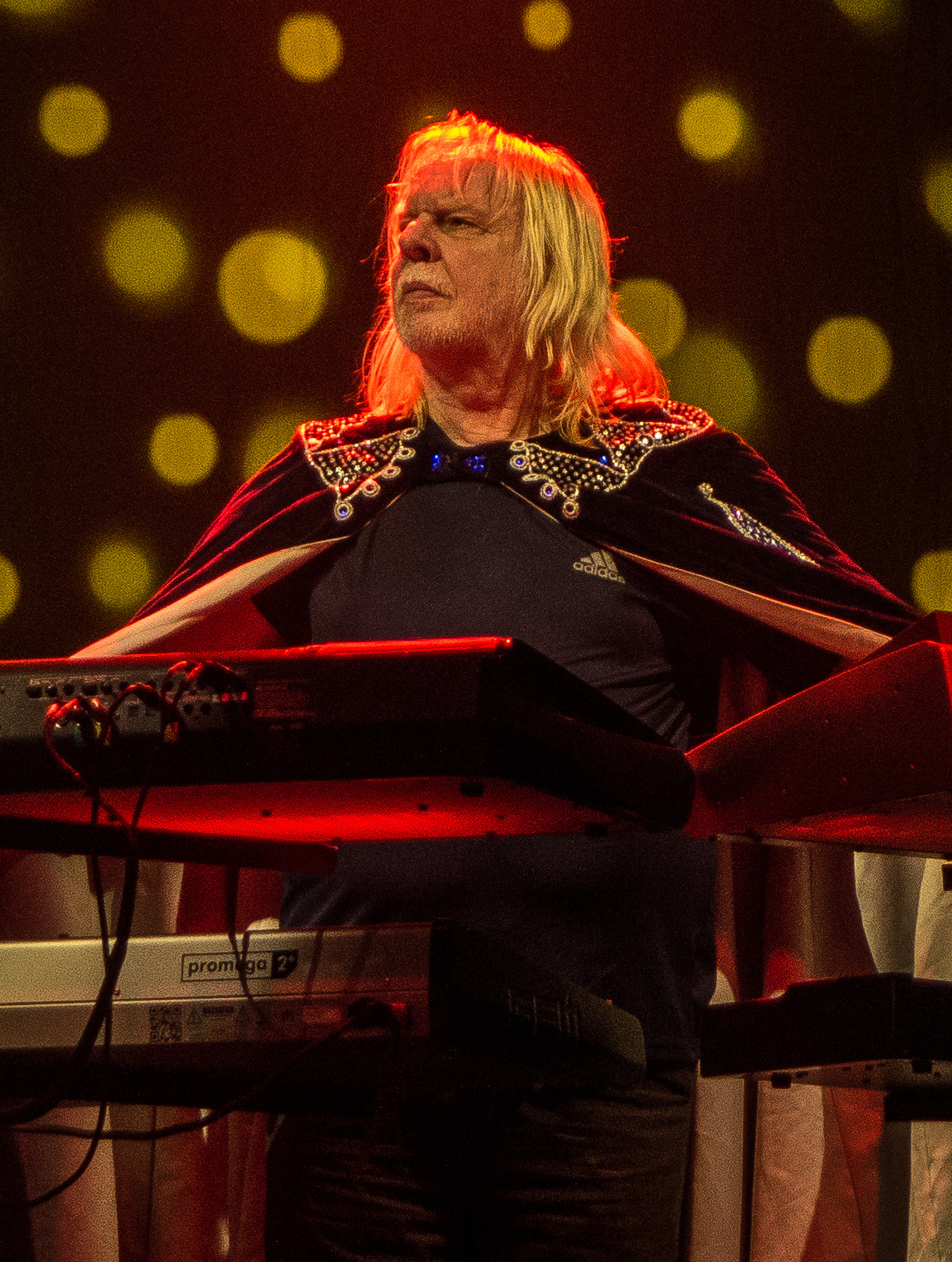
Richard Christopher Wakeman (born 18 May 1949) is an English keyboardist and composer best known for his multiple tenures in the progressive rock band Yes and for his prolific solo career, which has spanned six decades. His most successful and acclaimed albums are his first three progressive rock concept albums–The Six Wives of Henry VIII (1973), the UK number-one Journey to the Centre of the Earth (1974), and The Myths and Legends of King Arthur and the Knights of the Round Table (1975). AllMusic describes Wakeman as a "classically trained keyboardist extraordinaire who plied his trade with Yes and developed his own brand of live spectacular in a solo act." Born and raised in West London, Wakeman intended to become a concert pianist but quit the Royal College of Music in 1969 and became a sought after session musician. Amongst the estimated 2,000 sessions he did, he played on "Space Oddity" and "Life on Mars?" for David Bowie, "Morning Has Broken" by Cat Stevens, and on tracks for Elton John, Marc Bolan, and Lou Reed. After a brief stint in the folk rock group the Strawbs, during which he received national press attention, he joined Yes in 1971, playing on seminal albums such as Fragile (1971), Close to the Edge (1972) and Tales From Topographic Oceans (1973). His technical virtuosity on keyboards such as the Hammond organ, Moog synthesizer, and Mellotron, combined with his flamboyant stage presence and trademark capes, made him an iconic figure in 1970s progressive rock. In 1974, he formed his touring and recording band, the English Rock Ensemble, and in the following year, expanded into soundtrack work for Ken Russell's feature film Lisztomania (1975). Wakeman's subsequent career is characterised by its vast productivity and stylistic diversity, with a discography exceeding 100 solo albums. During the 1980s and 1990s, amidst shifting musical trends and personal financial strain, he transitioned toward low-budget albums for niche markets while maintaining a consistent presence as a live performer through band-led tours and one-man shows featuring music and anecdotal storytelling. This period saw Wakeman diversify into broadcasting and record label management, and pursued new musical directions with his first new-age and Christian music albums, Country Airs (1986) and The Gospels (1987), respectively. A commercial resurgence began with Return to the Centre of the Earth (1999), his first release to reach the UK Top 40 in 18 years, followed by a revisit of his three best-selling concept albums with new and expanded arrangements. His piano album Piano Portraits (2017) was his first UK Top 10 in 42 years. Throughout this time, Wakeman completed a total of five stints with Yes until 2004 and mostly recently performed in the offshoot band Yes Featuring Jon Anderson, Trevor Rabin, and Rick Wakeman from 2016 to 2020. In addition to music, Wakeman is a well-known media personality, recognised for his appearances on television shows such as Live at Jonguleurs, Countdown and Watchdog, and as a regular on the BBC comedy series Grumpy Old Men. He has published three books, presented a Saturday morning radio show on Planet Rock from 2005 to 2010, and has a podcast. He was inducted into the Rock and Roll Hall of Fame as a member of Yes in 2017, and was appointed a Commander of the Order of the British Empire (CBE) for his services to music and broadcasting in 2021.
Richard Christopher Wakeman was born on 18 May 1949 at Perivale Maternity Hospital in Perivale, Middlesex. He is the only child of Cyril Frank Wakeman and Mildred Helen Wakeman (née Eastment). The family lived in Wood End Gardens in nearby Northolt. Cyril worked at a building supplier, starting as an office boy at age 14 and working up to become one of its directors; he was also a pianist in Ted Heath's big band while serving in the British Army. Mildred worked at a removals firm. Wakeman attended Wood End Junior School until age ten, before moving on to Drayton Manor Grammar School in Hanwell, spending most of his summer holidays with his parents in Exmouth. Although raised in a Christian household where religion was never forced upon him, Wakeman enjoyed attending South Harrow Baptist Church. He took up the church organ at twelve, joined the Boys' Brigade, and completed a two-year course to qualify as a Sunday school teacher before he was baptised by immersion at eighteen. Wakeman was inspired to play the piano at the age of five. His parents, aunts and uncle had previously performed as a concert party troupe called The Wakeans until World War II caused them to disband. They occasionally revived the act in the front room on Sunday evenings, playing the piano and singing songs that Wakeman would listen to from his upstairs bedroom. He later recalled climbing out of bed to sit on the bottom of the stairs to listen, eventually being allowed to play a piece himself. "Everybody clapped, and I thought, I'll have some more of that, and refused to go back to bed." Sergei Prokofiev made a profound impression on him after his father took him to a concert performance of Peter and the Wolf around age eight, inspiring him to tell stories through music and making the Russian composer a lifelong hero. Other early musical influences included trad jazz musician Kenny Ball, skiffle singer Lonnie Donegan, and pianist Russ Conway, whose records were among his first purchases. His first keyboard was a simple reed organ bought from Woolworths. Between the ages of seven and eighteen, Wakeman took classical piano and theory lessons with Dorothy Symes in Harrow. His father spent nearly half of his income on the tuition. Wakeman passed each grade with distinction; Symes recalled him as "an enjoyable pupil to teach, full of fun and with a good sense of humour", though he often lacked the discipline to practise his scales and preferred adapting arrangements into his own style, revealing an early gift for composition. His first public performances were recitals organised by Symes for her pupils' parents, pieces he would fondly remember performing on stage decades later included "Buy a Broom" and "See a Monkey on a Stick". His natural showmanship also emerged early, when, at age ten, he played Conway's honky-tonk hit "Side Saddle" instead of his scheduled Clementi piano sonatina at the annual school talent show. That same year, Symes entered him into the Southall Music Festival, which he won in his category. Over the following years, he accumulated numerous awards on the London competition circuit; biographer Dan Wooding noted he earned over 100 certificates and 20 medals and cups. Wakeman described himself as "a horror" at Drayton Manor, noting that he worked hard in his first year before easing up. He passed O Level examinations in music, art, maths and English, and went on to study music, art, and British constitution at A-level, failing the latter. Jazz pianist Mike Westbrook served as his A-level art teacher, and Wakeman also played football for the school team.
Wakeman began his musical career performing in a variety of local jazz, blues, and dance ensembles during his teenage years in West London. At age twelve, he formed the traditional jazz outfit named Brother Wakeman and the Clergymen, followed in 1963 by a year-long residency with the Atlantic Blues at a rehabilitation club in Neasden—an experience he later credited with teaching him the essential discipline of playing in a group. Over the subsequent years, he played pop and dance standards with local groups such as the Concordes (later the Concorde Quartet), which featured his cousin Alan Wakeman on saxophone and clarinet, and the Green Dolphin Trio, which held a residency at the Brent council social club in Alperton. Earnings from these performances led to the purchase of his first electronic keyboard, a Hohner Pianet. In 1967, Wakeman joined the Ronnie Smith Band at the Top Rank ballroom in Watford, where he met vocalist Ashley Holt, who would become a frequent collaborator on his future solo projects. During this period, Wakeman also frequented jam sessions at the Red Lion pub in Brentford, performing alongside notable contemporary musicians including John Entwistle and Mitch Mitchell. These connections led to his first radio appearance when singer James Royal invited him to join a live BBC session alongside Entwistle and guitarist Mick King. In 1968, Wakeman secured a scholarship to the Royal College of Music in London, aiming to pursue a career as a concert pianist. His admission followed a period of intense study, having been forced to complete two years of curriculum in ten months. Though he initially enrolled in the performer's course, with piano as his primary study and clarinet, orchestration, and modern music as his second, he soon switched to the teacher's course after feeling intimidated by the technical standard of his peers. Despite this shift, his classical tenure provided foundational influences on his future progressive rock career when his orchestration professor, Philip Cannon, introduced him to Nikolai Rimsky-Korsakov's seminal textbook Principles of Orchestration. However, Wakeman's tenure at the college was marked by increasing friction with the institution's traditionalism. His proposals to establish a rock and jazz club were rejected, and he clashed with faculty over his appearance after refusing a professor's demand to cut his hair. Disillusioned with academia, Wakeman began neglecting his studies and spending time at the Musical Bargain Centre, a music shop in Ealing. The shop's owner, Dave Simms, recognised Wakeman's potential and employed him as a pianist in his own dance band. Wakeman's breakthrough into the professional recording industry occurred when guitarist Chas Cronk visited the shop seeking an organist and brass arranger for a session with Jimmy Thomas, a vocalist for the Ike & Tina Turner Revue. Simms recommended Wakeman, who attended the session at Olympic Studios where he met influential producers Denny Cordell, Gus Dudgeon, and Tony Visconti. Though he initially struggled with the technicalities of scoring for brass—incorrectly writing the parts in concert pitch—his playing style impressed Cordell, who subsequently offered Wakeman freelance session work for Regal Zonophone Records. This lucrative outside work provided a necessary supplement to his small student grant but directly violated the college's official rules against external professional engagements. Encouraged by his clarinet professor, Basil Tschaikov, to follow his professional momentum, Wakeman officially withdrew from the Royal College of Music in 1969 after one year of study.
Following his departure from the Royal College of Music, Wakeman secured a steady income by returning to the Ronnie Smith band at the Top Rank ballroom in Reading. This period proved significant personally as well as professionally; he met his first wife, Rosaline Woolford, at the venue, and the pair were engaged within three months. Later that year, Wakeman accepted a seven-day-a-week residency with the Spinning Wheel, the house band at The Greyhound pub in Chadwell Heath. This stable employment allowed him to leave his family home in Northolt and relocate with Woolford to a basement flat in nearby Ilford. To supplement his evening residencies, Wakeman worked as a freelance session musician during the day, embarking on a rigorous schedule that often encompassed three or four sessions daily across various London studios. Starting at a rate of £9 per full session, his reputation for efficiency and technical precision soon commanded fees of up to £15. His ability to deliver the required arrangements with minimal rehearsal earned him the nickname One Take Wakeman. He formed a prolific partnership with prominent session contractor David Katz, who frequently employed Wakeman as his primary pianist for television scores, including the theme tunes for The Avengers and Jason King.
Wakeman's transition into high-profile session work began in early 1969 with the psychedelic rock band Junior's Eyes. Under the production of Visconti and Cordell, he contributed to a non-album single and their debut LP, Battersea Power Station (1969). This collaboration proved a catalyst for his career; when Dudgeon sought a Mellotron player for David Bowie's "Space Oddity", Visconti—who had been impressed by Wakeman's technical facility—recommended him. The June 1969 session at Trident Studios showcased the efficiency that would define Wakeman's reputation. Dudgeon later recalled: "We did a run-through and Rick came in at the right place. And what he played was exactly what I wanted... We did one more take and it was a master. I thought, 'This is weird. This strange bloke... off he went, just like that, back to his ballroom job.'" For his performance on the track, which eventually peaked at number one in the UK in 1975, Wakeman was paid a standard session fee of £9. The recording garnered him his first media coverage: an interview with the Middlesex County Times. His contributions to Bowie's self-titled 1969 album extended to the B-sides "Wild Eyed Boy from Freecloud" and "Memory of a Free Festival". The professional bond between the two remained strong. In July 1970, Bowie supported Wakeman with an acoustic set at the White Hart pub in Acton. Intended to clear debts from the Booze Droop—a failing folk club residency Wakeman had organised—the performance was famously poorly attended; only a dozen people appeared, as many locals dismissed the advertisements as a hoax. Throughout this period, Wakeman's studio career continued to diversify. In a gesture of support, Visconti booked Wakeman for Marsha Hunt's cover of "I Walk on Guilded Splinters", tasking him with playing a single piano note solely to ensure he qualified for the session fee. The two also collaborated with Marc Bolan on a one-off project, releasing the single "Oh My Love" under the pseudonym Dib Cochran and the Earwigs. Around this time, Wakeman was approached by bassist Nick Simper to join Warhorse, a new project formed following Simper's departure from Deep Purple. Although he participated in several rehearsals, Wakeman departed before the band's first demo recordings, with Simper later attributing the split to Wakeman's struggle adapting to the band's hard rock direction. By the end of his session career, Wakeman had contributed to what is estimated to be approximately 2,000 sessions encompassing pop records, television and radio jingles, and film soundtracks. Despite his considerable financial success, he grew increasingly disillusioned with the industry. He felt constrained by the "hired hand" nature of the work, and the lack of creative input in the songwriting process left him artistically unfulfilled, prompting him to seek a permanent role within an established band.
In March 1970, Dave Cousins invited Wakeman to join the folk rock group Strawbs for a week's residency at a rock circus in Paris. Wakeman had previously contributed piano to their second album, Dragonfly (1970), the first recording to feature his name in the liner notes. Having married Woolford just weeks prior, Wakeman accepted the offer despite a reduction in pay, and the trip served as a working honeymoon. A notable incident occurred during one performance when surrealist artist Salvador Dalí made an unannounced guest appearance on stage; unaware of Dalí's identity, Wakeman accidentally pushed the artist off the platform to continue his keyboard solo. Wakeman's status shifted to that of a national star following the Strawbs' headline concert at London's Queen Elizabeth Hall on 11 July 1970. The performance, captured on the live album Just a Collection of Antiques and Curios (1970), showcased his technical virtuosity on the piano and Hammond organ. Two tracks in particular drew critical acclaim: "Where is This Dream of Your Youth", which featured an expansive, classically influenced organ solo, and "Temperament of Mind", a solo piano piece developed from improvisations used to entertain audiences during equipment failures. The performance earned a standing ovation and prompted a landmark front-page story in Melody Maker, which hailed Wakeman as "tomorrow's superstar" and the "pop find of 1970". During this period, he began developing the theatrical stage presence that would become his trademark, including the use of a screw-studded wooden plank to physically depress organ keys, allowing him to perform complex lead lines with both hands simultaneously. Wakeman maintained a prolific session schedule alongside his work with the Strawbs. He composed the theme tune to the BBC television show Ask Aspel and, in early 1971, provided the distinctive piano arrangement for Cat Stevens' UK top-ten hit "Morning Has Broken". Though initially uncredited, Stevens later apologised for the omission and, in 2002, arranged for a back-payment of royalties, which Wakeman donated to one of Stevens' educational charities. His studio versatility also led to collaborations with Elton John, with Wakeman contributing Hammond organ to Madman Across the Water (1971) and appearing as a guest performer at John's Royal Festival Hall concert that March. Despite these high-profile credits, Wakeman's finances remained precarious. Following a chance encounter with Bolan on Oxford Street while struggling to pay weekly rent, he recorded a series of piano glissandos for T. Rex's "Get It On" primarily to secure the session fee. However, his most significant artistic development occurred in June 1971, when Bowie invited him to his Beckenham home to audition material for his next album, Hunky Dory (1971). . Wakeman later described the songs, which included "Life on Mars?" and "Changes", as the finest selection of songs he had ever heard. His piano contributions became central to the album's sound, and he credited Bowie with teaching him essential studio craft. By mid-1971, Wakeman's session earnings allowed him to move to West Harrow and invest in new technology. He famously purchased a Minimoog synthesizer at half price from actor Jack Wild, who mistakenly believed the instrument was defective because it could only play one note at a time. During this period, the budget label Polydor released Piano Vibrations (1971), an album of pop and jazz covers featuring Wakeman alongside the John Schroeder orchestra and an unnamed singer; he was paid a flat fee of £36 and received no credit on the sleeve. Wakeman's final studio effort with the Strawbs was From the Witchwood, released in July 1971. The recording process exposed a growing creative rift; Cousins rejected Wakeman's songwriting contributions as overly complex and deemed his lyrics "awful", while Wakeman began prioritising session work over band rehearsals. Tensions peaked during a Top of the Pops performance of "The Hangman and the Papist", where Wakeman's flamboyant use of a paint roller to play his organ frustrated Cousins. Recognising that his interest in the band's folk direction had waned, Wakeman prepared to leave the group and briefly considered assembling his own band.


