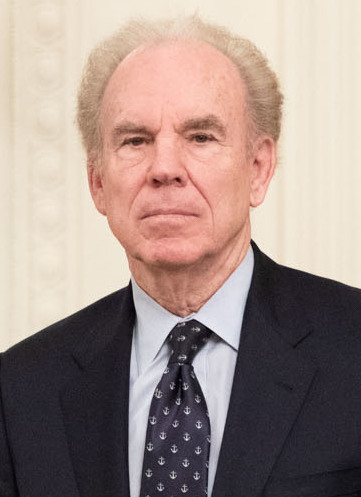
Background and career
Roger Thomas Staubach (, -; STAW-bahk, -back; born February 5, 1942), nicknamed "Roger the Dodger", "Captain America", and "Captain Comeback", is an American former professional football quarterback who played in the National Football League (NFL) for 11 seasons with the Dallas Cowboys. He attended the U.S. Naval Academy, where he played college football for the Navy Midshipmen and won the 1963 Heisman Trophy. After graduation, he served in the U.S. Navy, including a tour of duty in Vietnam. Staubach joined the Dallas Cowboys in 1969, becoming the team's second major franchise quarterback after the retirement of Don Meredith in 1968. Staubach played with the Cowboys during his entire career. He led the team to the Super Bowl five times, four as the starting quarterback. He led the Cowboys to victories in Super Bowl VI and Super Bowl XII. Staubach was named Most Valuable Player of Super Bowl VI, becoming the first of four players to win both the Heisman Trophy and Super Bowl MVP, along with Jim Plunkett, Marcus Allen, and Desmond Howard. He was named to the Pro Bowl six times during his 11-year NFL career. Staubach is one of ten players to both win the Heisman Trophy and be elected to the Pro Football Hall of Fame, and the only quarterback. Upon his retirement Staubach founded The Staubach Group, a commercial real estate firm that he later sold to Jones Lang LaSalle for $613 million in 2008. He then became executive chairman of the Americas region of Jones Lang LaSalle until his retirement in 2018. That same year, he received a Presidential Medal of Freedom.
Staubach was born in Cincinnati, Ohio, the only child of Elizabeth (née Smyth) and Robert Staubach. His father was a shoe and leather salesman and his mother worked as a secretary for General Motors. He is of partial German descent, and grew up in Silverton, a northeastern suburb of Cincinnati. He was a Boy Scout as a youth, attended St. John the Evangelist Catholic School, and graduated from the Catholic high school Purcell High School in Cincinnati (now named Purcell Marian High School) in 1960.
To prepare for his naval career, Staubach spent a year at New Mexico Military Institute in Roswell, where he set a school record for passing yards and scored 18 total touchdowns. Appointed by US Representative Donald D. Clancy, Staubach entered the U.S. Naval Academy in 1961 and played quarterback for the Midshipmen. As a third-class midshipman (sophomore) in 1962, he got his first opportunity to play, in the first game of the season, against Penn State.
A week later, playing against Cornell University, with the offense failing, coach Wayne Hardin decided to put Staubach into the game to see if he could improve the team's offense. He led Navy to six touchdowns, throwing for 99 yards and two touchdowns, while running for 88 yards and another score as Navy won 41–0. A few weeks later, Staubach started again in the famous Army–Navy game. President John F. Kennedy attended the game, performing the coin toss. Staubach led the team to a 34–14 upset over Army, throwing for two touchdowns and running for another. In his second class (junior) season of 1963, he led college football in completion percentage and won the Heisman Trophy, Maxwell Award, and the Walter Camp Memorial Trophy while leading the Midshipmen to a 9–1 regular season record and a final ranking of No. 2 in the nation. He appeared on the cover of Time in October; he would also have been on the cover of Life magazine's issue of November 29, 1963, but for the assassination of President Kennedy. Staubach and the Midshipmen won the 1963 Army–Navy Game. On New Year's Day, the Midshipmen lost the national championship to the No. 1 team, the University of Texas, in the 1964 Cotton Bowl. Earlier that season, Staubach led Navy to a 35–14 road victory in its annual rivalry with Notre Dame. Navy did not beat Notre Dame again until 2007, 43 years later. During three seasons at Navy, Staubach completed 292 of 463 passes with 18 touchdowns and 19 interceptions, while gaining a school-record 4,253 yards of total offense. Staubach is the last player from a military academy to win the Heisman Trophy. As a senior in 1964, he injured his left heel in the opening game victory over Penn State and missed the next four games, and Navy finished the season at 3–6–1. The Naval Academy retired Staubach's jersey number (12) during his graduation ceremony after his senior season. In 1981, Staubach was enshrined in the College Football Hall of Fame. In 2007, Staubach was ranked No. 9 on ESPN's Top 25 Players In College Football History list.
After his collegiate football career ended, Staubach also concluded his time at the Academy with a standout baseball season in 1962, where he batted .420, served as captain of the baseball team in 1965, and played for the school's basketball team.
During his junior year at the Naval Academy, Staubach's color blindness was detected and he was commissioned directly into the Supply Corps, which did not require being able to tell the difference between red (port) and green (starboard) lights or to discern the color differences in electrical circuitry. After graduating from the Naval Academy in June 1965, Staubach could have requested an assignment in the United States, but he chose to volunteer for a one-year tour of duty in South Vietnam. He served as a Supply Corps officer for the Navy at the Chu Lai Base Area until 1967. Staubach supervised 41 enlisted men. Staubach returned from South Vietnam in September 1967, and spent the rest of his naval career in the United States. He played football on various service teams to prepare for his future career in the National Football League. During his tour at the Naval Air Station Pensacola in Florida, he quarterbacked the Pensacola Navy Goshawks, a team consisting of fellow U.S. Navy officers, and played games against college football teams. He had access to the Dallas Cowboys playbook, and the Goshawks defeated many of the college teams they played against. Among his opponents was Youngstown State University, who had future actor Ed O'Neill on the defensive line.


