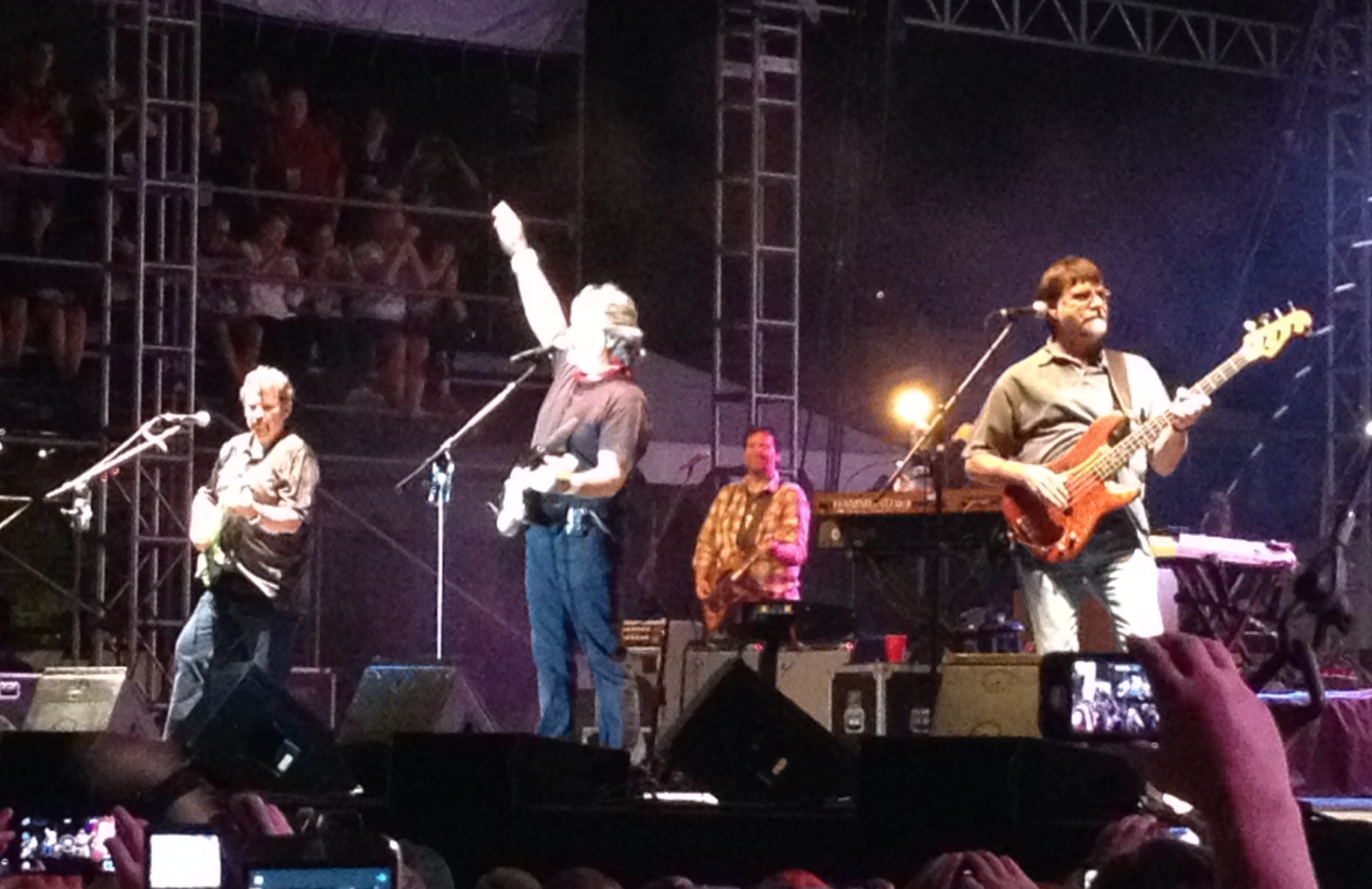
Background and career
Ronald Douglas Montrose (November 29, 1947 – March 3, 2012) was an American guitarist who founded and led the rock bands Montrose and Gamma. He also performed and did session work with a variety of musicians, including Van Morrison, Herbie Hancock, Beaver & Krause, Boz Scaggs, Edgar Winter, Gary Wright, The Beau Brummels, Dan Hartman, Tony Williams, The Neville Brothers, Marc Bonilla and Sammy Hagar. Montrose's 1973 debut album has often been cited as "America's answer to Led Zeppelin". Ronnie Montrose is often recognized as one of the most influential guitarists in early hard rock.
Montrose was born in San Francisco, California. When he was a toddler, his parents moved back to his mother's home state of Colorado (his father was from Bertrand, Nebraska, and his mother was from Golden, Colorado). He spent most of his younger years in Denver until he ran away at about 16 years old to pursue his musical career. Ultimately he spent most of his life in the San Francisco Bay area.
In late 1968, Montrose joined the San Francisco–based band Sawbuck, whose lineup at the time included Mojo Collins (vocals, guitar), Starr Donaldson (guitar), Chuck Ruff (drums), and Bill Church (bass).[1] Sawbuck was signed to Fillmore Records, the label co‑owned by producer David Rubinson and promoter Bill Graham, and performed throughout 1969–1970, opening for major acts.[2] The group was active locally, performing around the Bay Area while Montrose also worked independently as a carpenter. Through that work he met Bill Graham and producer David Rubinson, after being hired to build office partitions and sheetrock at their Fillmore Records offices. Montrose developed a working relationship with Rubinson, who allowed Sawbuck to rehearse in the Fillmore offices at night in exchange for Montrose’s carpentry work.
By late 1970, Sawbuck began recording what would become their self‑titled debut album. During these sessions Rubinson's secretary arranged an audition for Montrose with Van Morrison, who was assembling a new band for Tupelo Honey. Both Montrose and Church left Sawbuck to join Morrison, but each returned briefly as guest musicians during the completion of the Sawbuck album.[3] They appear on two tracks each, with one track featuring both of them together.[4] The album was released in 1972 with the final credited lineup of Mojo Collins, Starr Donaldson, Chuck Ruff, Nineyear Wooldridge (bass), and Stephen Hatley (keyboards).[5]
In 1971, Montrose auditioned for Van Morrison at the Lion Share club in San Anselmo, California. He later recalled that David Rubinson’s secretary phoned him unexpectedly and asked whether he would like to “play with Van Morrison,” which Montrose initially misunderstood as an invitation for his band to open a show. At the audition he found a dozen guitarists waiting, but said he felt a sudden certainty that he would be hired. When Morrison asked whether he knew “Domino,” Montrose improvised through the song, after which Morrison immediately offered him the job. Montrose said Morrison reacted warmly when he mentioned he was from Denver, explaining that as a child in Belfast he had been fascinated with American “cowboy” imagery brought home by his father, a sailor or Merchant Marine.Montrose later recounted that while they were touring with the J. Geils Band, J. Geils told him that Morrison had phoned and said, “Well, I got a cowboy,” pleased to have an American Western‑type guitarist in the lineup. The album opens with "Wild Night", a hybrid of R&B, soul and country music influences, which uses a moderate 44 time signature and features the lead guitar playing of Ronnie Montrose. The song's intro was created, according to Montrose, when "One afternoon I was messing around with what is now the intro on the record, [Van] stopped me and ... said ' ... that thing you just played ... that's the intro, don't forget it'". This guitar-driven intro in Clinton Heylin's opinion made it one of Morrison's most memorable singles. "Wild Night", which has been described by biographer Ken Brooks as "a great start to the album", was first recorded after the Astral Weeks sessions in Autumn 1968 and was re-recorded numerous times before its eventual release on Tupelo Honey. Morrison recalled during an interview that the song was originally "a much slower number, but when we got to fooling around with it in the studio, we ended up doing it in a faster tempo." According to WOAS – Woodshed of American Sound, a regional music‑history publication, tension developed between Montrose and Morrison during touring for Tupelo Honey. Bassist Bill Church recalled that the relationship soured after he and Montrose stepped to the front of the stage during a performance at UCLA’s Pauley Pavilion, an action Morrison strongly disapproved of; Church’s misstep was excused because he was taking pain medication, but Montrose’s was not. The article also reports the long‑circulated account that Morrison eventually told Montrose, “When the bus stops, somebody’s gotta get off,” effectively dismissing him mid‑tour. Montrose and Church also played on “Listen to the Lion,” recorded during the Tupelo Honey sessions and later released on Morrison’s Saint Dominic's Preview (1972). Two additional tracks from the same sessions featuring Montrose, “Ordinary People” and “Wonderful Remark,” remained unreleased until they appeared on the archival compilation The Philosopher's Stone (1999).[6]
Montrose played briefly with Boz Scaggs before joining the newly formed Edgar Winter Group in 1972. Winter assembled the lineup of Dan Hartman, Ronnie Montrose, and Chuck Ruff in late 1972 for what became the band’s breakthrough album, They Only Come Out at Night. Montrose’s recruitment of Ruff effectively ended the remnants of Sawbuck, the band they had both previously played in. Released in November 1972, They Only Come Out at Night peaked at No. 3 on the Billboard 200 and remained on the charts for 80 weeks. The album produced two major hits: the No. 1 instrumental "Frankenstein" and "Free Ride", written and sung by Hartman. Montrose recorded electric guitar, acoustic 12‑string, and mandolin on the album. According to drummer Chuck Ruff, Montrose left the Edgar Winter Group shortly afterward due to conflicts with manager Steve Paul: “Ronnie Montrose left the band because he and Steve Paul did not get along at all. They were gonna call a big meeting and fire him. I told Ronnie, so before they could do that he quit.” The later single version of “Free Ride,” released in August 1973 and running 3:05, features a noticeably different guitar solo. Ruff stated that the band “re‑recorded ‘Free Ride’ two or three times with Rick Derringer and Jerry Weems,” resulting in the revised single mix.
Sources
Net-worth figure: Celebrity Net Worth (October 2026), in USD. Biography and career facts: the person's Wikipedia article and linked reporting. Snapshot date for all StarWorth figures: 28 October 2026.