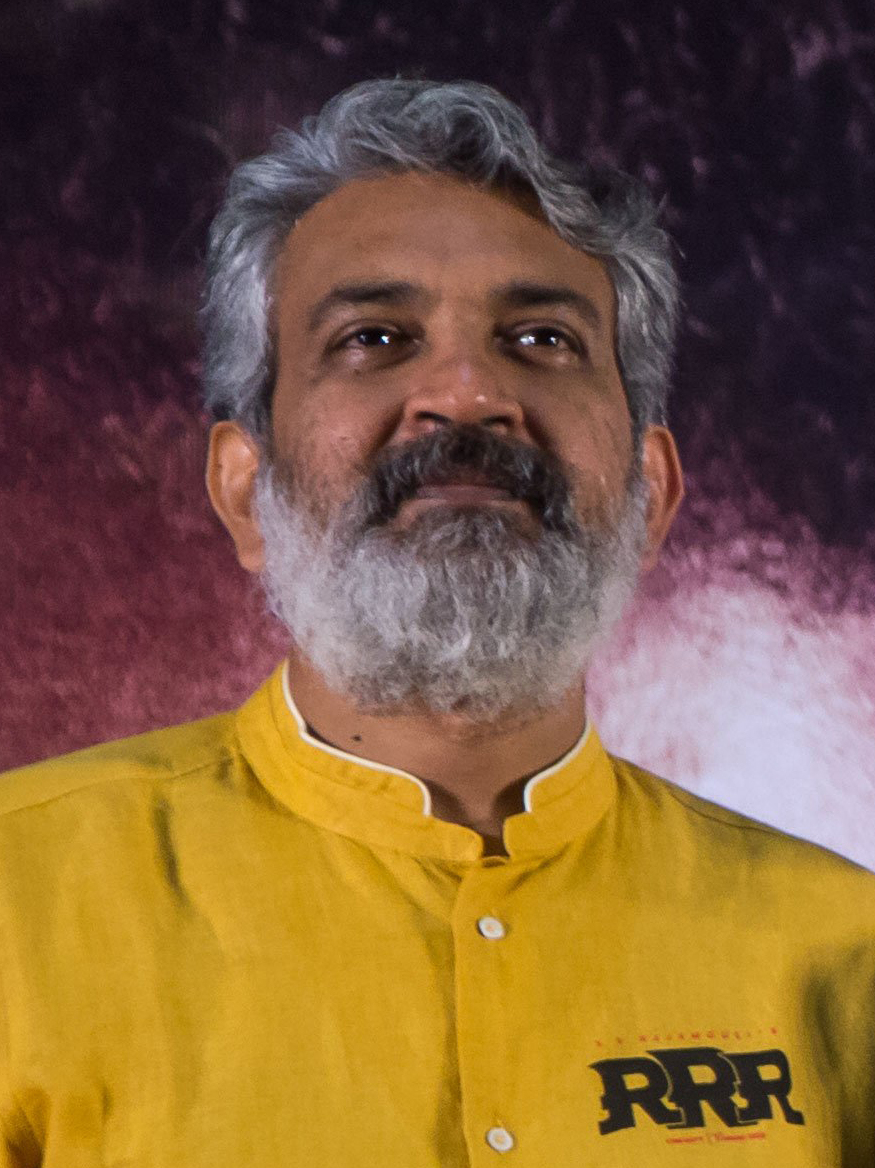
Background and career
Koduri Srisaila Sri Rajamouli ( RAH-juh-mow-li, Telugu: [koːɖuːɾi sriːsɐi̯lɐ sriː ɾaːdʒɐmɐu̯ɭi]; born 10 October 1973), is an Indian film director and screenwriter who works in Telugu cinema. Known for his epic, action drama, and fantasy genre films, he is one of the most prolific and the highest-paid directors in Indian cinema. Rajamouli is a recipient of various national and international honours including a New York Film Critics Circle award, a Critics' Choice Movie Award, two Saturn Awards, four National Film Awards, five Nandi Awards, and five Filmfare Awards. In 2016, the Government of India honoured him with the Padma Shri, for his contributions in the field of art. In 2023, he was included on the Time's list of the 100 most influential people in the world. In 2026, his name was permanently added to the Mur des Cinéastes (the wall of filmmakers) at the prestigious Institut Lumière in Lyon, France, known as the birthplace of cinema. Rajamouli has been described by film trade analyst Komal Nahta as "the biggest Indian film director ever" and by SOAS professor Rachel Dwyer as "India's most significant director today". He has directed twelve feature films, all of which have been box office successes. Three of his films—Baahubali: The Beginning (2015), Baahubali 2: The Conclusion (2017), and RRR (2022)—rank among the top 15 highest grossing-films in India. Each of these films was the most expensive Indian production at the time of its release. Baahubali 2 became the first Indian film to gross over ₹10 billion and held the record as the highest-grossing Indian film. It also sold over 100 million tickets, the highest for any film in India since Sholay (1975). The 2009 fantasy action film, Magadheera was the highest-grossing Telugu film ever at the time of its release. Eega (2012) won nine awards at the Toronto After Dark Film Festival, including the Most Original Film. Baahubali films have received six Saturn Award nominations with Baahubali 2 winning the Best International Film. RRR received various international accolades including an Academy Award and a Golden Globe Award for the song "Naatu Naatu", and a Critics' Choice Movie Award for Best Foreign Language Film. Rajamouli's films are typically characterized by their epic grandeur, stylized action sequences, unbridled heroism and larger-than-life characters with historical and mythological references. His films have been noted for their integration of CGI with practical effects. With his Baahubali films, he has pioneered the pan-Indian film movement. He is also credited for expanding the market of Telugu cinema and South Indian cinema into Northern India and international markets.
Koduri Srisaila Sri Rajamouli was born on 10 October 1973 in a Telugu family to V. Vijayendra Prasad and Raja Nandini. His parents were staying in Amareshwara Camp in Raichur district of Mysore State (present-day Karnataka) at the time of his birth. Both his parents hail from Andhra Pradesh — his father from Kovvur near Rajahmundry and his mother from Visakhapatnam. Rajamouli's father is a Kamma and his mother belonged to Kapu caste. Rajamouli's parents are ardent devotees of Lord Shiva. He was born after his mother had a dream when she visited the pilgrimage site of Srisailam. Hence, he was named Srisaila Sri Rajamouli. He has one elder sister who now lives in Australia. Rajamouli grew up in a joint family — his father and his five brothers lived in the same house with their families. Prasad's family had lands in Kovvur, which were lost when the railways lines were laid through them. Then, Prasad and his family moved to Karnataka from Kovvur in 1968. Prasad, along with his elder brother K. V. Sivashankar, bought seven acres of paddy fields in Hirekotikal village near Manvi in Raichur district. Their family moved back to Kovvur in 1977. Rajamouli was educated in Kovvur till fourth standard and then shifted to Eluru where he studied till Intermediate first year. He then took a break of two years and finished his Intermediate second year in Kovvur. After that, he did not pursue any further formal education. Rajamouli was passionate about storytelling right from his second standard. When he was seven years old, his grandmother introduced him to the epic story Ramayana, Mahabharata, and Bhagavata. At the same age, his father introduced him to Amar Chitra Katha comics that featured stories on Indian historical figures, religious legends and folktales. It had a huge impact on him and developed his penchant for larger-than-life characters. He would remember those stories and the films he watched and then re-tell them to his friends in his own way. His mother was keen on him learning English and would take him to watch English-language films in the nearby towns. She encouraged him to read comics and storybooks in his free time and never pressured him in academics. His father recollecting about Rajamouli's childhood noted, "he was not an ambitious child. For a long time, we did not know what interested him. He showed some inclination towards films. He played the role of young Krishna in a film I directed." Rajamouli's paternal grandfather was a wealthy landlord who owned 360 acres of land. By the time Rajamouli was 10 or 11 years old, they lost much of their wealth. As his father Vijayendra Prasad and uncle Siva Shakthi Datta were passionate about filmmaking, they sold most of their remaining assets and shifted to Madras to make films. They started many films that went unfinished. They faced financial losses and started working as ghostwriters to make ends meet. Thirteen members of his extended family started living in a two-room apartment in Madras. Rajamouli recollects his family sitting together and making fun of themselves and their condition at the time, but they were never sad about it.
Later Prasad established himself as a screenwriter with films like Bobbili Simham (1994) and Gharana Bullodu (1995). Wanting to make another film, his father then co-produced (along with Katragadda Prasad) and directed a film called Ardhangi (1996) with his life savings. Rajamouli recalls about that film:I was very actively involved in the project as an associate director. I felt that film was my child, even though I didn't direct the film. It was a miserable failure. My family went into a debt trap. It took us years to pick up and put the pieces together. All of that strongly stayed in my mind. That was a very low period for me. I then decided to never take anything for granted. It imbibed in me the work ethic to make everything perfect and interesting for the audience, no matter how small or unimportant that scene or shot might be. That lowest phase of my life taught me how I should work later on in my career.
Rajamouli started his film career as an apprentice since mid-1990s to the veteran film editor Kotagiri Venkateswara Rao and worked with him for six months. Rajamouli recollects, "Even in my early 20s, I didn't know how to plan for my future. My father would constantly scold me for doing nothing. I joined films just to get away from his nagging. Slowly, I found my love for direction." He worked at AVM recording theatre in Chennai for a few days. He also worked as an assistant director to Kranthi Kumar for some time. Then, he assisted his father Vijayendra Prasad for six years. He started writing for films but was always disappointed by the execution of his stories by other directors. His frustration as a writer motivated him to become a director so that he can bring out his vision as a writer perfectly onto the screen.
He then shifted to Hyderabad from Chennai and worked with his relative, Gunnam Gangaraju, from whom he learnt about the practical aspect of filmmaking. Later under the supervision of K. Raghavendra Rao, he directed social message-oriented commercials. He also directed a few advertisements for the Telugu Desam Party. He then worked for one and a half years as the director of the Telugu TV serial, Santhi Nivasam, along with Vara Mullapudi, which was produced by Raghavendra Rao. It aired on ETV. In an interview in 2005, Rajamouli called it the most arduous period in his life as he used to work for 17 hours a day. He recalled:"My main aim while working in television was to get Mr Rao's approval. During my TV days, I didn't have much of an idea of what I was making. The good thing was that I was a hard worker, and I earned the nickname work devil."
In 2001, Raghavendra Rao offered Rajamouli the chance to direct a feature film for his production house titled, Student No: 1, which the latter accepted. Raghavendra Rao provided the screenplay in addition to supervising the direction. Rajamouli later regretted not working for a longer time as an assistant director. "When I made my first film Student No: 1, I didn't know how to use a crane because I never used a crane while I was doing my TV serial." Student No:1 was a coming of age romantic action film and was the second film of NTR Jr. in a lead role. Rajamouli would go onto collaborate with NTR Jr. in three more films. Released on 27 September 2001, the film marked the official debut of SS Rajamouli as a director; the film went on to become a critical and commercial success, and was NTR Jr.'s first successful film. Rajamouli's second film was Simhadri (2003), again with NTR Jr. After his first film, he realised that the kind of films he wanted to make had more drama and action, and so he made Simhadri, an action film. It marked Rajamouli's first collaboration with his father Vijayendra Prasad who provided the story. Simhadri was also the first film penned by Rajamouli. The film emerged as a blockbuster and became one of the highest grossing Telugu films ever at the time. In the two-year gap between Student No.1 and Simhadri, Rajamouli planned his first mythological film with Malayalam actor Mohanlal, but the film eventually got shelved. In 2015, Assistant art director Manu Jagath, who later worked as the art director for Baahubali, released several sketches he had drawn for the shelved Mohanlal project. During the same period he was also supposed to direct a fantasy film with Prakash Kovelamudi as the lead but the film was shelved due to financial reasons. Rajamouli's third film was Sye (2004), starring Nithin and Genelia. He recalls, "I got plenty of offers after the success of Simhadri. But I deliberately made a decision not to make an emotionally charged mass film like Simhadri immediately. I don't want to get branded as mass director. Hence I did Sye, which is radically different compared to Simhadri." It was a first-of-its-kind film in Telugu cinema, in that it was based on the sport of Rugby. This film was also the first instance where Rajamouli collaborated with K. K. Senthil Kumar who would eventually work with him on seven more films. Sye was commercially successful and won four Nandi Awards. Sye made a huge impact on the Telugu popular culture through its popularisation of Rugby to the masses. His next venture was Chatrapathi (2005), an action drama set in Vizag dealing with the plight of refugees. Chatrapathi starred Prabhas in the lead role with music composed by M. M. Keeravani and cinematography by Senthil Kumar. It was Rajamouli's fourth consecutive hit and became one of the highest grossing Telugu films of the year. In his next project Vikramarkudu (2006), Rajamouli worked with Ravi Teja and Anushka Shetty. Rajamouli was attacked during the shooting of the film near Nanakramguda in Hyderabad. He suffered a hairline fracture on his hand and was admitted into a nearby Apollo hospital. Vikramarkudu was a breakthrough film for Anushka Shetty. The film was screened at the International Film Festival of India in the mainstream section. The film was a big success and was remade into several Indian languages including Kannada as Veera Madakari (2009), Tamil as Siruthai (2011), and Hindi as Rowdy Rathore (2012). He then directed Yamadonga (2007), a fantasy action comedy film starring NTR Jr., Priyamani, Mohan Babu, and Mamata Mohandas. The plot follows Raja, a thief who is killed by his rivals. Raja's soul travels to Naraka (hell) to face the trial for his sins by Yama, the Hindu god of death and justice. The film was successful at the box-office and became one of the highest grossing Telugu films ever at the time. Rajamouli started his own production company Visvamithra Creations named after the ancient Indian sage Visvamitra. Prabhas acted as Visvamitra for the logo shoot of the company. Yamadonga was produced under the Visvamithra Creations banner but the producers were Cherry and Urmila Gunnam with Rama Rajamouli presenting the film.


