Background and career
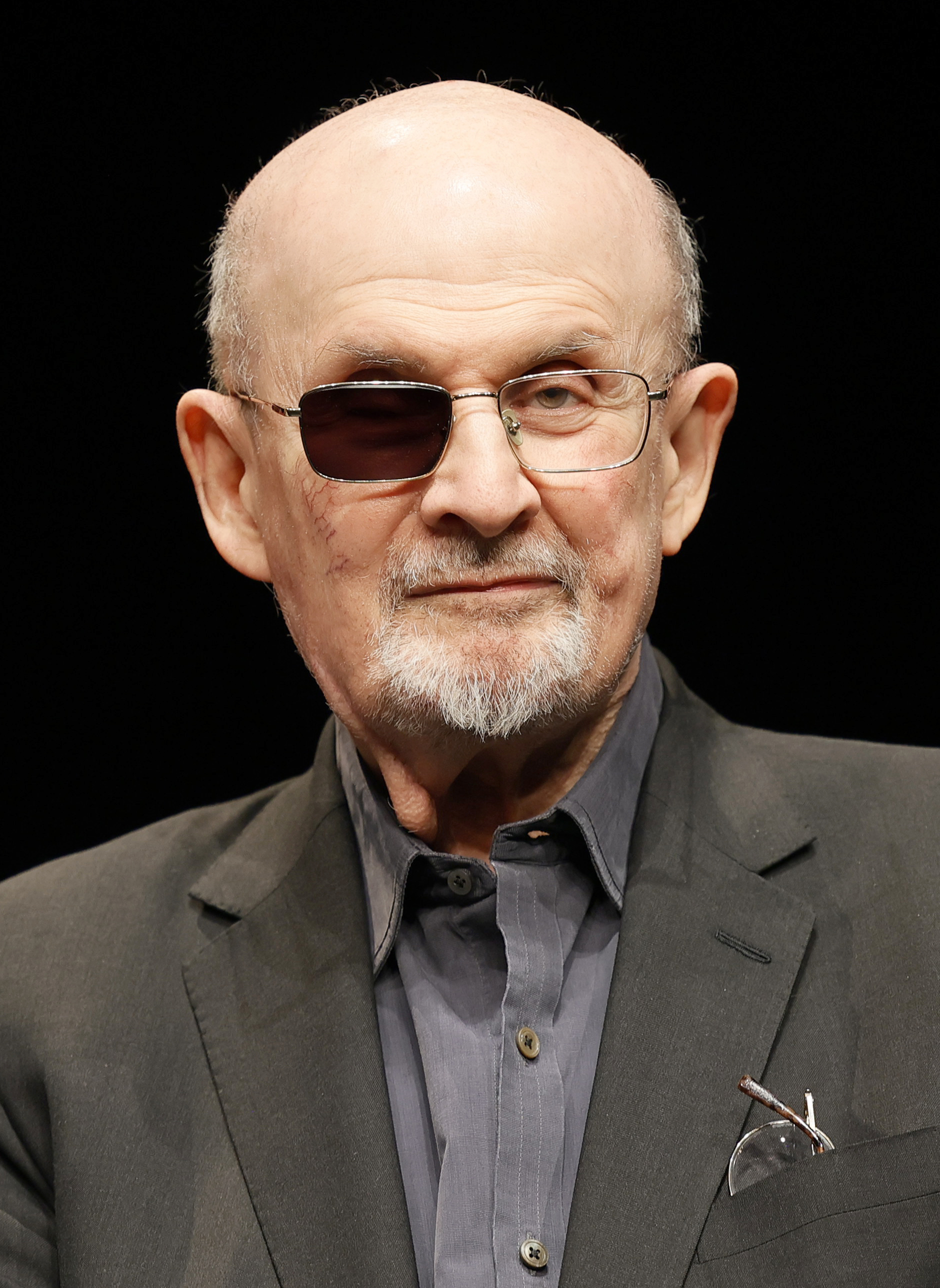
Sir Ahmed Salman Rushdie (born 19 June 1947) is an Indian-born British and American novelist. His work often combines magical realism with historical fiction and primarily deals with connections, disruptions, and migrations between Eastern and Western civilizations. His novels are typically set on the Indian subcontinent, feature an Indian protagonist, and/or portray Indian familial relationships. Rushdie's second novel, Midnight's Children (1981), won the Booker Prize in 1981 and was deemed to be "the best novel of all winners" on two occasions that marked the 25th and the 40th anniversary of the prize. After his fourth novel, The Satanic Verses (1988), Rushdie became the subject of several assassination attempts and death threats because of what was seen by some to be an irreverent depiction of Muhammad. The controversy involving the Satanic Verses included a fatwa calling for his death issued by Ruhollah Khomeini, the supreme leader of Iran. The book was banned in 20 countries. Numerous killings and bombings have been carried out by extremists who cited the book as motivation, sparking a debate about censorship and religiously motivated violence. In 2022, Rushdie survived a stabbing at the Chautauqua Institution that led to loss of his right eye and inflicted damage to his liver and hands. Rushdie was educated at King's College at the University of Cambridge, where he graduated with a degree in history in 1968. In 1983, Rushdie was elected a fellow of the Royal Society of Literature. He was appointed a Commandeur de l'Ordre des Arts et des Lettres of France in 1999. Rushdie was knighted in 2007 for his services to literature. In 2008, The Times ranked him 13th on its list of the 50 greatest British writers since 1945. Rushdie was named Distinguished Writer in Residence at the Arthur L. Carter Journalism Institute of New York University in 2015. Earlier, he taught at Emory University. In 2008, he was elected to the American Academy of Arts and Letters. In 2012, Rushdie published Joseph Anton: A Memoir, an account of his life in the wake of the events following The Satanic Verses. He was named one of the 100 most influential people in the world by Time magazine in April 2023. Since 2000, Rushdie has lived in the United States. He has been married five times. From 2004 to 2007, he was married to Indian-American television presenter and model Padma Lakshmi.
Rushdie was born into a Kashmiri Muslim family on 19 June 1947 in Bombay, now known as Mumbai, in British India. He is the son of Anis Ahmed Rushdie, a Cambridge-educated lawyer-turned-businessman, and Negin Bhatt, a teacher. His father was dismissed from the Indian Civil Services (ICS) after it emerged that the birth certificate submitted by him had changes to make him appear younger than he was. Rushdie has three sisters. He wrote in his memoir, Joseph Anton, that his father adopted the name Rushdie in honour of Ibn Rushd. Rushdie recalled his "first literary influence": "When I first saw The Wizard of Oz it made a writer of me." He recalled: "Every child in India in my day (and probably still) was obsessed with P. G. Wodehouse and Agatha Christie. I read mountains of books by both." Rushdie has his ancestral home built by his grandfather named Anees Villa in Solan, Himachal Pradesh. Rushdie also recalled that "Alice captured my imagination as few other books did: both the books, not just Alice's Adventures in Wonderland but Through the Looking-Glass as well, and I can still recite the whole of "Jabberwocky" and "The Walrus and the Carpenter" from memory. I also loved the Swallows and Amazons series by Arthur Ransome because of the unimaginable freedom those young people sailing in the Lake District were given by their families ... When I was 16, I read The Lord Of The Rings and became obsessed, and can still recite the inscription on the Ruling Ring ('One ring to rule them all...') in the dark language of Mordor. I read an astonishing amount of Golden Age science fiction, not just Ray Bradbury, Arthur C. Clarke and Kurt Vonnegut but more arcane writers like Clifford D. Simak, James Blish, Zenna Henderson and L. Sprague de Camp." He has written about his family following the Indian custom of kissing holy books if they were dropped on the floor. "But we kissed everything. We kissed dictionaries and atlases. We kissed Enid Blyton novels and Superman comics. If I'd ever dropped the telephone directory I'd probably have kissed that, too." While in India, Rushdie was educated at the Cathedral and John Connon School. He immigrated to England in 1961 and attended Rugby School. He then attended Cambridge as an undergraduate student at King's College, graduating in 1968 with a Bachelor of Arts degree in history.
Rushdie worked as a copywriter for the advertising agency Ogilvy & Mather, where he came up with "irresistibubble" for Aero and "Naughty but Nice" for cream cakes, and for the agency Ayer Barker (until 1982), for whom he wrote the line "That'll do nicely" for American Express. Collaborating with musician Ronnie Bond, Rushdie wrote the words for an advertising record on behalf of the now defunct Burnley Building Society that was recorded at Good Earth Studios, London. The song was called "The Best Dreams" and was sung by George Chandler. It was while at Ogilvy that Rushdie wrote Midnight's Children, before becoming a full-time writer. Rushdie was a personal friend of Angela Carter's, calling her "the first great writer I ever met".
Rushdie's works are often categorized as postmodern, particularly within the tradition of Magic Realism. However, they also reveal early signs of a literary and cultural shift beyond postmodernism. In our contemporary world – saturated with reality TV, talk shows and other forms of pure entertainment – apathy, passivity and inaction have become defining features. Jeffrey T. Nealon identifies this prevailing sense of disengagement as a hallmark of the post-postmodern condition, which is sometimes referred to as metamodernism: "we post-postmodern capitalists are trained by our media masters to watch rather than act, consume rather than do."
Rushdie's debut, the science fiction tale Grimus (1975), was considered for a science-fiction award by Kingsley Amis, Arthur C Clarke and Brian Aldiss, but was otherwise unsuccessful. His next novel, Midnight's Children (1981) follows the life of Saleem Sinai, born at the stroke of midnight as India gained its independence, who is endowed with special powers and a connection to other children born at the birth of the modern nation of India. Sinai has been compared to Rushdie. However, Rushdie refuted the idea of having written any of his characters as autobiographical, stating, "People assume that because certain things in the character are drawn from your own experience, it just becomes you. In that sense, I've never felt that I've written an autobiographical character." Rushdie writes of his "debt to the oral narrative traditions of India and also to the great novelists Jane Austen and Charles Dickens—Austen for her portraits of brilliant women caged by the social convention of their time, women whose Indian counterparts I knew well; Dickens for his great, rotting, Bombay-like city, and his ability to root his larger-than-life characters and surrealist imagery in a sharply observed, almost hyperrealistic background." Shortly after its publication, V. S. Pritchett wrote: "In Salman Rushdie, the author of Midnight's Children, India has produced a glittering novelist—one with startling imaginative and intellectual resources, a master of perpetual storytelling. Like García Marquez in One Hundred Years of Solitude, he weaves a whole people's capacity for carrying its inherited myths—and new ones that it goes on generating—into a kind of magic carpet. The human swarm swarms in every man and woman as they make their bid for life and vanish into the passion or hallucination that hangs about them like the smell of India itself. Yet at the same time there are strange Western echoes, of the irony of Sterne in Tristram Shandy—that early nonlinear writer—in Rushdie's readiness to tease by breaking off or digressing at the gravest moments. This is very odd in an Indian novel! The book is really about the mystery of being born and the puzzle of who one is." Midnight's Children won the 1981 Booker Prize and, in 1993 and 2008, the Best of the Bookers and Booker of Bookers special prizes. In 2003, Rushdie worked with Tim Supple and Simon Reade on a stage adaptation of the novel. After Indian premier Indira Gandhi sued Rushdie for defamation over a portion regarding her, he removed the portion. After Midnight's Children, Rushdie depicted the political turmoil in Pakistan with Shame (1983), basing his characters on Zulfikar Ali Bhutto and General Muhammad Zia-ul-Haq. Shame won France's Prix du Meilleur Livre Étranger (Best Foreign Book) and was a close runner-up for the Booker Prize. Both these works of postcolonial literature are characterised by a style of magic realism and the immigrant outlook that Rushdie is very conscious of as a member of the Kashmiri diaspora. Rushdie wrote a non-fiction book about Nicaragua in 1987 called The Jaguar Smile. This book has a political focus and is based on his first-hand experiences and research at the scene of Sandinista political experiments. He became interested in Nicaragua after he had been a neighbour of Madame Somoza, wife of the former Nicaraguan dictator, and his son Zafar was born around the time of the Nicaraguan revolution.
The Satanic Verses, was published in 1988 and won the Whitbread Award. The book was highly controversial. Ruhollah Khomeini issued a fatwa calling for Rushdie's execution, and the author went into hiding. The Satanic Verses was followed by Haroun and the Sea of Stories (1990). Written whilst the fatwa was in effect, it is a children's book about the magic of story-telling.


