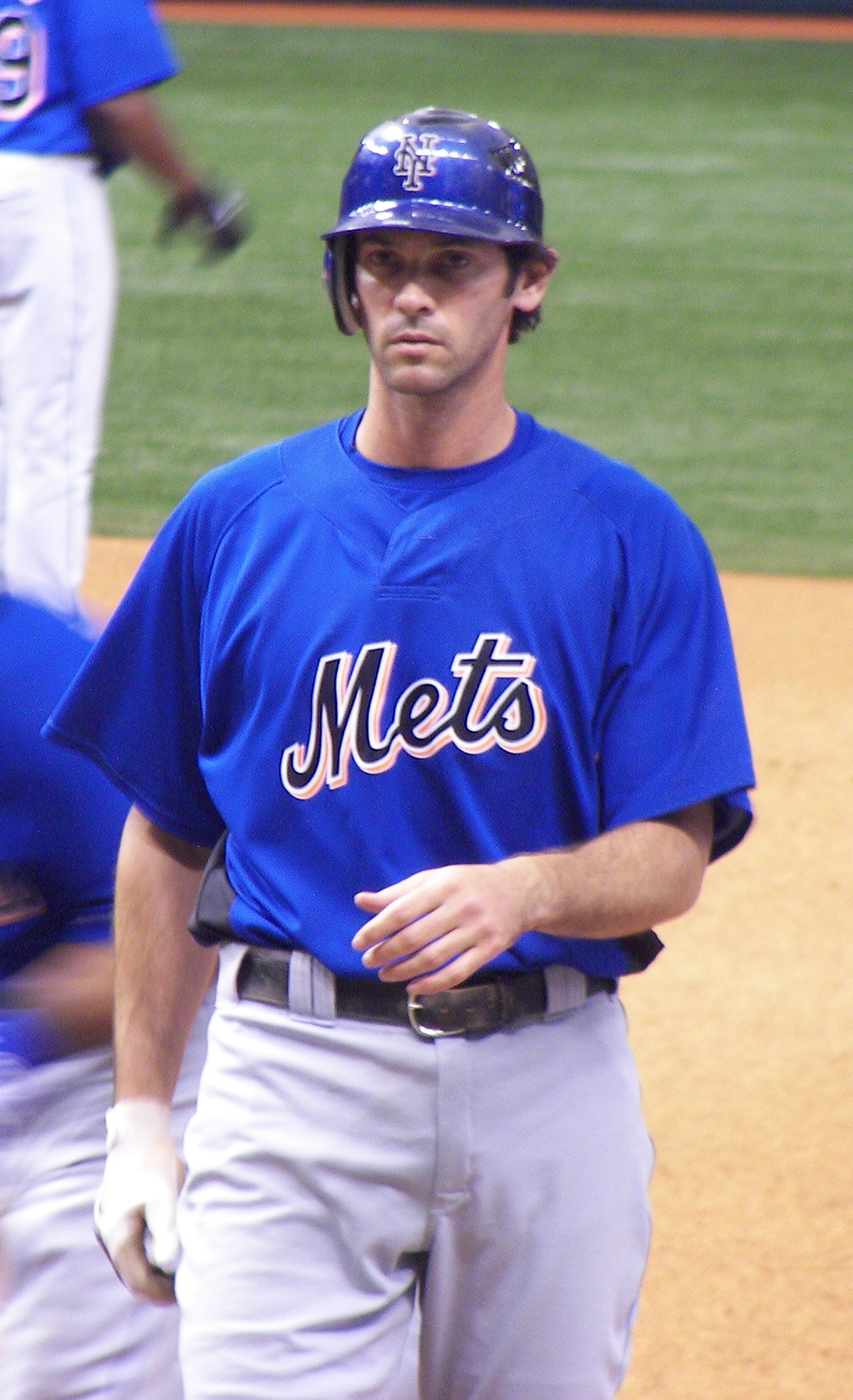
Background and career
Shawn David Green (born November 10, 1972) is an American former professional baseball right fielder who played for multiple teams in Major League Baseball (MLB). Green was a first-round draft pick and a two-time major league All-Star. He drove in 100 runs four times and scored 100 runs four times, hit 40 or more home runs three times, led the league in doubles, extra base hits, and total bases, won both a Gold Glove Award and a Silver Slugger Award, and set the Dodgers then single-season record in home runs. Green also set the MLB record for most total bases in a single game, with 19, on May 23, 2002 vs. the Milwaukee Brewers. Green was in the top five in the league in home runs, RBIs, intentional walks, and MVP voting multiple times throughout his career. Besides having the most total bases in a game, Green holds or is tied for the following major league records: most home runs in a game (four), most extra base hits in a game (five), most runs scored in a game (six), most home runs in two consecutive games (five), most home runs in three consecutive games (seven), and most consecutive at bats in a game with a home run (four). Green broke the record of 18 total bases (four home runs and one double) set by Joe Adcock of the Milwaukee Braves (vs. Brooklyn Dodgers) in 1954. Athletics rookie Nick Kurtz matched Green’s 19 total bases (also four home runs, one double, and a single) against the Houston Astros on July 25, 2025. At the time of his retirement, he was one of only fourteen players with at least 300 home runs, 1,000 runs and RBIs, 400 doubles, a .280 batting average, and 150 stolen bases; among the players in that club included Barry Bonds and George Brett.
Green was born in Des Plaines, Illinois, and is Jewish. His family moved to New Jersey when he was one year old, then to San Jose, California, and finally to Tustin, California, when he was 12 years old. His father, Ira, played basketball at DePaul University for the Blue Demons during the 1960s, graduating in 1966, and his mother is the former Judy Schneider. Green was one of the best-known Jewish major league ballplayers, and the most prominent one with the New York Mets since Art Shamsky played right field for the 1969 World Series champion Mets. Of Jewish major leaguers, only Hank Greenberg, with 331 home runs and 1,276 RBIs, has more major league home runs and RBIs than Green. Green opted to miss games on Yom Kippur, even when his team was in the middle of a playoff race. While Green is often likened to Hank Greenberg, Green's grandfather in fact shortened the family name from Greenberg to Green, for "business reasons". Green was arguably the best Jewish baseball player since Sandy Koufax, although his stats (especially his home runs) declined in his last years. Green retired on February 28, 2008. Green has a residence in the Orange County, California, city of Irvine. In 2002, he married Lindsay Bear in a mixed Jewish and Christian ceremony. They have two daughters.
He attended Tustin High School in Tustin, California, where he tied the California Interscholastic Federation record with 147 hits during his high school career. He was a first team selection to the 1991 USA Today All-USA high school team, while ranking third in his class academically.
In 1991, Green won a baseball scholarship to Stanford University, where he became a brother of the Delta Tau Delta International Fraternity. Green was drafted by the Toronto Blue Jays as their first round pick (16th overall) in the 1991 amateur draft. The Blue Jays drafted him using a compensation pick from the San Francisco Giants, to whom they had lost Bud Black via free agency. Green ultimately struck a deal with the Blue Jays. They agreed that Green would play in the minor leagues during the summer, but go back to the university in the off-season. Green received one of the highest signing bonuses at that time ($725,000; ($1,714,000 today)), a portion of which he donated to the Metropolitan Toronto Housing Authority Breakfast Club (which provides breakfast for kids who would otherwise go to school hungry).
In 1992, Green played for the Dunedin Blue Jays of the Florida State League, and was selected to the league's all-star team. Green spent most of 1993 and 1994 in the minors, where he compiled impressive numbers. In 1994, he hit .344—winning the International League batting title—while ranking third in runs, hits, and on-base percentage and hitting thirteen home runs with 61 RBIs for Toronto's AAA affiliate, the Syracuse Chiefs. He was an International League all-star, was voted the International League Rookie of the Year, and was also voted the International League's Best Batting Prospect, Best Outfield Arm, and Most Exciting Player in Baseball America's Tools of the Trade poll. In addition, he won the R. Howard Webster Award as the Chief's MVP, and was the Blue Jays' Minor League Player of the Year. Green then hit .306 in the 1994–1995 Venezuelan Winter League.
Green made his Major League debut on September 28 as the second-youngest player in the Major Leagues. Though he did not play in the 1993 World Series, he was awarded a World Series ring. He appeared in just seventeen games in 1993 and 1994. In 1995, his full rookie season, Green started in 97 games, hitting fifteen home runs and batting .288. Green set Blue Jays rookie records in doubles (31), hit streak (14), extra base hits (50), and slugging percentage (.509). He came in fifth in voting for the American League Rookie of the Year. His 1996 and 1997 seasons were similar, in that Green was given limited at-bats, wasn't trusted to hit left-handed pitching, and produced only sporadically. Green was, however, more aggressive on the base paths in 1997 than in any previous year, stealing 14 bases while being caught only three times. In 1998, Green was granted an everyday spot in the line-up and he delivered by becoming the first Blue Jay to become a member of the 30–30 club, in which he hit over 30 home runs and stole 30 or more bases in the same season. He also became the tenth Major Leaguer to hit 35 or more home runs and steal 35 or more bases in a season, joining among others Willie Mays, Barry Bonds, and Alex Rodriguez. Green had never hit more than eighteen home runs in a season (major or minor leagues). He finished the season batting .278 with 35 home runs, 100 RBIs, and 35 stolen bases (a career best). In 1999, Green proved his new-found power was no fluke. On April 22, he hit a 449-foot (137 m) home run into SkyDome's fifth deck, putting him in prestigious company with José Canseco, Mark McGwire, and Joe Carter. By the All-Star break, he had hit 25 home runs and knocked in 70 runs, earning him not only his first All-Star appearance, but also a chance to compete in the Home Run Derby at Fenway Park. Green hit only two home runs, however, and was eliminated in the first round. He finished the season batting .309 (a career best), with 42 home runs (5th in the league), 134 runs (2nd in the league, and a career best), 123 RBIs, and a .588 slugging percentage (fifth best in the league). Green also led the league in doubles (45), extra-base hits (87), and total bases (361). He hit a home run in every 14.6 at-bats. After the season, he was awarded a Gold Glove Award for his defense, and a Silver Slugger Award for his offense, and came in ninth in the voting for MVP. In the off-season, Green expressed a desire to sign as a free agent with a team closer to his California roots after the 2000 season. The Blue Jays, facing the rising contract demands of Green and slugger teammate Carlos Delgado, decided not to leave the decision of which player to pursue until mid-way through the season. On November 8, 1999, Green was traded with Jorge Nuñez to the Los Angeles Dodgers for Pedro Borbón Jr. and Raúl Mondesí. Green quickly signed an extension with Los Angeles, agreeing to an $84 million ($157,000,000 today)/six-year deal that included a $4 million ($7,478,000 today) signing bonus.
Sources
Net-worth figure: Celebrity Net Worth (October 2026), in USD. Biography and career facts: the person's Wikipedia article and linked reporting. Snapshot date for all StarWorth figures: 28 October 2026.


