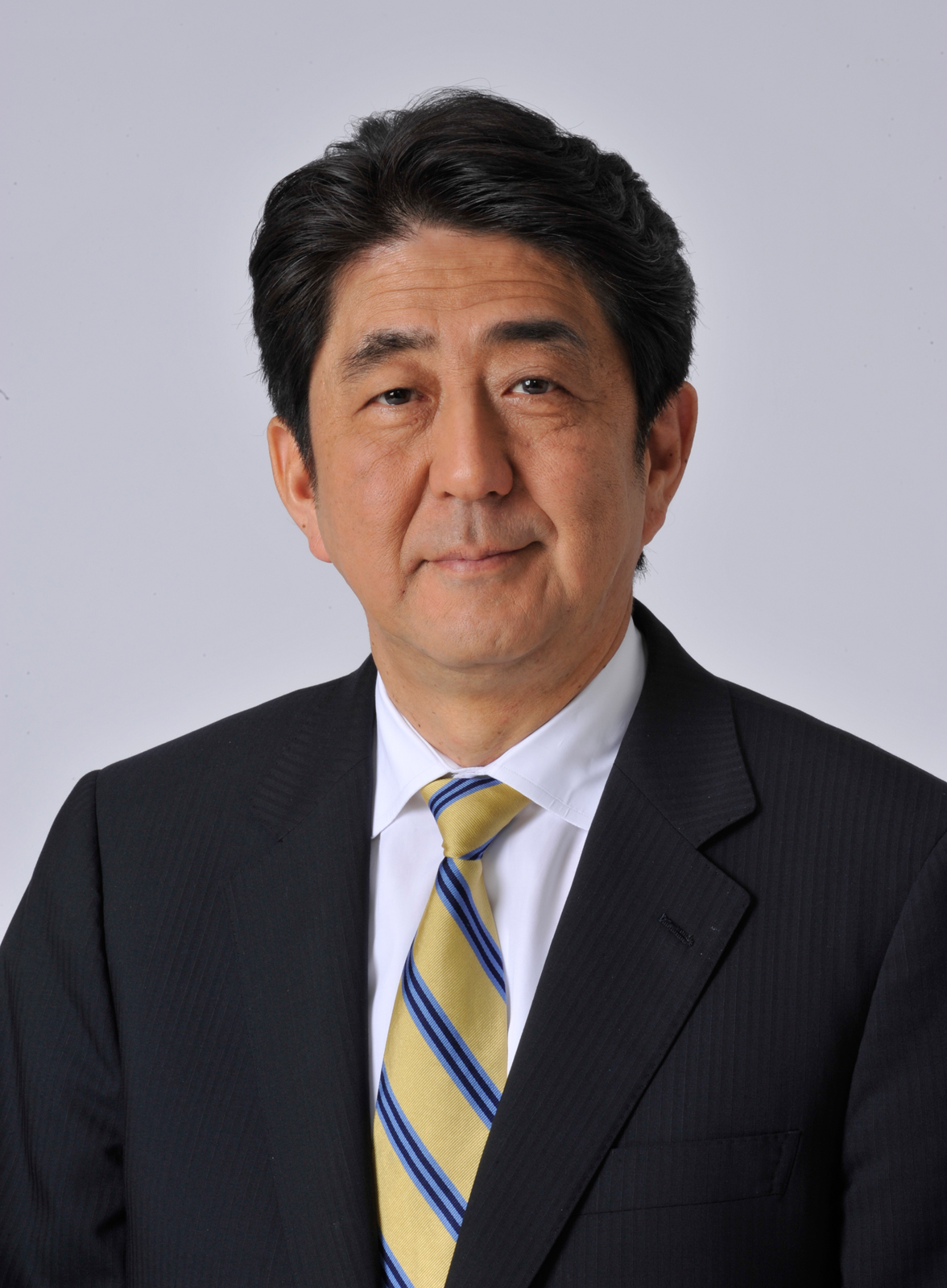
Background and career
Shinzo Abe (21 September 1954 – 8 July 2022) was a Japanese statesman and politician who served as Prime Minister of Japan and President of the Liberal Democratic Party (LDP) from 2006 to 2007 and again from 2012 to 2020. He was the longest-serving prime minister in Japanese history, serving for nearly nine years in total. Abe was born in Tokyo into the prominent Satō–Kishi–Abe family, the son of LDP politician Shintaro Abe and grandson of prime minister Nobusuke Kishi. He graduated from Seikei University and also attended the University of Southern California. After graduating from university, Abe worked in industry and party posts before being elected to the House of Representatives in 1993. Abe served as LDP Secretary-General from 2003 to 2004 and Chief Cabinet Secretary under Prime Minister Junichiro Koizumi from 2005 to 2006, when he replaced Koizumi as LDP President and Prime Minister. Abe became Japan's youngest post-war premier, and the first born after World War II. A staunch conservative and member of the ultranationalist organization Nippon Kaigi, which holds negationist views on Japanese history, Abe took right-wing stances including downplaying Japanese atrocities in textbooks, denying government coercion in the recruitment of comfort women during the war, and seeking revision of Article 9 of the Constitution. In 2007, he initiated the Quadrilateral Security Dialogue with the US, Australia, and India, aimed at resisting China's rise as a superpower. He resigned as premier that year due to his government's unpopularity and illness. After recovering from his illness, Abe staged a political comeback in 2012, when he was again elected LDP President, leading the party to a landslide victory in that year's election. He became the first former Prime Minister to return to office since Shigeru Yoshida in 1948. In Abe's second term, he attempted to counter Japan's economic stagnation with "Abenomics", with mixed results. He was credited with reinstating the Trans-Pacific Partnership with a new agreement in 2018. In 2015, he passed the Legislation for Peace and Security which allowed deployment of the Japan Self-Defense Forces overseas under certain strict conditions, which was controversial and met with protests by Students Emergency Action for Liberal Democracy. Abe led the LDP to further victories in the 2014 and 2017 elections, becoming Japan's longest-serving Prime Minister. In 2020, he again resigned, citing a relapse of his illness, and was succeeded by Yoshihide Suga. In 2022, Abe was assassinated in Nara while delivering a campaign speech for the upper house elections. The killer, Tetsuya Yamagami, confessed he was motivated by Abe's ties with the Unification Church. This was the first assassination of a former Japanese Prime Minister since 1936. A polarizing figure in Japan, Abe was praised by his supporters for strengthening Japan's security and international stature, while opponents criticized him for nationalistic policies and historical negationism, which they viewed as threatening Japanese pacifism and damaging relations with China and South Korea.
Shinzo Abe was born on 21 September 1954 to a prominent political family in Shinjuku, Tokyo. His father Shintaro Abe served in the House of Representatives from 1958 to 1991, with stints as Chief Cabinet Secretary, Minister for International Trade and Industry, and Minister for Foreign Affairs, and was considered a strong candidate for prime minister before his death. His mother Yōko was a noted calligrapher. Abe's maternal grandfather, Nobusuke Kishi, was a minister in the wartime cabinet of Prime Minister Hideki Tojo. At the end of the war, Kishi was imprisoned as a suspected "Class-A" war criminal by the US military occupation of Japan, but was released and later de-purged as part of the Occupation's "reverse course" due to the Cold War. Kishi helped found the Liberal Democratic Party (LDP) in 1955 and served as Prime Minister of Japan from 1957 until his 1960 resignation following the Anpo protests. Abe viewed Kishi as his "No 1 role model" and was influenced by many of his beliefs, like Kishi's hawkish stance on China. Regarding Kishi, Abe later wrote: "Some people used to point to my grandfather as a 'Class-A war criminal suspect,' and I felt strong repulsion. Because of that experience, I may have become emotionally attached to 'conservatism,' on the contrary". Abe's paternal grandfather, Kan Abe, was a Yamaguchi landowner who served in the House of Representatives during World War II. Kan Abe was a pacifist who opposed the Tojo government and war in East Asia.
Abe attended Seikei Elementary School and Seikei Junior and Senior High School (成蹊中学校・高等学校). Although as a boy he aspired to become a filmmaker, Abe's family history led him upon a political path. At the age of 17, he was diagnosed with ulcerative colitis. He studied public administration and graduated with a bachelor's degree in political science from Seikei University in 1977. From 1978 to 1979, Abe attended the University of Southern California where he studied English as a visiting student. After taking courses in history, international relations, and political science for three semesters, Abe left. Abe is reported to have been an average student. In April 1979, Abe began working for Kobe Steel. He left the company in 1982 to serve as secretary to his father, who had been appointed foreign minister in the Nakasone cabinet. Shintaro Abe visited 81 countries in the 1980s. These travels imparted to Abe the importance of building relations with foreign leaders. He continued as secretary when his father served as chairman of the LDP General Council and LDP secretary-general.
After his father's death in 1991, Abe was elected to the first district of Yamaguchi Prefecture in 1993, winning the most votes of the four Representatives elected in the SNTV multi-member district. Abe joined the Seiwa Seisaku Kenkyūkai, a faction in the Liberal Democratic Party. Shintaro Abe had headed the faction from 1986 until his death. Yoshirō Mori and Junichiro Koizumi were seniors in the faction. When Abe first became a member of parliament, the opposition parties had agreed to form a "non-LDP, non-communist" government with Morihiro Hosokawa as Prime Minister. The LDP later returned to government by forming a coalition with the Japan Socialist Party, with JSP leader Tomiichi Murayama as Prime Minister. Abe and other conservatives supported the coalition, but criticized the compromises given, with Abe later wriing that "By making the leader of a party with public approval of only five or six percent prime minister, naturally the dissatisfaction within the party was amplified. The opposition was especially large from people who had become representatives who approved of the LDP’s ideas, who, if I had to say, belonged to the conservative mainstream." Abe became one of the few newly elected LDP representatives to be named to the Foreign Affairs Committee. During this time, he extensively read on the constitution and national security, while also reading the writing of conservative author Susumu Nishibe and Spanish theorist José Ortega y Gasset’s The Revolt of the Masses. During the 1990s, Abe joined various right-wing conservative parliamentary groups such as the Diet members’ league of the Shinto Association of Spiritual Leadership, the 50th Anniversary of the End of the War established in 1994, and the Junior Parliamentarian Group to Consider Education and the Way Forward for Japan and the Nippon Kaigi Parliamentarian Association established in 1997. He was particularly active in the Junior Parliamentarian Group, where he served as the director of its Secretariat. Many of his future political allies came from these groups, including his close political friend Shōichi Nakagawa, with whom he focused on battling the "masochistic" narrative on the comfort women. Abe also took on the issue of Japanese abductees taken to North Korea; in 1997, he raised the issue in the Diet, where he criticized the government's response as "equivalent to abdicating the duties of the state". He became involved in the creation of the Association of the Families of Victims Kidnapped by North Korea and became the leader of the Parliamentarians’ League to Rescue Japanese Citizens Suspected of Being Abducted by North Korea. He attacked the LDP, the bureaucracy and the media for its handling of the issue, accusing North Korea of "state terrorism". In 1998, he became the deputy chairman of the LDP's Parliamentary Affairs Committee. Abe suffered a severe ulcerative colitis attack in 1998 but found a treatment to that allowed remission. April 1999 he formed a study group with Yasuhisa Shiozaki, Nobuteru Ishihara, and Takumi Nemoto that was dubbed as the "NAIS Club". In 1999, Abe became Director of the LDP Social Affairs Division. In 2000, Abe's home and the office of his supporters in Shimonoseki, in Yamaguchi Prefecture, were attacked with Molotov cocktails on numerous occasions. The perpetrators were several yakuza belonging to the Kudo-kai, a Kitakyushu-based designated bōryokudan syndicate. The reason for the attacks was believed to be that Abe's local aide refused to give cash to a Shimonoseki real estate broker in return for supporting a Shimonoseki mayoral candidate in 1999.
Abe was Deputy Chief Cabinet Secretary in the Yoshirō Mori and Junichiro Koizumi Cabinets from 2000 to 2003. During this time, he had a close relationship with Koizumi, though his relationship with Chief Cabinet Secretary Yasuo Fukuda was chillier. In one instance in 2002, 2001, Abe secured a visa for former Taiwanese president Lee Teng-hui despite Fukuda's objections. In May 2002, Abe made an off-the-record statement during a speech at Waseda University stating that Japan was not prohibited from possessing nuclear weapons, which reportedly enraged Fukuda. Abe was the chief negotiator for the Japanese government on behalf of the families of Japanese abductees taken to North Korea. As a part of the effort, he accompanied Koizumi to meet North Korean leader Kim Jong Il in 2002. After North Korea revealed a list of abducted Japanese citizens, with some being dead, Abe advised Koizumi to be prepared to leave without signing a joint consensus if Kim Jong Il was not prepared to apologize. He gained national popularity when he demanded that Japanese abductees visiting Japan remain in the country, in defiance of North Korea. Kim later spoke to the Japanese delegation, acknowledging the "appalling incident", with the two countries subsequently signing the Pyongyang Declaration. North Korea's admittance of the abductions caused Abe's popularity to rise due to his previously hawkish stance on North Korea. Abe also successfully pushed Koizumi's administration for a tougher stance on North Korea. After North Korea allowed the five victims that it said were alive to return to Japan, on the condition that they return later to North Korea, Abe argued that they should not be returned, while Fukuda urged the government to honor the deal. Eventually, Abe secured a victory and the abductees were not returned; the eight family members of the abductees were eventually released in May 2004.
In September 2003, Koizumi mulled appointing Abe as an LDP Deputy Secretary-General; instead he was appointed LDP Secretary-General. Abe was the leader of a project team within the LDP that conducted a survey on "excessive sexual education and gender-free education". Among the items to which this team raised objections were anatomical dolls and other curricular materials "not taking into consideration the age of children", school policies banning traditional boys' and girls' festivals, and mixed-gender physical education. The team sought to provide a contrast to the Democratic Party of Japan (DPJ), which it alleged supported such policies. After the 2003 general election, in which the DPJ gained seats, Abe was demoted to acting secretary-general. Abe supported sending the Japan Self-Defense Forces (JSDF) on a dispatch to Iraq to help rebuild the country after the United States invasion. In a parliamentary vote to approve the dispatch of the SDF, Abe tried convince to three skeptical senior LDP representatives, Kooichi Katoo, Makoto Koga and Shizuka Kamei, to vote in favor, later issuing reprimands against them due to them abstaining. Abe was quiet on the privatization of Japan Post, instead focusing on cultural issues. On 13 October 2005, Koizumi appointed Abe as Chief Cabinet Secretary, helping Abe to be more visible. Regarding the economy, Abe favored fiscal expansion instead of raising taxes. On 12 August 2006, he declared his candidacy for the LDP presidential election. His chief competitors for the position were Sadakazu Tanigaki and Tarō Asō. Yasuo Fukuda was a leading early contender but ultimately chose not to run. Former prime minister Yoshirō Mori, to whose faction both Abe and Fukuda belonged, stated that the faction strongly leant toward Abe. On 20 September 2006, Abe was elected to succeed Koizumi as the president of the ruling Liberal Democratic Party.


