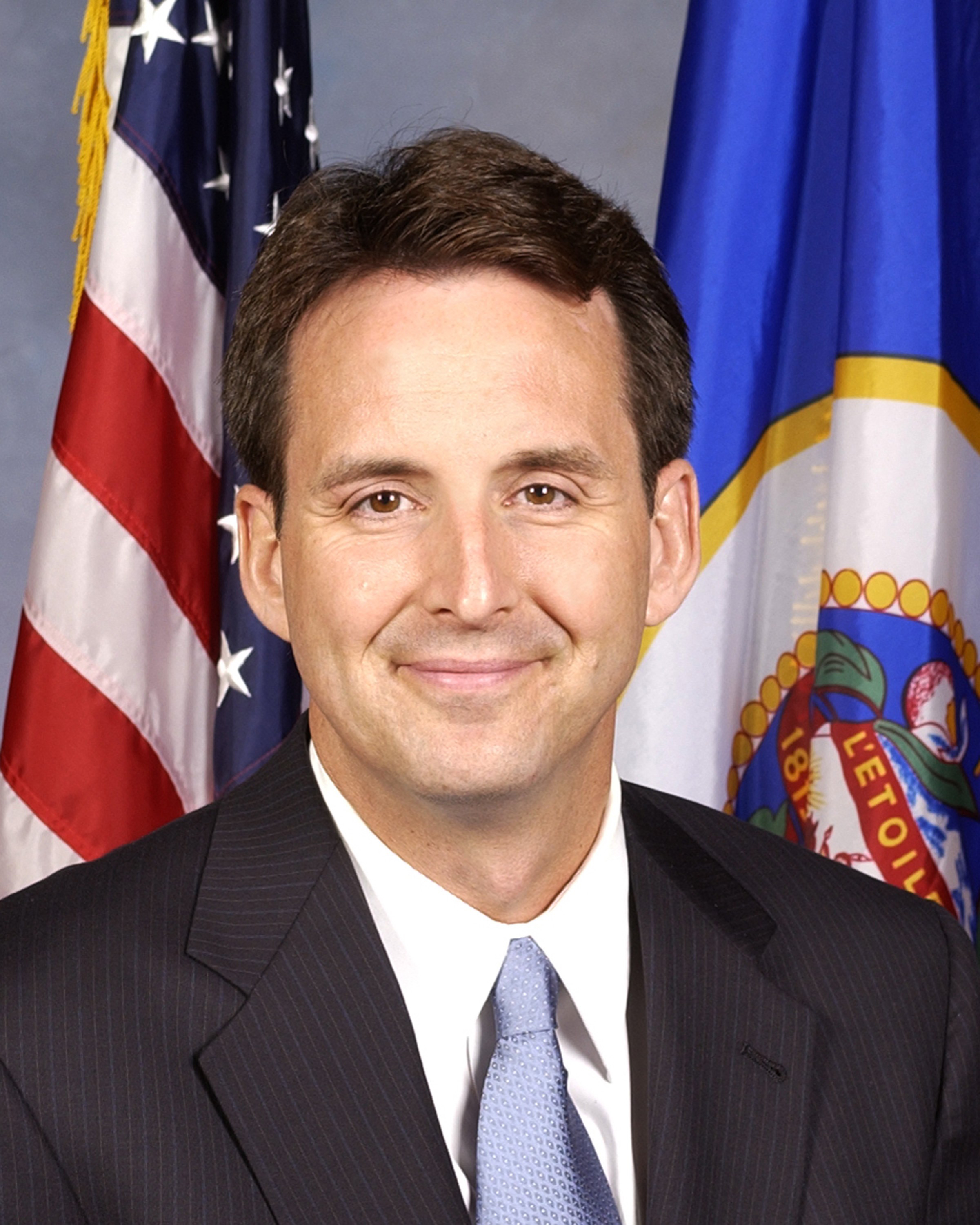
Background and career
Timothy James Pawlenty ( pə-LEN-tee; born November 27, 1960) is an American attorney, businessman, and politician who served from 2003 to 2011 as the 39th governor of Minnesota. A member of the Republican Party, Pawlenty served in the Minnesota House of Representatives from 1993 to 2003, and as House Majority Leader from 1999 to 2003. He unsuccessfully ran for the Republican presidential nomination in the 2012 presidential election. Pawlenty graduated from the University of Minnesota, becoming a labor law attorney and the vice president of a software company. In 1992 he was elected to represent District 38B, a district in suburban Dakota County, in the Minnesota House of Representatives. He was reelected four times and was elected majority leader in 1998. After securing the Republican endorsement, Pawlenty won the three-way 2002 Minnesota gubernatorial election. He campaigned on a conservative platform with a pledge not to raise taxes. He worked to lower the state's deficit by cutting funds from state programs and instituting "user fees". He was reelected in 2006 by a margin of less than one percent. Although Pawlenty eliminated the budget deficit in his first term, the deficit returned as a result of the Great Recession in 2007. The effectiveness of Pawlenty's economic policy as governor is disputed. As governor, Pawlenty also reformed Minnesota's education system, passed a concealed carry law, and codified a 24-hour wait period before receiving an abortion. His administration advocated for numerous notable public works projects, including the construction of the Northstar Commuter Rail Line and Target Field. From 2007 to 2008, Pawlenty chaired the National Governors Association. Pawlenty was rumored to be a contender for both the Republican presidential and vice-presidential nominations in the 2008 presidential election. He went on to co-chair John McCain's unsuccessful 2008 presidential campaign. Pawlenty ran for president in the 2012 Republican presidential primary. His campaign fell short of expectations by failing to gain traction. After withdrawing from the race, Pawlenty became a finalist to join Mitt Romney on the 2012 ticket as the vice presidential candidate. He was not selected, but he served as co-chair of Romney's campaign until his departure two months before the election. Pawlenty sought a third term as governor of Minnesota in the 2018 election with Michelle Fischbach as his running mate. He lost the Republican primary to Jeff Johnson. As of 2025, Pawlenty is the most recent Republican governor of Minnesota. In 2026, Pawlenty became president of the Solar Energy Industries Association, a trade association for the solar power industry.
Pawlenty was born in Saint Paul, Minnesota, to Eugene Joseph Pawlenty, and his wife, Virginia Frances (née Oldenburg). His father, who drove a milk delivery truck, was of Polish descent, while his mother was of German ancestry. She died of cancer when he was 16. Pawlenty grew up in South St. Paul, where he played ice hockey on his high school's junior varsity squad. Intending to become a dentist, Pawlenty enrolled in the University of Minnesota, the only one in his family to go beyond high school. But he changed his plans and spent the summers of 1980 and 1982 working as an intern at the office of U.S. Senator David Durenberger. In 1983, he graduated with a Bachelor of Arts in political science. He received a Juris Doctor from the University of Minnesota Law School in 1986. There, he met his wife, Mary Anderson, whom he married in 1987. Pawlenty first worked as a labor law attorney at the firm Rider Bennett (formerly Rider, Bennett, Egan & Arundel), where he had interned while a law student. He later became vice president of a software as a service company, Wizmo Inc. Having moved to Eagan, Minnesota, a suburb of Minneapolis–Saint Paul, Pawlenty was appointed to the city's Planning Commission by Mayor Vic Ellison. One year later, at age 28, he was elected to the City Council. Pawlenty entered state politics in 1990 as a campaign advisor for Jon Grunseth's campaign for governor. After becoming engulfed in a scandal, Grunseth dropped out of the race just weeks before the general election. After Pawlenty himself became governor, he appointed Grunseth's ex-wife, Vicky Tigwell, to the board of the Minneapolis−Saint Paul International Airport, which was called out as an ethics and accountability issue in 2003.
Pawlenty was elected to the Minnesota House of Representatives in 1992, winning 49.1% of the vote in District 38B (suburban Dakota County). In the House, he authored bills instituting term limits for committee chairmen, funding for infant parenting classes, minimum sentences for repeat domestic violence offenders, and community notification for sex offenders. In response to a state budget surplus, he advocated reducing taxes rather than increasing education funding. He was reelected four times and was chosen House Majority Leader when Republicans gained the majority in the State Legislature in 1998.
In 2002, Pawlenty wanted to run for governor, but party leaders made it clear they favored businessman Brian Sullivan. Pawlenty then decided on the U.S. Senate, but abandoned those plans when Vice President Dick Cheney asked him to step aside and allow former St. Paul mayor Norm Coleman to challenge Senator Paul Wellstone without Republican primary opposition. Pawlenty returned to his original ambition and won a hard-fought and narrow race against Sullivan in the Republican primary. In the general election, Pawlenty faced two strong opponents. His main rival was veteran Democratic–Farmer–Labor (DFL) state senator Roger Moe. Former Democratic Congressman Tim Penny ran on the Independence Party ticket. Until mid-October 2002, all three were essentially tied in the polls. Pawlenty's major campaign stances included a pledge not to raise taxes to balance the state's budget deficit (while allowing increases in license and user fees); that visa expiration dates be required to be printed on driver's licenses; that women seeking an abortion be required to wait 24 hours; enactment of a concealed carry gun law; and reform of the state's education requirements. He won the election with 43.8% of the vote. His largest gains after the tied polling were reportedly among voters in the suburbs of Minneapolis–St. Paul.
Pawlenty ran for reelection in 2006. Conservatives criticized him on funding issues, in particular two pieces of legislation for stadiums for the Gophers and Minnesota Twins, and bond issues for public transit, including the Northstar commuter rail line. The race included Minnesota Attorney General Mike Hatch, of the DFL; Peter Hutchinson of the Independence Party; and Ken Pentel of the Green Party. Pawlenty won, defeating Hatch by less than one percent, though both the state House and Senate gained DFL majorities.
Pawlenty was elected in 2002 on a platform of balancing the state's budget without raising taxes. He emphasized his campaign and first term with the Taxpayers League of Minnesota slogan "no new taxes". His governorship was characterized by a historically low rate of spending growth. According to the Minnesota Management and Budget Department, general-fund expenditures from 2004 to 2011 increased an average of 3.5% per two-year term, compared to an average of 21.1% from 1960 to 2003 (these numbers are not inflation-adjusted). University of Minnesota political science professor Larry Jacobs said that slowing state spending and opposing tax increases were Pawlenty's signature issues. In his first year as governor, Pawlenty inherited a projected two-year budget deficit of $4.3 billion, the largest in Minnesota history. After a contentious budget session with a Democrat-controlled Senate, he signed a package of fee increases, spending reductions, and government reorganization that eliminated the deficit. It reduced the rate of funding increases for state services, including transportation, social services, and welfare, and enacted a perennial proposal to restructure city aid based on immediate need rather than historical factors. Pawlenty agreed to several compromises, abandoning a public employee wage freeze and property tax restrictions. During his second term, Pawlenty erased a $2.7-billion deficit by cutting spending, shifting payments, and using one-time federal stimulus money. His final budget (2010–11) was the state's first two-year period since 1960 in which net government expenditures decreased. Pawlenty has claimed this as "the first time in 150 years" that spending was cut, but fact-checkers disputed this claim as no public budget records before 1960 are known to exist. Some criticized Pawlenty for providing a short-term budget solution but coming up short in his long-term strategy as governor. The state department of Management and Budget reported that the two-year budget starting in July 2011 was projected to come up $4.4 billion short. Former Minnesota Governor Arne Carlson, a Republican, criticized Pawlenty's budget strategy: he borrowed more than $1 billion from the tobacco settlement (money set aside for health care), more than $1.4 billion from K-12 education funding, and more than $400 million from the Health Care Access Fund for low-income families, among other short-term shifts in accounting. The result was a $5-billion deficit, the seventh largest in the United States. Minnesota property taxes rose $2.5 billion, more than the previous 16 years combined, and Moody's lowered the state's bond rating. Carlson told Time, "I don't think any governor has left behind a worse financial mess than [Pawlenty] has." Pawlenty responded, "My friend governor Arne Carlson is, of course, now an Obama and John Kerry supporter."


