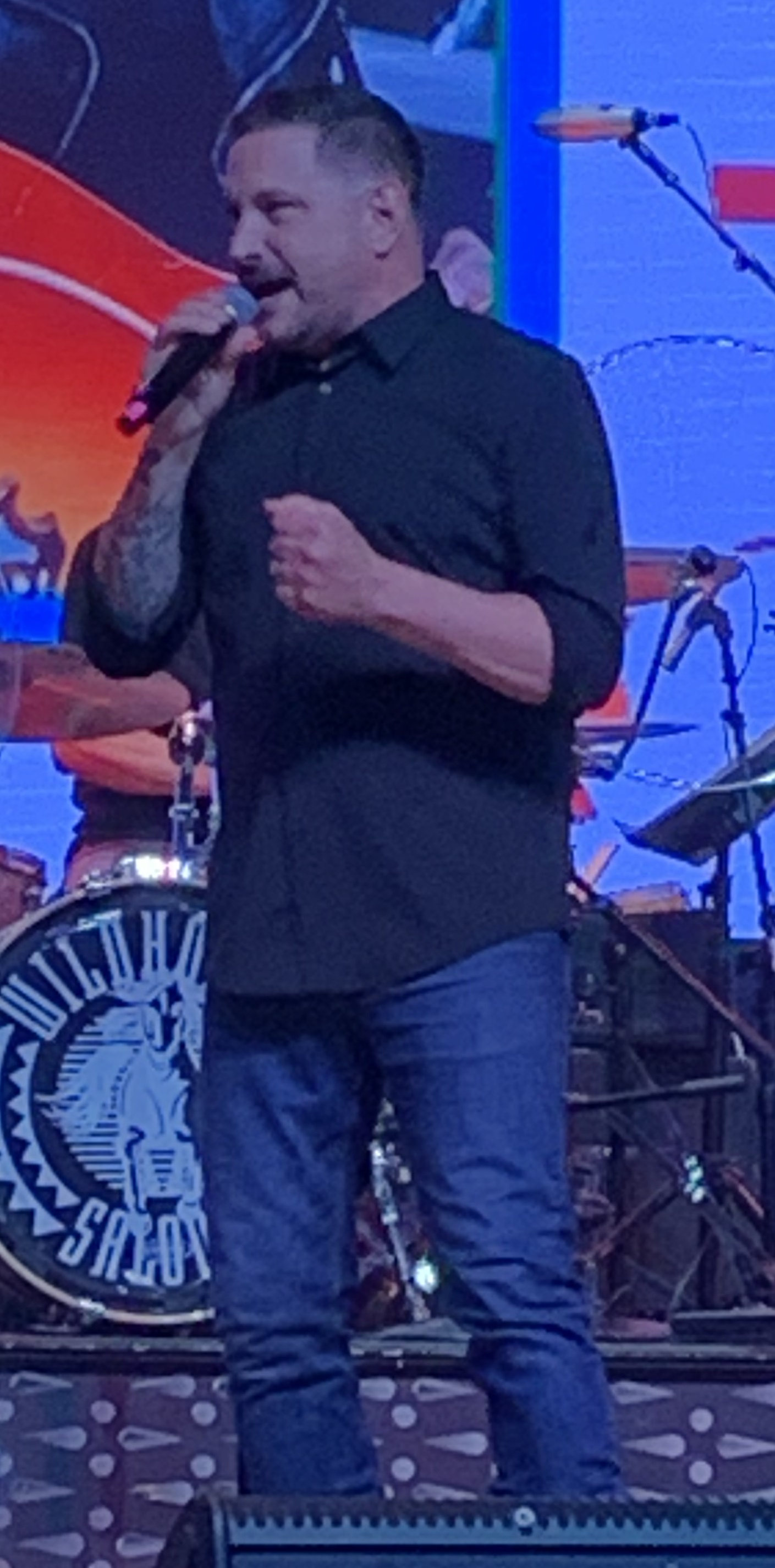
Background and career
Boyd Tyrone Herndon (born May 2, 1962) is an American country music singer and songwriter. His music career began in the 1980s as a member of the Tennessee River Boys, a predecessor to the country band Diamond Rio. Herndon quit the band early on and gained his first national exposure as a competitor on Star Search. He then played at various honky-tonks in Texas. After signing to Epic Records in 1993, Herndon made his debut in 1995 with his single, "What Mattered Most", which reach number one on the Hot Country Songs chart published by Billboard. This was followed that same year by the release of his first album, also titled What Mattered Most. Herndon released three more studio albums and a compilation for Epic: Living in a Moment (1996), Big Hopes (1998), Steam (1999), and This Is Ty Herndon: Greatest Hits (2002). He recorded a Christmas album in 2002 before a recording hiatus. He returned with his fifth studio album, Right About Now (2007) for the Titan Pyramid label; his sixth studio release, Journey On, followed in 2010. Herndon has charted a total of 17 singles on Hot Country Songs. This figure includes three number-one singles: "What Mattered Most", "Living in a Moment", and "It Must Be Love". His singles "I Want My Goodbye Back", "Loved Too Much", "A Man Holdin' On (To a Woman Lettin' Go)", and "Hands of a Working Man" all made top ten on the same chart. Herndon gained further media attention in 2014 after he came out as gay, becoming the first mainstream male country music singer to do so. His personal life has been the subject of mainstream media for other reasons, including his struggles with drug addiction and mental health. His musical style is defined by his singing voice and an emphasis on ballads.
Boyd Tyrone Herndon was born on May 2, 1962, in Meridian, Mississippi, to Boyd and Renee Herndon. He was raised just across the state line in Butler, Alabama. His grandmother played guitar and hosted her own radio show in Butler. He became involved in music in his youth. Herndon's first performance on a stage came during this period, when he won $75 at a talent show in Toxey, Alabama. Shortly after graduating from Austin High School in Decatur, Alabama, Herndon moved to Nashville, Tennessee, to pursue a career in country music. At this point he also attended Belmont University. Herndon's first major role came in 1983 when he became lead vocalist of the Tennessee River Boys, a group that performed at the Opryland USA theme park in Nashville. This band was originally intended to perform a one-time show to promote the park, but became one of several regular performers there. Herndon left the band after only a year to become a contestant on the television talent show Star Search. Following Herndon's departure, the Tennessee River Boys underwent a number of membership changes and became Diamond Rio. When his tenure on Star Search proved commercially unsuccessful, Herndon attempted to secure a recording contract in Nashville. He told The Tennessean in 1995 that multiple labels rejected him as they considered him a "pretty boy". Despite this, he found work singing jingles for Pepsi and Dodge, as well as demo tracks for other artists. He lost a significant amount of money due to an unfavorable management deal, which led to his mother having to sell her house to refinance the amount of money lost. In addition, Herndon's father died of a brain hemorrhage, putting further strain on both him and his family. Herndon then moved to Texas and found work performing in various honky-tonks across the state, to regain some of the money he had lost. His tenure in Texas included a stint with Louise Mandrell in 1987 at Billy Bob's Texas, a country music nightclub in Fort Worth. He competed on another television talent show titled You Write the Songs in 1987, but was unsuccessful. Herndon also appeared on The Porter Wagoner Show, a musical variety show hosted by country singer Porter Wagoner. By 1989 he had formed a backing band called Bayou. This act opened for Little Texas in 1989 prior to that band's signing with Warner Records. In 1993, Herndon won a local music award called Texas Entertainer of the Year. At the awards ceremony, Herndon was discovered by a representative of Epic Records, and he signed with the label later in the year.
Herndon began recording music for Epic in 1994. He made his debut in early 1995 with the single "What Mattered Most", a song written by Gary Burr and Vince Melamed. The song went to number one on the Billboard Hot Country Songs charts in the United States and the former RPM country music charts in Canada. Follow-up single "I Want My Goodbye Back" reached a Hot Country Songs peak of number seven in 1995. Its b-side, a duet with Stephanie Bentley titled "Heart Half Empty", peaked at number 21 in early 1996. "In Your Face" was the last single from What Mattered Most. This song was the least successful, charting for two weeks and reaching number 63. The album featured backing vocals from several artists on Epic or sister label Columbia Records, including Patty Loveless, Joe Diffie, Ron Wallace, and Gibson/Miller Band member Blue Miller. Doug Johnson, then the vice-president of artists and repertoire (A&R) of Epic's Nashville branch, produced the album and co-wrote "I Want My Goodbye Back". In addition to the singles, What Mattered Most included a cover of Jim Croce's "You Don't Mess Around with Jim". Another track, the Vince Gill and Don Schlitz composition "You Just Get One", was later recorded by Jeff Wood on his 1997 album Between the Earth and the Stars. Wood's rendition charted on Hot Country Songs that same year. "Heart Half Empty" later appeared on Bentley's 1996 album Hopechest, also issued on Epic. The music video for "What Mattered Most" was aired on CMT and the former TNN (The Nashville Network). Herndon promoted the album further by starting a tour in 1995. Michael McCall of New Country magazine rated the album three-and-a-half stars out of five, as he considered Herndon's vocal delivery "confident" but was more mixed toward the lyrical content of the songs. An uncredited review published by Billboard was favorable, stating, "With a rich, expressive voice that is equally suited to pensive ballads and rollicking, uptempo tunes, Herndon is one of country's most impressive newcomers." In early 1997, What Mattered Most was certified gold by the Recording Industry Association of America (RIAA) for shipments of 500,000 copies. Executives of Sony Music Nashville, of which Epic was a division at the time, attributed the album's commercial success to a marketing strategy they employed at the time. Under this plan, albums by new artists were priced a dollar lower than the national average for sixty days after their release. These same executives also noted this strategy had been successful on albums by Wade Hayes and James House.
In 1996, Herndon won the Male Star of Tomorrow, a fan-voted award from the TNN Music City News awards (now known as CMT Music Awards). His second album Living in a Moment was released in August of the same year. The album's lead single "Living in a Moment" reached number one on the country charts in both the US and Canada. Three more singles charted from the album throughout 1997. The first was "She Wants to Be Wanted Again", which peaked at number 21 early in the year. This song had been recorded by Lee Greenwood, Restless Heart vocalist Larry Stewart, and Western Flyer prior to Herndon's rendition. After "She Wants to Be Wanted Again" came the number two hit "Loved Too Much" and the top-twenty "I Have to Surrender". Johnson co-wrote "Living in a Moment" and "I Have to Surrender", and once again served as producer. Stephanie Bentley, Blue Miller, and John Wesley Ryles were among the album's backing vocalists. Also contributing in this capacity were Doug Virden and Drew Womack, then recording on Epic in Sons of the Desert. Thom Owens of Allmusic wrote, "Although he is in fine voice throughout the album, Ty Herndon's Living in a Moment is bogged down by mediocre material that fails to given him a proper showcase for his talents." He considered the title track and "Don't Tell Mama" the strongest lyrically. Alanna Nash of Entertainment Weekly similarly thought "Don't Tell Mama" was the strongest track, but criticized the rest of the album as "formulaic". Colin Larkin of the Virgin Encyclopedia of Country Music thought this album had "a shortage of standout material". The album's closing track "I Know How the River Feels" was later a single in 1999 for Diamond Rio. Living in a Moment was also certified gold in 1997.
Big Hopes, Herndon's third album, followed in 1998. Doug Johnson produced five of the tracks and Byron Gallimore, best known for his work with Tim McGraw, produced the other six. Herndon told the Journal & Courier that he considered Gallimore to have a more "understated" production style that put greater emphasis on his vocals than Johnson's production did. Lead single "A Man Holdin' On (To a Woman Lettin' Go)", one of the tracks produced by Gallimore, was a top-five country hit that same year. After it came Herndon's third and final number-one single "It Must Be Love", which also became his only top-40 hit on the Billboard Hot 100. The song featured uncredited backing vocals from Sons of the Desert. Jack Sundrud, formerly of Poco, had co-written "It Must Be Love" for Great Plains, another band he was a member of at the time. When they did not record the song, it became available for Herndon. "Hands of a Working Man" was also a top-five country hit from Big Hopes. Walter Allread of Country Standard Time wrote that the tracks produced by Gallimore, such as the title track, were stronger due to their "smaller" production style relative to those produced by Johnson. Thom Owens of AllMusic was mixed toward the album, as he thought that it had "filler" tracks and "glossy production", although he praised Herndon's singing on "A Man Holdin' On" and "Hands of a Working Man". Uncredited reviews of "A Man Holdin' On" and "Hands of a Working Man" in Billboard were both favorable. The former was praised for Gallimore's production and the "unique perspective...of men in difficult transitions", while the latter was described as being appealing to working class listeners due to its lyrical focus on a father's struggles.
In 1999, Epic released his next studio album Steam. Herndon selected a new producer for this album, as he thought his previous albums did not reflect the energy of his live performances. He chose Joe Scaife because of that producer's work with K.T. Oslin, a 1980s country artist Herndon referred to as "one of [his] all-time favorites". Herndon selected the songs for the album by performing them in concert so he and Scaife could gauge the audience's reaction to each. In addition, Herndon recorded demos with his road band, which he then played for the album's session musicians to give them an idea of how he wanted each song to sound. Among the involved musicians were drummer Paul Leim, steel guitar player Dan Dugmore, and guitarist Chris Leuzinger of Garth Brooks' studio band The G-Men. The album also included a horn section fronted by Jim Horn, and a string section including members of the Nashville String Machine. "Steam", the album's title track, was also its lead single. It reached top twenty by the end of 1999, but was less successful than the lead singles of Herndon's previous albums. Two other singles, "No Mercy" and "A Love Like That", peaked even lower. Also included on the album was a cover of Joe Cocker's "You Can Leave Your Hat On", which Herndon had sung in concert for many years prior. While not a single, the cover charted at number 72 on Hot Country Songs in 2000 due to unsolicited radio airplay. Herndon considered the album more "sexy" than his previous efforts, citing both this cover and the title track as examples. Dan MacIntosh of Country Standard Time considered Herndon "too darn polite" for such material, also criticizing the album for "by-the-numbers" arrangements. A more favorable review came from AllMusic, whose Maria Konicki Dinoia wrote, "With a new production team in tow, Herndon has played a bigger part in selecting the album's songs...and it's clear he sings from the heart, as he always has." Deborah Evans Price of Billboard found both "Steam" and "No Mercy" "equally sensuous" in a review of the latter.
Sources
Net-worth figure: Celebrity Net Worth (October 2026), in USD. Biography and career facts: the person's Wikipedia article and linked reporting. Snapshot date for all StarWorth figures: 28 October 2026.



