Background and career
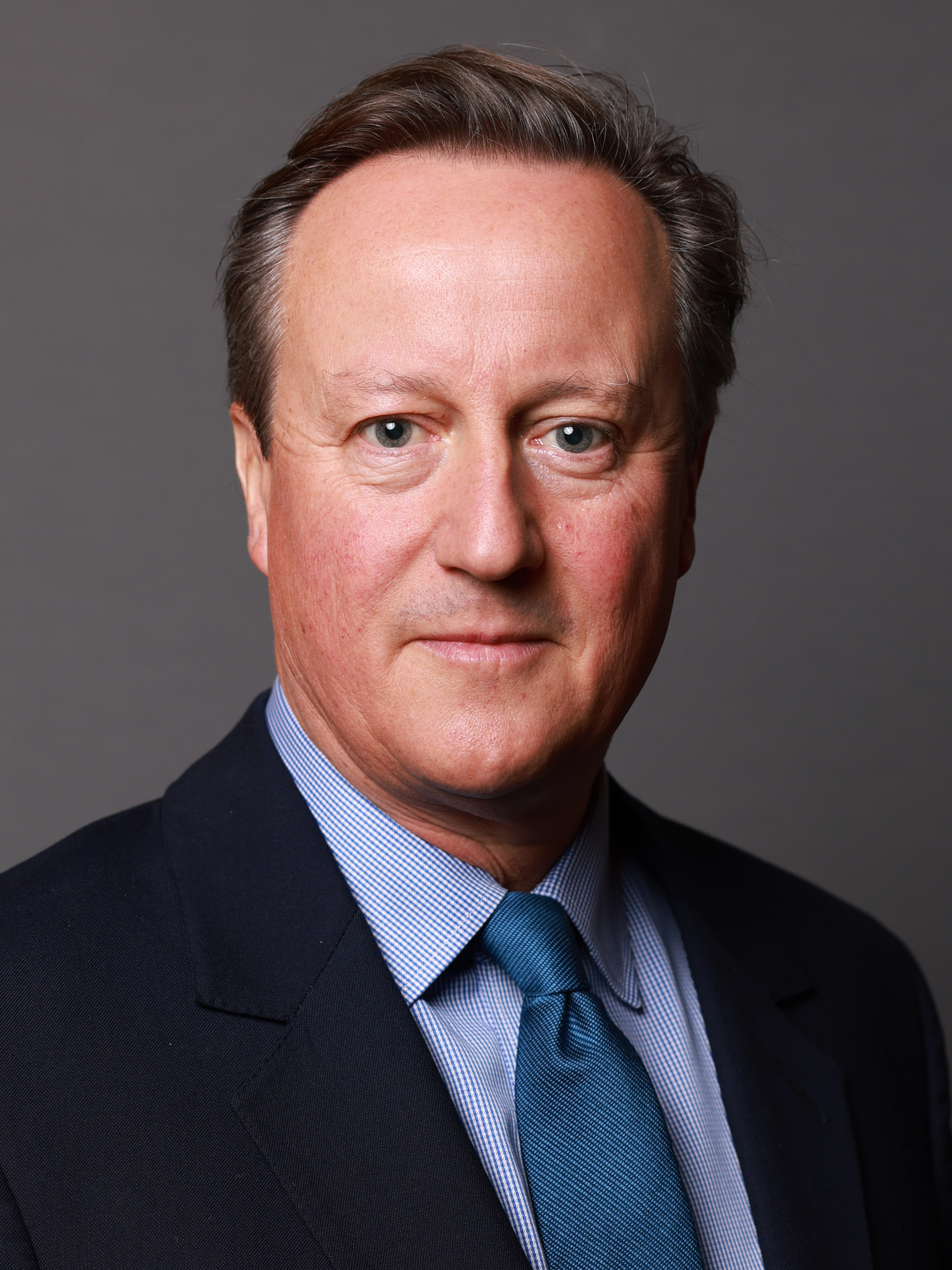
David William Donald Cameron, Baron Cameron of Chipping Norton (born 9 October 1966), is a British politician who served as Prime Minister of the United Kingdom from 2010 to 2016. Cameron was Leader of the Conservative Party from 2005 to 2016 and Leader of the Opposition from 2005 to 2010. He was Member of Parliament (MP) for Witney from 2001 to 2016. After his premiership he was elevated to the House of Lords as a life peer in November 2023 to serve as Foreign Secretary in the Sunak ministry until July 2024. Cameron identifies as a one-nation conservative and has been associated with both economically and socially liberal policies. He is the most recent British prime minister to have held the office continually for a full parliament. Born in London to an upper-middle-class family, Cameron was educated at Eton College and Brasenose College, Oxford. After becoming an MP at the 2001 general election, he served in the opposition Shadow Cabinet under the Conservative leader Michael Howard, and succeeded Howard in 2005. Following the 2010 general election, negotiations led to Cameron becoming prime minister as the head of a coalition government formed by the Conservative Party and the Liberal Democrats. Cameron's premiership was marked by the effects of the 2008 financial crisis and the Great Recession, which the government sought to address through austerity measures. Parliament passed the Health and Social Care Act and the Welfare Reform Act, which allowed the government to introduce large-scale changes to healthcare and welfare. The government also attempted to enforce stricter immigration policies via the Home Office hostile environment policy, introduced reforms to education, and oversaw the 2012 London Olympics. It privatised Royal Mail and some other state assets, implemented the Equality Act 2010, and legalised same-sex marriage in England and Wales. Internationally, Cameron oversaw Operation Ellamy in the First Libyan Civil War and authorised the bombing of the Islamic State in Syria. Constitutionally, the government oversaw the 2011 United Kingdom Alternative Vote referendum and the 2014 Scottish independence referendum, both of which confirmed Cameron's favoured "no" outcome. When the Conservatives secured an unexpected majority in the 2015 general election, Cameron began leading a Conservative-majority government. He introduced the Brexit referendum on the UK's continuing membership of the European Union in 2016, and supported the Britain Stronger in Europe campaign, which lost. Following the success of Vote Leave, Cameron resigned as prime minister and party leader and was succeeded by Theresa May, his home secretary. Cameron resigned his seat in the House of Commons in September 2016, and thereafter maintained a low political profile for several years. He was president of Alzheimer's Research UK from 2017 to 2023, and returned to this position in 2025. He was implicated in the Greensill scandal. His memoir, For the Record, was published in 2019. In 2023 he was appointed foreign secretary by Rishi Sunak, that appointment facilitated by his becoming a member of the House of Lords as a life peer. He served as foreign secretary until the Conservatives lost the 2024 general election. Cameron has been credited for helping to modernise the Conservative Party and for reducing the UK's national deficit. He has also been criticised for austerity measures, his support for foreign intervention in the Libyan and Syrian civil wars, as well as his decision to hold the EU membership referendum, which led to political instability in the UK during the late 2010s.
David William Donald Cameron was born on 9 October 1966 at the London Clinic in Marylebone, London, and raised at Peasemore in Berkshire. He has two sisters and had an elder brother, Alexander Cameron (1963–2023). David is the younger son of Ian Donald Cameron, a stockbroker, and his wife Mary Fleur, a retired Justice of the Peace and the daughter of Sir William Mount, 2nd Baronet. David also descends from King William IV and his mistress Dorothea Jordan through their illegitimate daughter Lady Elizabeth FitzClarence to the fifth-female-generation Enid Agnes Maud Levita. Therefore, through his descent from William IV's father, George III, Cameron is sixth cousin once removed to King Charles III. Cameron's father was born at Blairmore House near Huntly, Aberdeenshire, and died near Toulon, France, on 8 September 2010; Blairmore was built by Cameron's great-great-grandfather Alexander Geddes, who had made a fortune in the grain trade in Chicago in the United States before returning to Scotland in the 1880s. Blairmore was sold soon after Ian's birth. Cameron has said: "On my mother's side of the family, her mother was a Llewellyn, so Welsh. I'm a real mixture of Scottish, Welsh and English." He has also referenced the German Jewish ancestry of one of his great-grandfathers, Arthur Levita, a descendant of the Yiddish author Elia Levita.
Cameron was educated at two private schools. From the age of seven, he was taught at Heatherdown School in Winkfield, Berkshire. Owing to good grades, he entered its top academic class almost two years early. At the age of 13, he went on to Eton College in Berkshire, following his father and elder brother. His early interest was in art. Six weeks before taking his O-levels, he was caught smoking cannabis. He admitted the offence and had not been involved in selling drugs, so he was not expelled; instead he was fined, prevented from leaving the school grounds and given a "Georgic" (a punishment that involved copying 500 lines of Latin text). Cameron passed twelve O-levels and then three A levels: History of Art; History, in which he was taught by Michael Kidson; and Economics with Politics. He obtained three 'A' grades and a '1' grade in the scholarship level exam in Economics and Politics. The following autumn, he passed the entrance exam for the University of Oxford, and was offered an exhibition at Brasenose College.
After leaving Eton in 1984 Cameron started a nine-month gap year. For three months, he worked as a researcher for his godfather Tim Rathbone, then Conservative MP for Lewes, during which time he attended debates in the House of Commons. Through his father, he was then employed for a further three months in Hong Kong by Jardine Matheson as a 'ship jumper', an administrative post. Returning from Hong Kong, Cameron visited the Soviet Union, where he was approached by two Russian men speaking fluent English. He was later told by one of his professors that it was "definitely an attempt" by the KGB to recruit him. In October 1985 Cameron began his Bachelor of Arts course in Philosophy, Politics and Economics (PPE) at Brasenose. His tutor, Vernon Bogdanor, has described him as "one of the ablest" students he has taught, with "moderate and sensible Conservative" political views. Guy Spier, who shared tutorials with Cameron, remembers him as an outstanding student: "We were doing our best to grasp basic economic concepts. David—there was nobody else who came even close. He would be integrating them with the way the British political system is put together. He could have lectured me on it, and I would have sat there and taken notes." When commenting in 2006 on his former pupil's ideas about a "Bill of Rights" to replace the Human Rights Act, however, Bogdanor, himself a Liberal Democrat, said: "I think he is very confused. I've read his speech and it's filled with contradictions. There are one or two good things in it but one glimpses them, as it were, through a mist of misunderstanding". At Oxford Cameron become a member of the controversial Bullingdon Club, an exclusive all-male dining society for Oxford University's students with a reputation for elitism, and a culture of excessive drinking associated with boisterous behaviour and damaging property. In his 2019 memoir For the Record, Cameron wrote about being a member of the Bullingdon, his regret for having joined and its impact on his political career, saying "When I look now at the much-reproduced photograph taken of our group of appallingly over-self-confident 'sons of privilege', I cringe. If I had known at the time the grief I would get for that picture, of course I would never have joined. But life isn't like that..." and: "These were also the years after the ITV adaptation of Brideshead Revisited when quite a few of us were carried away by the fantasy of an Evelyn Waugh-like Oxford existence." Cameron's period in the Bullingdon Club was examined in a 2009 Channel 4 docudrama, When Boris Met Dave, the title referring to Boris Johnson, another high-profile Conservative Party figure, the then-mayor of London, who had been a member at the same time, and who would go on to be prime minister himself. Cameron graduated in 1988 with a first-class BA degree (later promoted to an MA by seniority).
After graduation, Cameron worked for the Conservative Research Department between September 1988 and 1993. His first brief was Trade and Industry, Energy and Privatisation; he befriended fellow young colleagues, including Edward Llewellyn, Ed Vaizey and Rachel Whetstone. They and others formed a group they called the "Smith Square set", which was dubbed the "Brat Pack" by the press, though it is better known as the "Notting Hill set", a name given to it pejoratively by Derek Conway. In 1991 Cameron was seconded to Downing Street to work on briefing John Major for the then twice-weekly sessions of Prime Minister's Questions. One newspaper gave Cameron the credit for "sharper ... Despatch box performances" by Major, which included highlighting for Major "a dreadful piece of doublespeak" by Tony Blair (then the Labour Employment spokesman) over the effect of a national minimum wage. He became head of the political section of the Conservative Research Department, and in August 1991 was tipped to follow Judith Chaplin as political secretary to the prime minister. Cameron lost to Jonathan Hill, who was appointed in March 1992. Instead, he was given the responsibility for briefing Major for his press conferences during the 1992 general election. During the campaign, Cameron was one of the young "brat pack" of party strategists who worked between 12 and 20 hours a day, sleeping in the house of Alan Duncan in Gayfere Street, Westminster, which had been Major's campaign headquarters during his bid for the Conservative leadership. Cameron headed the economic section. It was while working on this campaign that Cameron first worked closely with and befriended Steve Hilton, who was later to become Director of Strategy during his party leadership. The strain of getting up at 04:45 every day was reported to have led Cameron to decide to leave politics in favour of journalism.
The Conservatives' unexpected success in the 1992 election led Cameron to hit back at older party members who had criticised him and his colleagues, saying "whatever people say about us, we got the campaign right", and that they had listened to their campaign workers on the ground rather than the newspapers. He revealed he had led other members of the team across Smith Square to jeer at Transport House, the former Labour headquarters. Cameron was rewarded with a promotion to special adviser to the chancellor of the exchequer, Norman Lamont. Cameron was working for Lamont at the time of Black Wednesday, when pressure from currency speculators forced the pound sterling out of the European Exchange Rate Mechanism. At the 1992 Conservative Party conference, he had difficulty trying to arrange to brief the speakers in the economic debate, having to resort to putting messages on the internal television system imploring the mover of the motion, Patricia Morris, to contact him. Later that month, Cameron joined a delegation of Special Advisers who visited Germany to build better relations with the Christian Democratic Union; he was reported to be "still smarting" over the Bundesbank's contribution to the economic crisis. Lamont fell out with John Major after Black Wednesday and became highly unpopular with the public. Taxes needed to be raised in the 1993 Budget, and Cameron fed the options Lamont was considering through to Conservative Campaign Headquarters for their political acceptability to be assessed. By May 1993, the Conservatives' average poll rating dropped below 30%, where they would remain until the 1997 general election. Major and Lamont's personal ratings also declined dramatically. Lamont's unpopularity did not necessarily affect Cameron, who was considered as a potential "kamikaze" candidate for the Newbury by-election, which includes the area where he grew up. However, Cameron decided not to stand. During the by-election, Lamont gave the response "Je ne regrette rien" to a question about whether he most regretted claiming to see "the green shoots of recovery" or admitting to "singing in his bath" with happiness at leaving the European Exchange Rate Mechanism. Cameron was identified by one journalist as having inspired this gaffe; it was speculated that the heavy Conservative defeat in Newbury may have cost Cameron his chance of becoming chancellor himself, even though as he was not a member of Parliament he could not have been. Lamont was sacked at the end of May 1993, and decided not to write the usual letter of resignation; Cameron was given the responsibility to issue to the press a statement of self-justification.
Sources
Net-worth figure: Celebrity Net Worth (October 2026), in USD. Biography and career facts: the person's Wikipedia article and linked reporting. Snapshot date for all StarWorth figures: 28 October 2026.