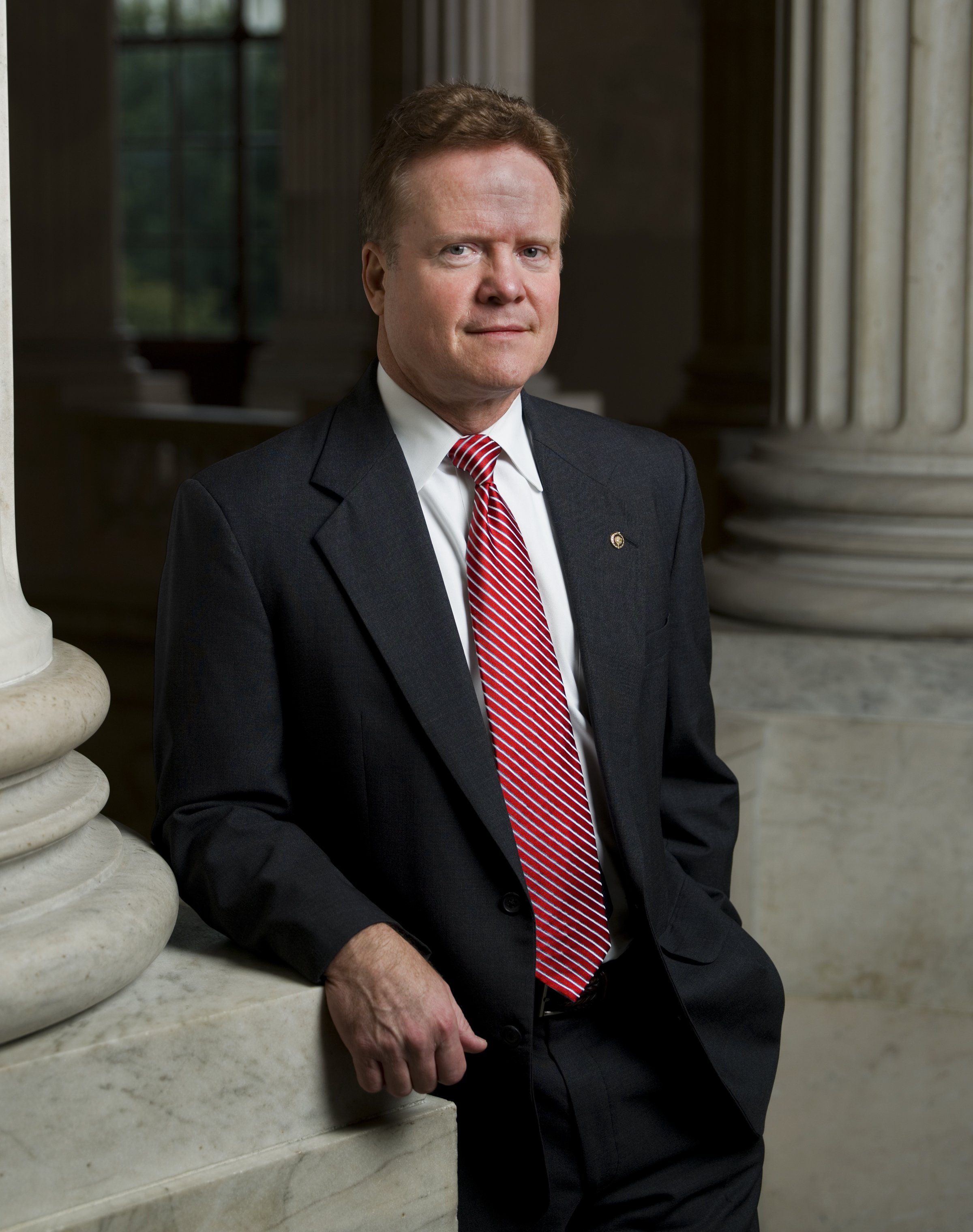
Background and career
James Henry Webb Jr. (born February 9, 1946) is an American politician and author who served as a United States senator from Virginia from 2007 to 2013. He previously served as secretary of the Navy, assistant secretary of defense for reserve affairs, counsel for the United States House Committee on Veterans' Affairs and is a retired Marine Corps officer. Webb has been a member of the Democratic Party since 2006, having initially been a Republican. He was the first Democratic senator to be elected in Virginia since 1994 and is the most recently elected senator who did not serve as governor of Virginia. Webb has also worked as a journalist and filmmaker, and is the author of ten books. In addition, he has taught literature at the United States Naval Academy and was a fellow at the Harvard Institute of Politics. As a member of the Democratic Party, Webb announced on November 19, 2014, that he was forming an exploratory committee to evaluate a run for president of the United States in 2016. On July 2, 2015, he announced that he would be joining the race for the Democratic nomination for president, but ended his campaign on October 20, 2015, stating that he was "not comfortable" with many political positions of the party's leadership. In 2020, Webb was named the first distinguished fellow of University of Notre Dame's International Security Center.
Webb was born in St. Joseph, Missouri, to James Henry Webb, and his wife, Vera Lorraine (Hodges). The second of four children and the older son, he grew up in a military family, moving frequently as his father's career in the United States Air Force required. The family crisscrossed the country, living in Missouri, Illinois, Texas, Alabama, Nebraska, California, and Virginia, as well as in England, where his father was an exchange officer with the Royal Air Force. His father flew B-17s and B-29s during World War II, and flew Air Force cargo aircraft during the 1948-49 Berlin airlift. After developing an inner ear disorder, Meniere's Disease, he became a pioneer in the Air Force missile program, later serving as the commanding officer of the 1001st Missile Squadron at Vandenberg Air Force Base. Webb's parents are buried at the Arlington National Cemetery. Webb is descended from Scots-Irish immigrants from Ulster who emigrated in the mid-18th century to the British North American colonies. Webb's 2004 book Born Fighting: How the Scots-Irish Shaped America details his family history, noting that his ancestors fought in every major American war. A 2014 TV documentary on the Smithsonian Channel, also entitled Born Fighting, was adapted from Webb's book and is narrated by him. Webb attended more than a dozen schools across the U.S. and in England. After graduating from high school in Bellevue, Nebraska, he attended the University of Southern California on a Naval Reserve Officers Training Corps scholarship from 1963 to 1964 and he also was a member of Delta Chi. In 1964, Webb earned appointment to the United States Naval Academy in Annapolis, Maryland. At Annapolis, Webb was a member of the Brigade Honor Committee and the Brigade Staff. When he graduated in 1968, he received the Superintendent's Letter for Outstanding Leadership. After his medical retirement from the Marine Corps due to injuries suffered in Vietnam, Webb enrolled in law school at Georgetown Law Center where he earned a Juris Doctor and received the Horan Award for excellence in legal writing.
After graduating from the Naval Academy, Webb was commissioned as a second lieutenant in the U.S. Marine Corps. Attending the Marine Corps Officer Basic School shortly after leaving Annapolis, he graduated first in his class. He was promoted to first lieutenant in the second half of his tour in Vietnam. He served as a platoon commander with Delta Company, 1st Battalion 5th Marines. He was awarded the Navy Cross for heroism in Vietnam, the second-highest decoration in the Navy and Marine Corps. Webb also was awarded the Silver Star, two Bronze Stars, and two Purple Hearts. After returning from Vietnam, he was assigned to Marine Corps Base Quantico, Virginia, as an instructor for Officer Candidates School (OCS). He was then assigned to the Secretary of the Navy's office for the remainder of his active duty. His war wounds left him with shrapnel in his knee, kidney, and head. The injury to his knee led a medical board to recommend his medical retirement.
Webb received the Navy Cross for actions on July 10, 1969. The citation read:
The Navy Cross is presented to James H. Webb, Jr., First Lieutenant, U.S. Marine Corps, for extraordinary heroism while serving as a Platoon Commander with Company D, First Battalion, Fifth Marines, First Marine Division (Reinforced), Fleet Marine Force, in connection with combat operations against the enemy in the Republic of Vietnam. On July 10, 1969, while participating in a company-sized search and destroy operation deep in hostile territory, First Lieutenant Webb's platoon discovered a well-camouflaged bunker complex that appeared to be unoccupied. Deploying his men into defensive positions, First Lieutenant Webb was advancing to the first bunker when three enemy soldiers armed with hand grenades jumped out. Reacting instantly, he grabbed the closest man and, brandishing his .45 caliber pistol at the others, apprehended all three of the soldiers. Accompanied by one of his men, he then approached the second bunker and called for the enemy to surrender. When the hostile soldiers failed to answer him and threw a grenade that detonated dangerously close to him, First Lieutenant Webb detonated a claymore mine in the bunker aperture, accounting for two enemy casualties and disclosing the entrance to a tunnel. Despite the smoke and debris from the explosion and the possibility of enemy soldiers hiding in the tunnel, he then conducted a thorough search that yielded several items of equipment and numerous documents containing valuable intelligence data. Continuing the assault, he approached a third bunker and was preparing to fire into it when the enemy threw another grenade. Observing the grenade land dangerously close to his companion, First Lieutenant Webb simultaneously fired his weapon at the enemy, pushed the Marine away from the grenade, and shielded him from the explosion with his own body. Although sustaining painful fragmentation wounds from the explosion, he managed to throw a grenade into the aperture and completely destroy the remaining bunker. By his courage, aggressive leadership, and selfless devotion to duty, First Lieutenant Webb upheld the highest traditions of the Marine Corps and of the United States Naval Service. His Silver Star citation read:
The President of the United States of America takes pleasure in presenting the Silver Star to First Lieutenant James Henry Webb, Jr. (MCSN: 0-106180), United States Marine Corps, for conspicuous gallantry and intrepidity in action while serving as a Platoon Commander with Company D, First Battalion, Fifth Marines, FIRST Marine Division in connection with combat operations against the enemy in the Republic of Vietnam. On 9 May 1969, during Operation Muskogee Meadow, a six-man reconnaissance patrol from First Lieutenant Webb's platoon was ambushed and temporarily pinned down by a large North Vietnamese Army force concealed in a tree line four hundred meters in front of Company D's night defensive position. Immediately upon learning of the dangerous situation, First Lieutenant Webb organized a reaction force and proceeded to the point of contact to aid his beleaguered Marines. When his reaction unit came under enemy automatic weapons and rocket fire as it approached the ambush site, he executed a skillful evasive maneuver, established a base of fire, and continued to advance across the fire-swept terrain to the patrol's position. Rallying and encouraging his men, he directed his base of fire forward to a more advantageous position and led his assault team one hundred and fifty meters across on an open rice paddy in a bold attempt to recover several casualties lying in an open area directly in the line of enemy fire. As his Marines delivered a heavy volume of fire at hostile positions, First Lieutenant Webb repeatedly exposed himself to enemy fire as he dashed into the open and pulled the casualties, one at a time, back to friendly lines. Then, consolidating his platoon, he initiated a sudden, vigorous attack which routed the enemy soldiers from their bunkers, disorganized their fire plan, and forced them to retreat from the area. His determination and bold fighting spirit inspired all who observed him and were instrumental in saving the lives of at least two Marines and undoubtedly thwarting the enemy's plan to launch a major attack against his unit's night position. By his leadership, extraordinary courage, and unflagging devotion to duty at great personal risk, First Lieutenant Webb upheld the highest traditions of the Marine Corps and of the United States Naval Service. In 1980, Webb was interviewed for Vietnam: The Ten Thousand Day War, a Canadian television documentary about the Vietnam War. In one segment, he discussed how hard it was to adjust to arriving in Vietnam: "We stepped off an air conditioned plane, where I just watched a first-run movie, and you know, this German stewardess says, 'Have a nice war.'" In the October 13, 2015, CNN Democratic Debate, when asked, "Which enemy are you most proud of?", Webb stated, "I'd have to say, the enemy soldier that threw the grenade that wounded me, but he's not around right now to talk to." In a November 19, 2006 appearance on Meet the Press, Webb told host Tim Russert, "I'm one of these people who—there aren't many of us—who can still justify for you the reasons that we went into Vietnam, however screwed up the strategy got."
Sources
Net-worth figure: Celebrity Net Worth (October 2026), in USD. Biography and career facts: the person's Wikipedia article and linked reporting. Snapshot date for all StarWorth figures: 28 October 2026.


