Background and career
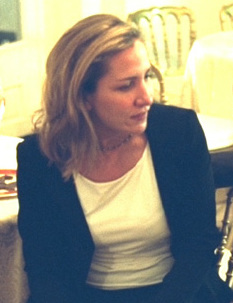
Laura Hillenbrand (born May 15, 1967) is an American author. Her two bestselling nonfiction books, Seabiscuit: An American Legend (2001) and Unbroken: A World War II Story of Survival, Resilience, and Redemption (2010), have sold over 13 million copies, and each was adapted for film. Her writing style is distinct from New Journalism, dropping "verbal pyrotechnics" in favor of a stronger focus on the story itself. Hillenbrand fell ill in college and was unable to complete her degree. She shared that experience in an award-winning essay, A Sudden Illness, published in The New Yorker in 2003. Her books were written while she was disabled by myalgic encephalomyelitis, also known as chronic fatigue syndrome. In a 2014 interview, Bob Schieffer said to Laura Hillenbrand: "To me your story – battling your disease... is as compelling as his (Louis Zamperini's) story."
Hillenbrand began her career as a freelance magazine writer, pitching and submitting stories to various publications. Initially, she began submitting stories while living in a tiny apartment in Chicago. Having been forced by her ill health to suspend her studies at Kenyon College in Ohio, she turned to freelance writing as a focus until she could return to school. Her fiancé was working on his PhD at the time. She first wrote for Equus magazine with a story called Surviving Fractures in June 1990 (Equus 152). This piece catalogued innovations in equine orthopedic surgery. She continued to contribute to the magazine and in 1997 she became a contributing editor. Equus editors were impressed by Hillenbrand's dedication to her research and getting to the essence of a story. Consequently, she produced some of the magazine's most powerful stories. Many of these stories would provide her with the perfect preparation for the book she would eventually write. One in particular, Of Love and Loss, from Equus 238, was a special report exploring the dimensions of grief associated with the death of a horse. Hillenbrand recalled:
“That was one of my favorites. I learned so much about how an animal’s passing is unique, and it was gratifying because the story was so well received by EQUUS readers. In fact, I still occasionally hear from people who were touched by it.” Her first book was the acclaimed Seabiscuit: An American Legend (2001), a nonfiction account of the career of the great racehorse. She won the William Hill Sports Book of the Year in 2001 for this book. She says she was compelled to tell the story because she "found fascinating people living a story that was improbable, breathtaking and ultimately more satisfying than any story [she'd] ever come across." She first covered the subject in an essay, "Four Good Legs Between Us", that was published in American Heritage magazine. Given positive feedback, she decided to proceed to write a full-length book. In a C-Span record of a rare personal appearance on 29 August 2002 to promote Seabiscuit, Hillenbrand said:
"When you're a journalist you get used to working for almost no money and nobody earns less than I did. You tell stories because you want to tell stories and this was the story I waited my career for." The book received positive reviews for the storytelling and research. It was adapted as the film Seabiscuit, nominated for Best Picture of 2003 at the 76th Academy Awards. Hillenbrand's second book, Unbroken: A World War II Story of Survival, Resilience, and Redemption (2010), was a biography of World War II hero Louis Zamperini, an Olympian track runner. The book's film adaptation is called Unbroken (2014). These two books topped the best seller lists in both hardback and paperback. Combined, they sold more than 10 million copies, which was reported in 2016 to have increased to over 13 million copies. Hillenbrand's essays have appeared in The New Yorker, Equus magazine, American Heritage, The Blood-Horse, Thoroughbred Times, The Backstretch, Turf and Sport Digest, and other publications. Her 1998 American Heritage article on the horse Seabiscuit won the Eclipse Award for Magazine Writing. Hillenbrand is a co-founder of Operation International Children.
Hillenbrand's writing style belongs to a new school of nonfiction writers, who come after the new journalism, focusing more on the story than a literary prose style:
Hillenbrand belongs to a generation of writers who emerged in response to the stylistic explosion of the 1960s. Pioneers of New Journalism like Tom Wolfe and Norman Mailer wanted to blur the line between literature and reportage by infusing true stories with verbal pyrotechnics and eccentric narrative voice. But many of the writers who began to appear in the 1990s ... approached the craft of narrative journalism in a quieter way. They still built stories around characters and scenes, with dialogue and interior perspective, but they cast aside the linguistic showmanship that drew attention to the writing itself.
Sources
Net-worth figure: Celebrity Net Worth (October 2026), in USD. Biography and career facts: the person's Wikipedia article and linked reporting. Snapshot date for all StarWorth figures: 28 October 2026.