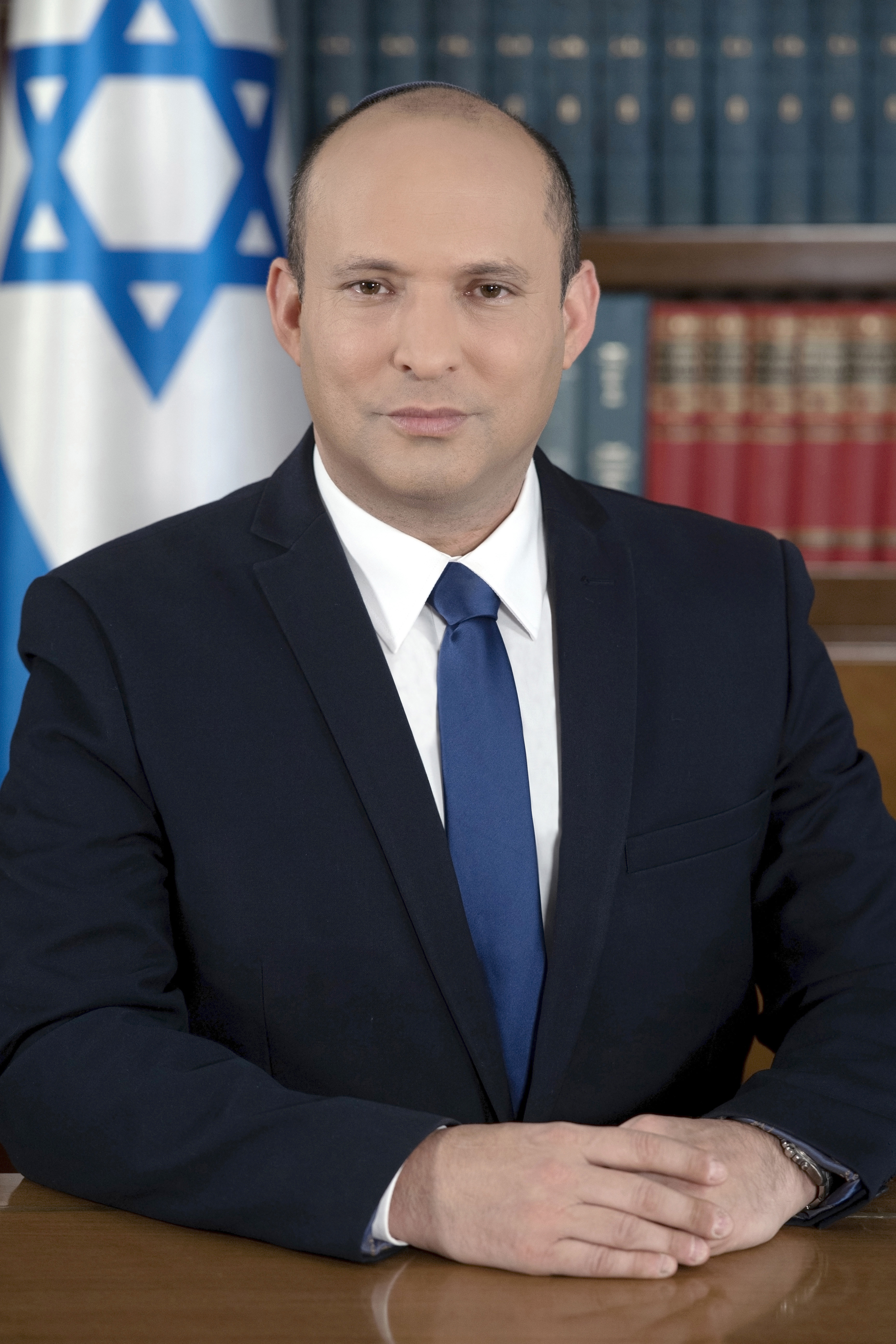
Background and career
Naftali Bennett (Hebrew: נַפְתָּלִי בֶּנֶט; born 25 March 1972) is an Israeli politician, businessman, and soldier who served as the prime minister of Israel from 2021 to 2022, and as the alternate prime minister from July to November 2022. Bennett has served as the head of Bennett 2026 since 2025; the party is allied with Yesh Atid as part of an alliance called Together. Bennett was the leader of the New Right party from 2018 to 2022, having previously led the religious Zionist and far-right political party The Jewish Home between 2012 and 2018. The son of immigrants from the United States, Bennett was born and raised in Haifa. Bennett served in the Sayeret Matkal and Maglan special forces units of the Israel Defense Forces, commanding many combat operations, and subsequently became a software entrepreneur. In 1999, he co-founded and co-owned the US company Cyota. The company was sold in 2005 for $145 million. He was also CEO of Soluto, an Israeli cloud computing service, that sold in 2013 for a reported $100–130 million. Bennett entered politics in 2006 as Chief of Staff for Benjamin Netanyahu until 2008. From 2010 to 2012, he was the director of the Yesha Council. In 2011, together with Ayelet Shaked, he co-founded the My Israel extra-parliamentary movement. In 2012, Bennett was elected as the party leader of The Jewish Home. In the 2013 Knesset election, the first contested by The Jewish Home under Bennett's leadership, the party won 12 seats in the Knesset. He served under Prime Minister Benjamin Netanyahu as Minister of Economy and Religious Services from 2013 to 2015, before being appointed Minister of Education in 2015. In December 2018, Bennett left The Jewish Home to form the New Right party. After he lost his Knesset seat in the April 2019 Knesset election, he was dismissed by Netanyahu as Education Minister in June 2019. He regained his seat in the September 2019 Knesset election, representing the New Right (now a member of the Yamina alliance), and was appointed Minister of Defense, before leaving the position the following year. In the 2021 Knesset election, Yamina under Bennett's leadership won 7 seats. On 2 June 2021, Bennett agreed to a rotation government with Yair Lapid, whereby Bennett would serve as Israel's prime minister until 2023, after which Lapid would assume the role until 2025. Bennett was sworn in on 13 June 2021. On 20 June 2022, following failures of the coalition to pass bills in the Knesset, Bennett announced he would call for a vote to dissolve the Knesset and step down as prime minister after the dissolution, to be succeeded by Lapid. On 29 June, he announced that he would not seek re-election in the 2022 Israeli legislative election. Lapid succeeded him as prime minister on 1 July 2022, while Bennett succeeded Lapid as the Alternate Prime Minister. He announced his resignation as alternative prime minister on 6 November, which became effective on 8 November. Bennett registered a new political party in April 2025 under the placeholder name Bennett 2026. In April 2026, Bennett 2026 formed a new political alliance with Yesh Atid named Together.
Bennett was born in Haifa, Israel, on 25 March 1972. He is the youngest of three sons born to Jim and Myrna (née Lefko) Bennett, American-Jewish immigrants who moved to Israel from San Francisco in July 1967. Both his parents were from Ashkenazi Jewish backgrounds. His father's ancestors were from Poland, Germany, and the Netherlands. Bennett's paternal great-great-great-grandfather Julius Salomonson was from Łobżenica, Poland, and arrived in San Francisco in 1851 during the California Gold Rush. His mother's ancestors lived in Russia and Poland, and her parents immigrated to the United States prior to World War II. They later moved to Israel, joining their daughter's family there, and settled on Vitkin Street in Haifa, close to where Bennett and his brothers grew up. Some of his mother's family members who remained in Poland were murdered in the Holocaust. Bennett's parents were raised in non-Orthodox Jewish homes and were progressive activists during the 1960s. His father was arrested while taking part in a Civil rights movement sit-in protest in 1964. They later began to observe Modern Orthodox Judaism and embraced right-wing Israeli politics. After moving to Israel in 1967, they volunteered for a few months at kibbutz Dafna, where they studied the Hebrew language, then settled in the Ahuza neighborhood of Haifa. Jim Bennett found a job in the Technion, working for its fundraising team, and became a successful real estate broker and real estate entrepreneur. Myrna Bennett was the deputy director general of the Association of Americans and Canadians in Israel's northern region. In the summer of 1973, when Bennett was one year old, the family returned to San Francisco at the urging of his mother. With the outbreak of the Yom Kippur War in October 1973, Jim Bennett returned to Israel to fight in the Israel Defense Forces, serving in an artillery unit on the Golan Heights front. Following the war, the rest of the family returned to Israel at his request as he was held in reserve duty for months after the war. Bennett's parents ultimately decided to stay permanently in Israel. In 1976, when Bennett was four years old, the family moved to Montreal for two years as part of his father's job. In Montreal he attended a Chabad preschool, which he credited with influencing his family in turning towards religious observance. After returning to Haifa, Bennett attended Carmel elementary school. When he was in second grade, the family moved to Teaneck, New Jersey for two years, again as part of his father's job. While living in New Jersey, Bennett attended Yavneh Academy. The family returned to Haifa when Bennett was ten. During Bennett's childhood, he visited San Francisco on family vacations nearly every summer. Bennett attended Yavne Yeshiva High School in Haifa and became a group leader (madrich) in the religious Zionist youth movement Bnei Akiva. Bennett has two brothers; they are Asher, a former Israeli Navy submarine officer and businessman based in the United Kingdom, and Daniel, an accountant for Zim Integrated Shipping Services.
Bennett was drafted into the Israel Defense Forces in 1990. He served in the elite Sayeret Matkal commando unit, and after his regular service was selected for officer training. He was given a choice of remaining in Sayeret Matkal but as a regular operator rather than a commander or transferring to the Maglan commando unit to receive a command position and chose to transfer to Maglan. He became a company commander in the Maglan unit. Bennett was discharged from active service after six years but continued to serve in the reserves and attained the rank of major. During the time that Bennett was living in the United States and building his career as a software entrepreneur, he repeatedly traveled to Israel to do reserve duty. Bennett served during the First Intifada and in the Israeli security zone in Lebanon during the 1982–2000 South Lebanon conflict. He commanded many operations. Among other missions, he served as an officer in Operation Grapes of Wrath. After his regular IDF service, Bennett received a law degree from the Hebrew University of Jerusalem. During the Second Intifada, he participated in Operation Defensive Shield. He was called up as a reservist in the Maglan special forces unit during the 2006 Lebanon War and participated in a search and destroy mission behind enemy lines, operating against Hezbollah rocket launchers. One of Bennett's actions as a commando officer became highly controversial. During Operation Grapes of Wrath, while leading a force of 67 Maglan soldiers operating in southern Lebanon, Bennett radioed for support after his unit came under mortar fire. The IDF launched an artillery barrage to cover his force, and the shelling hit a United Nations compound in which civilians were taking refuge, an incident that became known as the Qana massacre. A total of 106 Lebanese civilians were killed. The incident resulted in a wave of international condemnation, and the subsequent diplomatic pressure caused Israel to end Operation Grapes of Wrath sooner than planned. Journalist Yigal Sarna, writing in Israeli national tabloid Yedioth Ahronoth, argued that Bennett displayed "poor judgement" during the operation. Sarna wrote that "Bennett led a force of 67 combat troops into Lebanon. At a certain point, he decided to ignore orders and change operational plans, without coordinating these moves with his superiors, who in his mind were cowardly, and not steadfast enough. Near the village of Kfar Kana, Bennett's troops were caught in an ambush." Citing a "senior army figure", journalist Raviv Drucker said that Bennett's radio call for support after his unit came under fire was "hysterical" and contributed to the loss of life which occurred. Bennett responded: "I have now been subjected to an attack claiming that I am 'responsible for the massacre in Kfar Kana.' Heroism will not be investigated. Keep looking in the archives. My military file is available for viewing, and it's waiting for you." Former members of Bennett's unit wrote a letter defending him, saying: "Naftali ... led many successful operations that led to the elimination of Hezbollah terrorists deep in enemy territory." Other officers involved in the operation, including one who was Bennett's deputy during the Qana incident, also denied that he had changed plans without consulting his superiors. In October 2023, immediately following the start of the Gaza war, Bennett enlisted to do reserve duty, serving in the emergency storage unit of the IDF's Technological and Logistics Directorate.
In 1999, Bennett co-founded Cyota, an anti-fraud software company, and became its CEO. He moved to New York City in 2000 to oversee Cyota's corporate development, settling on the Upper East Side of Manhattan, and lived there for four years. In 2005, the company was sold to RSA Security for $145 million, making Bennett a multimillionaire. A stipulation of the deal allowed the Israeli arm of Cyota to remain intact. As of 2013, 400 Israelis were employed at the company's Israeli offices in Beersheba and Herzliya. Bennett was the CEO of Soluto, a technology company providing cloud-based service that enables remote support for personal computers and mobile devices in 2009, at a time when he and partner Lior Golan were engaged in raising funds for myriad Israeli technology startup companies. Soluto had hitherto raised $20 million from investors, including venture capital funds Giza Venture Capital, Proxima Ventures, Bessemer Venture Partners, Index Ventures, Michael Arrington's CrunchFund, and Eric Schmidt's Innovation Endeavors and Initial Capital. The sale of Soluto for a reported $100–130 million to the American company Asurion was finalized in October 2013. In June 2021, Forbes Israel reported that Bennett was expected to make $5 million from his investment in the American fintech company Payoneer. Bennett invested several hundred thousand dollars in the company before entering politics. Payoneer is set to list on the Nasdaq stock exchange with a $3.3 billion valuation after reaching a SPAC merger with FTAC Olympus Acquisition Corp in February 2021.
From 2010 to 2012, Bennett served as the director of the Yesha Council. In April 2011, together with Ayelet Shaked, he co-founded My Israel, which claims to have 94,000 Israeli members. In April 2012, he founded a movement named Yisraelim ("Israelis"). The movement's main goals include increasing Zionism among centre-right supporters, increasing dialogue between the religious and secular communities, and promoting "The Israel Stability Initiative." Bennett was elected the leader of The Jewish Home party in 2012. He was reelected as the party's leader in 2015 and 2017. Following his election to the Knesset, and before he could take his seat, Bennett had to renounce his U.S. citizenship, which he held as the son of American parents. He was appointed Minister of Economy and Minister of Religious Services in March 2013. In April 2013, he was also appointed Minister of Jerusalem and Diaspora Affairs. After being reelected in the 2015 Knesset election, Bennett was appointed Minister of Education and retained the Diaspora Affairs portfolio in the new government. In May 2015, Netanyahu split the Ministry of Jerusalem and Diaspora Affairs, initially taking back the Jerusalem Affairs portfolio for himself. He later appointed Ze'ev Elkin to the role of Jerusalem Affairs Minister. As Minister of Education, Bennett issued an official order prohibiting school principals from inviting members of Breaking the Silence and other organizations that denounce Israel's military conduct in the West Bank. In October 2015, Bennett resigned from the Knesset in order to allow Shuli Mualem to take his seat. His resignation took place under the Norwegian Law, which allowed ministers to resign their seats when in the cabinet but return to the Knesset if they leave the government. He returned to the Knesset on 6 December after Avi Wortzman opted to vacate his seat, having temporarily had to resign as a minister in order to do so. Following Avigdor Lieberman's resignation as Defense Minister in November 2018, Bennett announced that he was seeking the position for himself. On 16 November 2018, a Likud party spokesman announced that Netanyahu had rejected Bennett's request and that Netanyahu himself would take the position instead. It was then announced that Bennett's Jewish Home party would no longer be affiliated with Netanyahu's government. On 19 November, Bennett reneged on his pledge to withdraw from Netanyahu's coalition. In December 2018, Bennett was among the Jewish Home MKs to leave the party and form the breakaway New Right party. In the April 2019 Knesset election, New Right narrowly failed to cross the electoral threshold; as a result, Bennett did not gain a seat in the 21st Knesset. In June 2019, he left the government after Netanyahu dismissed Bennett from his positions as Education and Diaspora Affairs Minister. After the Knesset dissolved and a second election in 2019 was called for September, the New Right formed an electoral alliance with the Jewish Home and National Union-Tkuma, named the United Right which was later renamed Yamina, and was led by Ayelet Shaked. The list won seven seats in the election, and Bennett regained his Knesset seat. In November 2019, Bennett rejoined Netanyahu's government as Minister of Defense. After briefly dissolving, the Yamina alliance was reunified in January 2020 ahead of the 2020 Knesset election, with Bennett succeeding Ayelet Shaked as the new leader of the alliance. Yamina won six seats in that election. In May 2020, with negotiations taking place between Netanyahu and Benny Gantz (leader of the centrist Blue and White alliance) to form a new government, Yamina announced that it would go into the opposition, ending Bennett's tenure as Defense Minister. The day before, Rafi Peretz, the leader of The Jewish Home, had split from the alliance, and would be named as the Minister of Jerusalem in the thirty-fifth government of Israel. On 17 May, Bennett met with Gantz, who also succeeded him as Defense Minister, and declared that Yamina was now a "head held high" member of the opposition. Tkuma, which rebranded as the Religious Zionist Party on 7 January 2021, split from Yamina on 20 January. In spite of this, Yamina won seven seats in the 2021 Knesset election in March.
On 9 May 2021, it was reported that Bennett and Leader of the Opposition and Yesh Atid leader Yair Lapid had made major headway in coalition talks for forming a new Israeli government which would oust Prime Minister Benjamin Netanyahu. On 30 May, Bennett announced that he would be prime minister in a rotation government until August 2023, at which point Lapid would take over as prime minister until 2025. Bennett was sworn in on 13 June, ending Netanyahu's 12-year tenure in office. He is Israel's first kippah-wearing prime minister. On the fast of 9th of Av, 2021, as hundreds of Jews went to mourn on the temple mount, where it was forbidden for them to pray, Bennett wrote: "The Jewish people twice had a Jewish state on the Land of Israel, and both times we did not succeed to complete the eighth decade as an independent state, because of internal wars and baseless hatred ... At the time of the Roman siege on Jerusalem, the nation was divided, each group entrenched itself in its own position, and burned the food stores of the others, as part of the internal power struggle, so the Romans had a much easier task. The bitter end we all know, and until today every year on this date we mourn the awful destruction which a people with a little more baseless love, restraint, and listening, could have saved us from." Upon the government's formation in June 2021, it held 61 seats in the Knesset; all these members of the Knesset (MK) came from coalition parties excluding Yamina's Amichai Chikli. On 6 April 2022, Yamina MK Idit Silman, resigned from the coalition, causing the governing coalition to lose its majority in the Knesset. On 13 June, Yamina MK Nir Orbach left the coalition, arguing that left-wing members of the coalition were holding it hostage. Several days later, on 20 June, Bennett and Lapid announced the introduction of a bill to dissolve the Knesset in a joint statement, stating that Lapid would become the interim prime minister following the dissolution. The Knesset was dissolved on the night of 30 June, ending Bennett's term as prime minister.
Sources
Net-worth figure: Celebrity Net Worth (October 2026), in USD. Biography and career facts: the person's Wikipedia article and linked reporting. Snapshot date for all StarWorth figures: 28 October 2026.


