Background and career
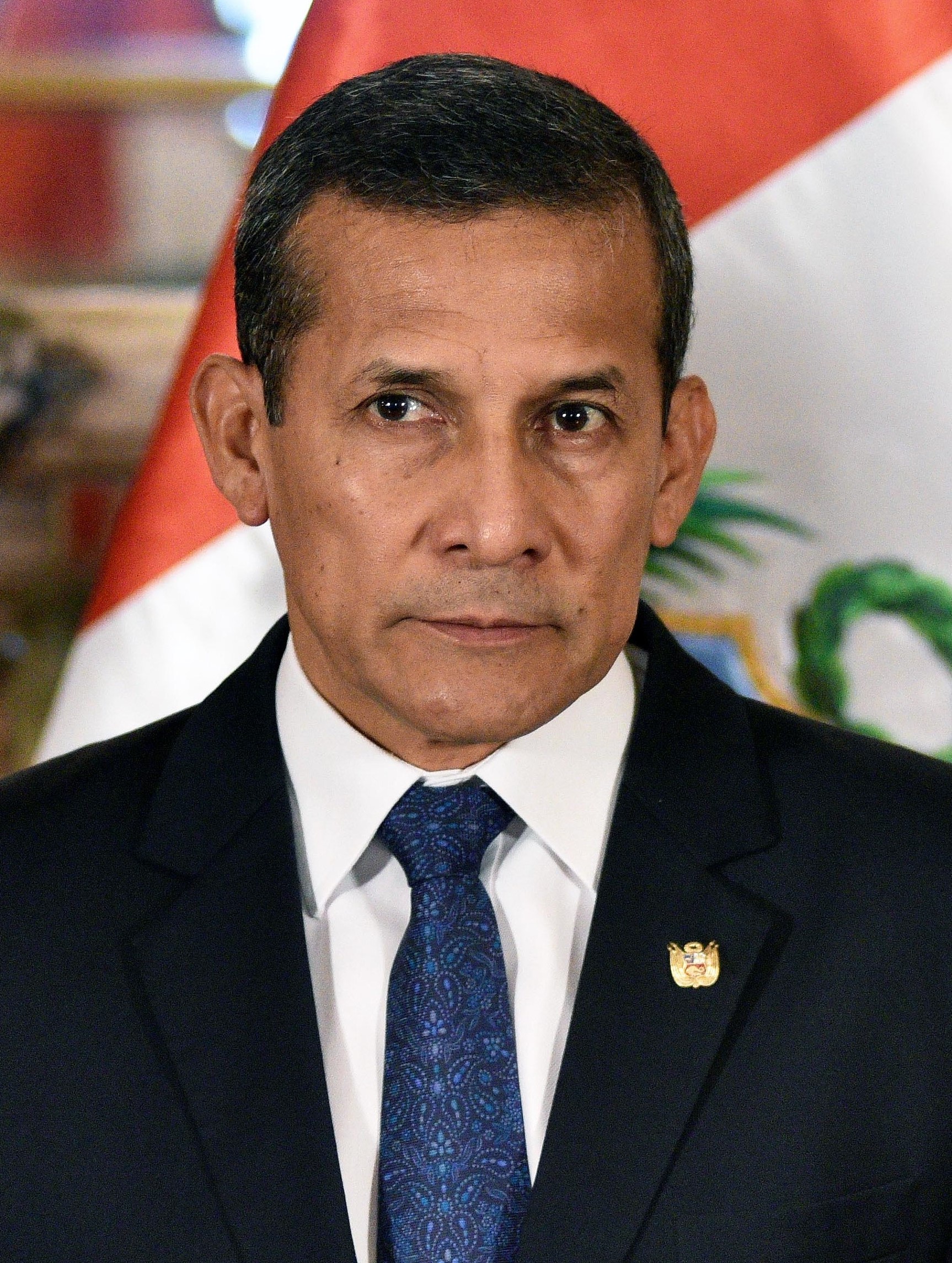
Ollanta Moisés Humala Tasso (born 27 June 1962) is a Peruvian former military officer and politician who served as president of Peru from 2011 to 2016. A leftist, he founded the Peruvian Nationalist Party, but shifted towards neoliberalism and the political centre during his presidency. Born to a prominent political family affiliated with the ethnocacerist movement, Humala is the son of Quechua labour lawyer Isaac Humala. He entered the Peruvian Army in 1981, eventually achieving the rank of lieutenant colonel. During his time in the military, he fought in the internal conflict against left-wing terrorist group Shining Path as well as in the Cenepa War with neighboring Ecuador. In October 2000, Humala attempted an unsuccessful coup d'etat against President Alberto Fujimori during the final days of his regime; eventually, the Congress of the Republic of Peru granted him amnesty and he was allowed to return to military duty. Humala entered electoral politics in 2005, founding the Peruvian Nationalist Party (PNP) in order to run in the 2006 Peruvian general election. After finishing first in the opening round, he lost the runoff by a narrow margin to the centre-left former president and Peruvian Aprista Party nominee Alan García. His campaign received widespread international attention in 2006 given the pink tide in Latin America. In the 2011 Peruvian general election, Humala ran again, defeating Keiko Fujimori of the right-wing Force 2011 in the runoff. To allay fears of radical policies, Humala filled much of his cabinet with centrists at the start of his term. His presidency proved unpopular and was overshadowed by corruption allegations involving him and Nadine Heredia. Environmentalists were highly critical of Humala's mining policies, and argued that he reneged on his campaign promise to rein in mining companies. In 2017, Humala was arrested by Peruvian authorities on corruption charges. Humala attempted a political comeback in the 2021 presidential election, but only received 1.5% of the vote, finishing in 13th place. In 2025, he and Heredia were convicted of money laundering linked to the Brazilian construction company Odebrecht and each sentenced to 15 years' imprisonment; Heredia was granted diplomatic asylum by Brazil and remains there. As of 2026, Humala was the last Peruvian president to serve a full term, with most of his successors either resigning or being impeached.
Humala was born in Lima, Peru on 27 June 1962. His father Isaac Humala, who is of Quechua ethnicity, is a labor lawyer, member of the Communist Party of Peru – Red Fatherland, and ideological leader of the Ethnocacerista movement. Ollanta's mother is Elena Tasso, from an old Italian family established in Peru at the end of the 19th century. He is the brother of Antauro Humala, who later served a 25-year prison sentence for kidnapping 17 police officers for 3 days and killing 4 of them in the Andahuaylas uprising and whose party Union for Peru was involved in the removal of former President Martín Vizcarra in 2020. Another brother is the academic and politician Ulises Humala. Humala attended the French-Peruvian school Franco-Peruano, and later the "Colegio Cooperativo La Union," established by part of the Peruvian-Japanese community in Lima. He began his military career in 1980 when he entered the Chorrillos Military School, like his brother Antauro (who had done so a year earlier). In 1983, he was a student at the School of the Americas (SOA), in the cadet combat course. He graduated as an Artillery lieutenant on 1 January 1984, forming part of the "Heroes of Pucará and Marcavalle" class. In 1997, he earned the graduate diploma of PADE in Business Administration from ESAN Graduate School of Business. In 2001, he completed a master's degree at the Center for Higher National Studies (CAEN) in National Defense and in 2002, he successfully completed a master's degree in political science at the Pontifical Catholic University of Peru.
In his military career, Humala was also involved in the two major Peruvian conflicts of the past 20 years, the battle against the insurgent organization Shining Path and the 1995 Cenepa War with Ecuador. In 1991, with the rank of captain, Humala served in Tingo María, Huanuco fighting the remnants of the Shining Path and in 1995 he served in the Cenepa War on the border with Ecuador.
In October 2000, Humala led an uprising in Toquepala against Alberto Fujimori on his last days as president due to multiple corruption scandals. The main reason given for the rebellion was the capture of Vladimiro Montesinos, former intelligence chief who had fled Peru for asylum in Panama after being caught on video trying to bribe an opposition congressman. The return of Montesinos led to fears that he still had much power in Fujimori's government, so Humala and about 40 other Peruvian soldiers revolted against their senior army commander. Montesinos claims that the uprising facilitated his concurrent escape. Many of Humala's men deserted him, leaving him only 7 soldiers. During the revolt, Humala called on Peruvian "patriots" to join him in the rebellion, and around 300 former soldiers led by his brother Antauro answered his call and were reported to have been in a convoy attempting to join up with Humala. The revolt gained some sympathy from the Peruvian populace with the influential opposition newspaper La República calling him "valiant and decisive, unlike most in Peru". The newspaper also had many letters sent in by readers with accolades to Ollanta and his men. In the aftermath, the Army sent hundreds of soldiers to capture the rebels. Even so, Humala and his men managed to hide until President Fujimori was impeached from office a few days later and Valentín Paniagua was named interim president. Finally, on 10 December, both brothers surrendered, being transferred to Lima, where they surrendered to the Second Judicial Zone of the country. The opening of the process was ruled for rebellion, sedition and insult to the superior. The lawyer Javier Valle Riestra requested an amnesty for the Humala, alleging that they had exercised the "right to insurrection against an illegitimate and totalitarian government." On 21 December 2000, Congress granted them the requested amnesty, which was extended to military and civilian personnel who participated in the insurrection and Humala was allowed to return to military duty.
In 2002, Humala received a master's degree in political science from the Pontifical Catholic University of Peru. He was sent as military attaché to Paris, then to Seoul until December 2004, when he was forcibly retired. His forced retirement is suspected to have partly motivated an etnocacerista rebellion in Andahuaylas led by his brother Antauro Humala in January 2005.
In October 2005 Humala created the Partido Nacionalista Peruano (the Peruvian Nationalist Party) and ran for the presidency in 2006 with the support of Union for Peru (UPP). Ambassador Javier Pérez de Cuéllar, the former Peruvian Secretary-General of the United Nations and founder of UPP, told the press on 5 December 2005, that he did not support the election of Humala as the party's presidential candidate. He said that after being the UPP presidential candidate in 1995, he had not had any further contact with UPP and therefore did not take part in choosing Humala as the party's presidential candidate for the 2006 elections. There were some accusations that he incurred in torture, under the nom de guerre "Capitán Carlos" ("Captain Carlos"), while he was the commander of a military base in the jungle region of Madre Mia from 1992 to 1993. His brother Antauro Humala stated in 2006 that Humala had used such a name during their activities. Humala, in an interview with Jorge Ramos, acknowledged that he went under the pseudonym Captain Carlos but stated that other soldiers went under the same name and denied participation in any human rights abuses. On 17 March 2006, Humala's campaign came under some controversy as his father, Issac Humala, said "If I was President, I would grant amnesty to him (Abimael Guzmán) and the other incarcerated members of the Shining Path". He made similar statements about amnesty for Víctor Polay, the leader of the Túpac Amaru Revolutionary Movement, and other leaders of the MRTA. But Ollanta Humala distanced himself from the more radical members of his family during his campaign. Humala's mother, meanwhile, made a statement on 21 March calling for homosexuals to be shot. Ollanta Humala's brother, Ulises Humala, ran against him in the election, but was considered an extremely minor candidate and came in 14th place in the election. On 9 April 2006, the first round of the Peruvian national election was held. Humala came in first place getting 30.62% of the valid votes, and immediately began preparing to face Alan García, who obtained 24.32%, in a runoff election on 4 June. Humala campaigned in Trujillo, an eminently Aprista city, during the last week of April. Starting in May, he visited the department of Ayacucho and then the city of Puno. On 9 May, he met again with Bolivian President Evo Morales, in the border town of Copacabana and received the support of the aforementioned president. Different Peruvian media opposed to Ollanta Humala, indicated at a certain point that the Canarian journalist Ramón Pérez Almodóvar would be advising the presidential candidate for the second electoral round, an accusation that was denied by the journalist, although he admitted that he was participating in the campaign. On 20 May 2006, the day before the first presidential debate between Alan García and Ollanta Humala, a tape of the former Peruvian intelligence chief Vladimiro Montesinos was released by Montesinos' lawyer to the press with Montesinos claiming that Humala had started the 29 October 2000 military uprising against the Fujimori government to facilitate his escape from Peru amidst corruption scandals. Montesinos is quoted as saying it was a "farce, an operation of deception and manipulation".
Sources
Net-worth figure: Celebrity Net Worth (October 2026), in USD. Biography and career facts: the person's Wikipedia article and linked reporting. Snapshot date for all StarWorth figures: 28 October 2026.