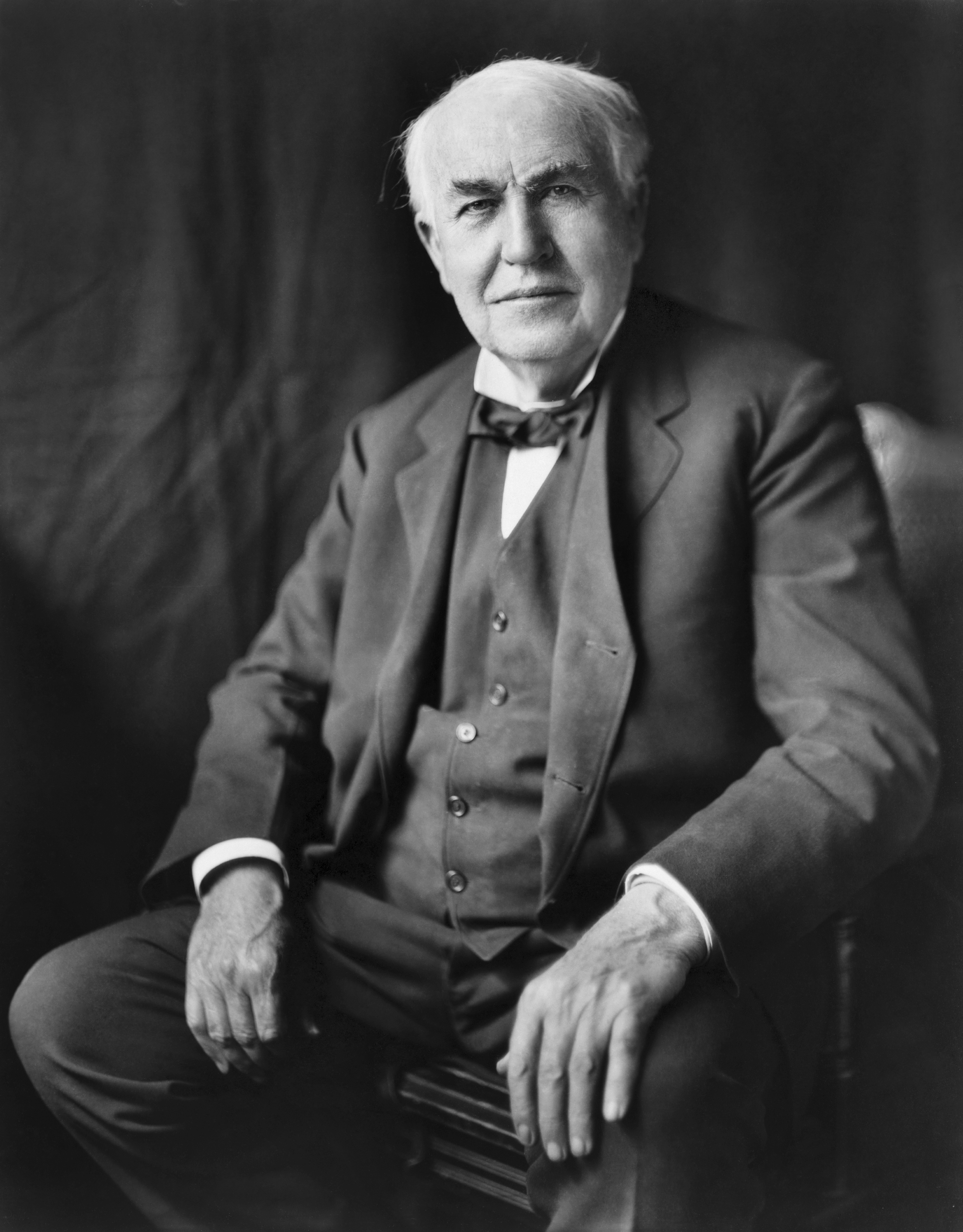
Background and career
Thomas Alva Edison (February 11, 1847 – October 18, 1931) was an American inventor and businessman known for his work on the incandescent light bulb, the phonograph, electric power distribution and early motion pictures. The merger of the Edison General Electric Company and the competitor Thomson-Houston Electric Company resulted in the formation of General Electric. Edison registered 1,093 patents in the United States. Edison was born in Milan, Ohio, but grew up in Michigan with little formal schooling. He became deaf as a child and learned through books and tinkering. Edison began working at a young age; as a railroad telegrapher, he spent much of his time inventing improvements to telegraph systems. By the age of 22, he had sold a few of his early inventions and moved to New York City to focus on engineering. He had three children with his first wife, Mary, but Edison was neglectful. She died at 29 years old. Edison had troubled relationships with his children for the rest of his life. With the help of friends, the inventor attracted investment and grew his company. By the age of 29, he owned a telegraph recorder factory in Newark with over one hundred employees. Edison expanded, developing Menlo Park, now considered the first industrial research laboratory. Edison, known as "The Wizard of Menlo Park", drove his staff extremely hard and constantly worked himself and his associates to exhaustion. The inventor also drove up investment and publicity. He rose to international fame with the invention of the phonograph which took many years to turn into a commercial success. He later built a larger research lab in West Orange, New Jersey. In 1878, Edison began working on an electrical lighting system which he hoped would replace the common gas lamp. Going from electrical light bulb to the modern electric grid took decades of invention, investment, and influence. Edison and his colleagues had the opportunity to get enormously wealthy as they designed and built a nation of light bulbs, generators, and electric distribution systems. Competition with Westinghouse's AC system forced Edison to yield and resulted in the creation of General Electric. Edison simultaneously created a mining company, which was never profitable, and he nearly went bankrupt. As his role in the illumination business declined, he established a cement company and began work on a motion picture camera. The motion picture camera went from an invention to the first movie production studio. He traveled around the United States and Europe promoting his many innovations, during which he met Mina, his second wife. They had three children together, and Edison was again neglectful. During their adulthood, he began to take more interest in his sons and they eventually worked for him. Charles Edison took over his father's business when he died. In addition to acute health issues from handling toxic and radioactive chemicals during his various experiments, Thomas faced a lifelong battle against diabetes. He worked vigorously until his death. Following the success of the illumination business, he ran several companies which produced batteries, movies, musical records, and phenol. His last obsession was the search for domestic rubber production.
Thomas Edison was born in 1847 in Milan, Ohio, and grew up in Port Huron, Michigan, after the family moved there in 1854. He was the seventh and last child of Samuel Ogden Edison Jr. and Nancy Matthews Elliott. Samuel Edison Jr. moved to Vienna, Ontario, before fleeing to Ohio after his involvement in the Rebellion of 1837. Edison was taught reading, writing, and arithmetic by his mother, a former school teacher. He attended school for only a few months, but was an inquisitive child who learned most things by reading on his own. Inspired by a copy of A School Compendium of Natural and Experimental Philosophy given to him by his mother, the young Edison tinkered and learned about electricity. His parents also owned a set of books by Thomas Paine, whose work inspired Edison's thinking throughout his life. Edison developed hearing problems at the age of 12. Historian Paul Israel attributed the cause of his deafness to a bout of scarlet fever during childhood and recurring untreated middle-ear infections. The young Alva, as he was known at the time, concocted elaborate fictitious stories about the cause of his deafness. He was completely deaf in one ear and barely hearing in the other. As an adult, he believed his hearing loss allowed him to avoid distraction and concentrate more easily on his work. Edison began his career as a news butcher, selling newspapers, candy, and vegetables on trains running from Port Huron to Detroit. By age 13 he profited about $50 ($1,792 in 2025) weekly. He spent the money on supplies for electrical and chemical experiments. He founded the Grand Trunk Herald, which he sold with his other papers. The paper ran twenty-four issues and was unique in its original coverage of local news. Five hundred people subscribed to the paper, and Edison was able to hire at least two assistants. Edison was proud of his work on the train; he displayed a framed copy of the paper's first issue in his home for the rest of his life. As a boy, Edison and a neighbor built a small telegraph line. While working on the trains he sat in with various telegraph operators to learn the skill. Edison began working as a telegrapher in a local general store before moving to Stratford Junction, Ontario, where he worked as a night telegrapher for the Grand Trunk Railway. While on the job, he studied qualitative analysis, conducted chemical experiments, and slept. This negligence led to the near collision of two trains, after which he resigned.
From 1863 to 1869, Edison held a succession of night-shift telegraphy positions across Ontario, Michigan, Kentucky, Ohio, and Massachusetts. As a Western Union employee, he worked the Associated Press bureau news wire. In Cincinnati, he lived with Ezra Gilliland. They formed a friendship which lasted 25 years. He joined the National Telegraph Union and wrote for their magazine. He earned a reputation among the other young, male telegraph operators for being bright and trying new things, but on several occasions his tinkering interfered with his work. In Boston, from 1867 to 1869, Edison made some money from inventing a stock ticker for local customers, but he lost it when he tried to expand the venture to New York. His first patent was for the electric vote recorder, U.S. patent 90,646, which was granted on June 1, 1869.
Edison moved to New York City in 1869. Among his early mentors was Franklin Leonard Pope a fellow telegrapher. He allowed the impoverished young Edison to live and work in the basement of his Elizabeth, New Jersey, home while Edison was employed by Samuel Laws at the Gold Indicator Company. Pope and Edison founded their own company in October 1869, working as electrical engineers. Edison attracted wealthy and connected investors. With the money, they hired fifty employees within a few months and opened a larger shop in Newark, New Jersey. The company rented out telegraph lines. To win business, they manufactured machines to record telegraphs and typewriters capable of printing directly to the wire. Edison strictly regulated his employees' productivity while endlessly experimenting. To support his work on a new telegraphy system with Charles Batchelor, Edison enrolled in a chemistry course at the Cooper Union. It was his only enrollment in courses at an institution of higher learning. At the factory, Edison and Batchelor collaborated fervently; their notebooks jointly signed "E&B" contain near-constant experimentation with improvements to the telegraph. Edison grew the company to a few hundred employees, and in 1874, received $30,000 ($853,676 in 2025) for the quadruplex telegraph, the first device that could simultaneously transmit four messages over a single wire. Until then, Edison had struggled to meet his financial obligations and had narrowly avoided foreclosure on multiple occasions. With the money, Edison invested in the Port Huron street railway, which was owned by his brother William Pitt. He expanded his own business, and he hired his young nephew and father.
In Menlo Park, New Jersey, Edison established the first industrial laboratory concerned with creating knowledge and then controlling its application. Built in 1876, in Raritan Township (now named Edison Township in his honor) the construction was funded by the sale of Edison's quadruplex telegraph. His staff was generally told to carry out his directions in conducting research, and he drove them hard to produce results. Edison's name is registered on 1,093 patents in the United States— during his adult life, he averaged a patent once every 10–12 days. As the leader of his laboratory, Edison was credited for inventions made in large part by those working under him. He worked extreme hours and expected those around him to follow suit. This often meant 18 hours per day Monday through Friday and additional work on Saturday and Sunday. One employee described the work as "the limits of human exhaustion." Edison employed several patent lawyers and challenged the intellectual property rights of many contemporaries. For Edison, big business came with big publicity. He shut down public and reporter access to the laboratory at Menlo Park and tailored his image via interviews. In just over a decade, Edison's Menlo Park laboratory had expanded to occupy two city blocks. Edison wanted the lab to have "a stock of almost every conceivable material".
In 1876, Edison set out to improve telephones by developing a carbon microphone. Western Union, seeking to compete with Alexander Graham Bell, financed Edison experiments. Edison believed that the weakness in Bell's telephone was the microphone designed by Emile Berliner. Edison iterated many different designs and tested which gave the best sound while ensuring it was loud enough for his deaf ears. His chosen design used two metal plates separated by carbon granules, which varied in electrical resistance in response to the pressure of sound waves. After testing 150 materials, Edison determined that parchment and tinfoil were best suited for constructing the diaphragm, while a specially coated rubber served as the semiconductor. David Edward Hughes also published a paper on the physics of loose-contact carbon microphones in 1878. He was credited for discovering the semiconductor effect. This angered Edison and caused public controversy, particularly because Hughes acknowledged that he was advised by one of Edison's colleagues.
Sources
Net-worth figure: Celebrity Net Worth (October 2026), in USD. Biography and career facts: the person's Wikipedia article and linked reporting. Snapshot date for all StarWorth figures: 28 October 2026.


