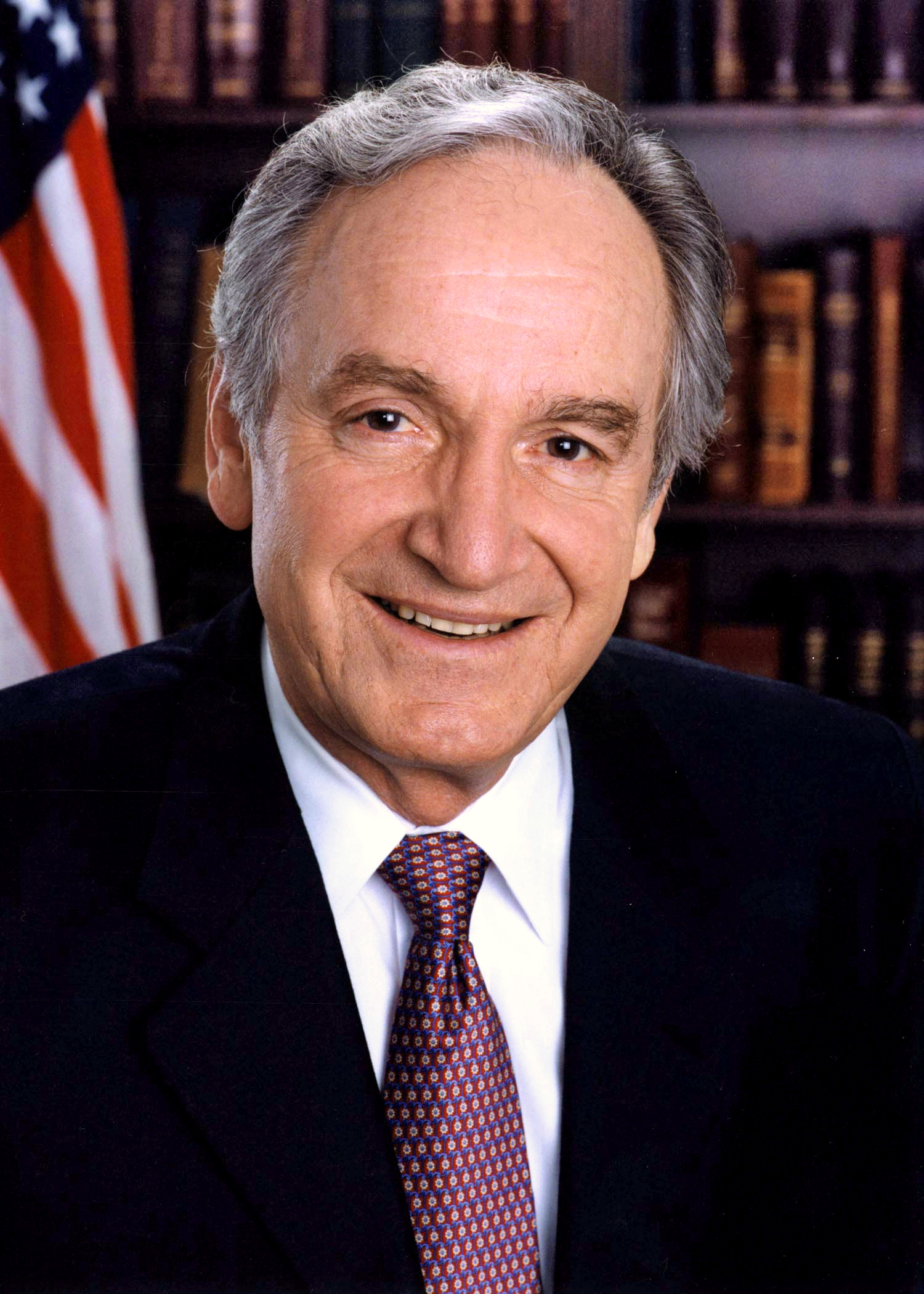
Background and career
Thomas Richard Harkin (born November 19, 1939) is an American lawyer, author, and politician who served as a United States senator from Iowa from 1985 to 2015. A member of the Democratic Party, he previously was the U.S. representative for Iowa's 5th congressional district from 1975 to 1985. He is the longest-serving United States Senator to spend their entire tenure as a state's junior senator. Born in Cumming, Iowa, Harkin graduated from Iowa State University and The Catholic University of America's Columbus School of Law. He served in the United States Navy as an active-duty jet pilot (1962–1967). After serving as a congressional aide for several years, he made two runs for the U.S. House of Representatives, losing in 1972 but winning in 1974. He went on to serve five terms in the House. Harkin won a race for U.S. Senate in 1984 by a wide margin. He was an early frontrunner for his party's presidential nomination in 1992, but he dropped out in support of eventual winner Bill Clinton. He served five Senate terms and at the end of his time in the Senate served as chair of the Senate Committee on Health, Education, Labor, and Pensions. He authored the Americans with Disabilities Act of 1990 and was its chief sponsor in the Senate. Harkin delivered part of his introduction speech in sign language, saying it was so his deaf brother could understand. On January 26, 2013, Harkin announced that he would not seek reelection in 2014.
Harkin was born in Cumming, Iowa. His father, Patrick Francis Harkin, an Irish American, was a coal miner, and his mother, Franciska Frances Valentine (née Berčič), was a Slovene immigrant who died when he was ten. Harkin has three half-siblings on his mother's side from her first marriage in Iowa to fellow Slovenian Valentine Brelih. Frances was born in Suha, Slovenia to Jakob and Marija (born Jugovec). He still maintains his childhood house, where he and his five siblings were raised without hot running water or a furnace. He attended Dowling Catholic High School which is located in West Des Moines, Iowa. Harkin attended Iowa State University on a Navy ROTC scholarship and became a member of Delta Sigma Phi fraternity. He graduated with a degree in government and economics in 1962, and served in the United States Navy as an active-duty jet pilot from 1962 to 1967. Harkin was stationed at Naval Air Facility Atsugi in Japan, where he ferried aircraft to and from the airbase that had been damaged in the Vietnam War and in operational and training accidents. He was also stationed for a time at Guantanamo Bay, where he flew missions in support of U-2 planes reconnoitering Cuba. After leaving active duty in 1967, he spent three years in the Ready Reserves, and transitioned into the Naval Reserves in 1970. He retired in 1989 with the rank of commander. In 1969, Harkin moved to Washington, D.C., and began work as an aide to Democratic U.S. Congressman Neal Smith. During his work for Smith, he accompanied a congressional delegation that went to South Vietnam in 1970. Harkin published photographs he took during the trip and a detailed account of the "Tiger cages" at Côn Đảo Prison in Life Magazine on July 17, 1970. The account exposed shocking, inhumane conditions and treatment to which prisoners were subjected. He received his Juris Doctor (J.D.) degree from The Catholic University of America's Columbus School of Law in 1972.
In 1972, the same year that he graduated from law school, Harkin returned to Iowa and immediately ran against an incumbent Republican Congressman, William J. Scherle. Scherle represented the southwestern portion of Iowa, which (with one brief exception) had not elected a Democrat to Congress since the end of the Great Depression. While winning a higher percentage of votes than any of Scherle's previous opponents, Harkin nevertheless lost the race. After his 1972 defeat, Harkin practiced law in Ames before seeking a rematch against Scherle in 1974. In what was generally a bad year for Republicans due to the Watergate scandal, Harkin defeated Scherle by only 3,500 votes. He was re-elected four more times from Iowa's 5th congressional district without serious difficulty.
In 1984, Harkin won the Democratic nomination for the United States Senate and defeated freshman Republican Roger Jepsen by 152,502 votes. He was re-elected in 1990, 1996, 2002, and 2008.
Harkin served in the United States Senate longer than any Democrat in Iowa's history. In 2009, he passed Neal Edward Smith as the longest-serving Democrat in either chamber from Iowa. Notably, he spent his entire tenure as Iowa's junior Senator, due to his colleague Chuck Grassley having served in the chamber since 1981. He and Grassley had a fairly good relationship, despite their often sharp ideological differences, and their seniority made Iowa influential in national politics. Indeed, during his tribute to Harkin shortly before his departure, Grassley got notably choked up as Harkin entered the chamber. Harkin and Barbara Boxer were the only Senate Democrats to support Wisconsin Senator Russ Feingold's 2006 resolution to censure President George W. Bush. Harkin (in addition to U.S. Senators Dick Lugar, Tim Johnson, Byron Dorgan, Joe Biden and Norm Coleman), introduced the BioFuels Security Act (S. 2817/109th) on March 16, 2006. Harkin came out in favor of the Fairness Doctrine during an interview with Bill Press. (February 11, 2009) Harkin has been influential in increasing research funding for alternative medicine. He was instrumental in the creation of the U.S. Office of Alternative Medicine in 1992, which later became the National Center for Complementary and Alternative Medicine. His efforts and the center's results, however, have been criticized. On July 16, 2013, Harkin introduced the Cooperative and Small Employer Charity Pension Flexibility Act (S. 1302; 113th Congress) into the Senate. The bill would make changes to the Employee Retirement Income Security Act of 1974 (ERISA) and the Internal Revenue Code of 1986 to alter the funding requirements of certain private pension plans that are maintained by more than one employer where the employers are either cooperatives or charities. The bill would make permanent an existing exemption from the Pension Protection Act of 2006 for a few small groups. On November 19, 2013, Harkin introduced the Minimum Wage Fairness Act (S. 1737; 113th Congress). The bill would amend the Fair Labor Standards Act of 1938 (FLSA) to increase the federal minimum wage for employees to $10.10 per hour over the course of a two-year period. The bill was strongly supported by President Barack Obama and many of the Democratic Senators, but strongly opposed by Republicans in the Senate and House.
Harkin introduced the Americans with Disabilities Act (ADA) into the Senate. Harkin delivered part of a speech in sign language so his deaf brother could understand. Harkin has taken issue with the Supreme Court's handling of a number of cases related to ADA, concerned that the judgments severely limited the scope of the legislation's effectiveness: "Together, these cases, as handled by the nation's highest court, have created a supreme absurdity: The more successful a person is at coping with a disability, the more likely it is for a court to find that he or she is no longer sufficiently disabled to be protected by the ADA. If that is the ruling, then these individuals may find that their requests for reasonable accommodations at work can be denied. Or that they can be fired—without recourse." In order to address these issues Harkin proposed the ADA Amendments Act, which in his words "will restore the proper balance and application of the ADA by clarifying and broadening the definition of disability, while increasing eligibility for ADA protections." Harkin has also been a vocal critic of what he describes as the biased nature of the Medicaid program: "The current Medicaid system is unacceptably biased in favor of institutional care. Two-thirds of Medicaid long-term care dollars are spent on institutional services, with only one-third going to community-based care. It's time to rebalance the system." During his political career, Harkin has generally supported the Supreme Court ruling Roe v. Wade, which decided that a right to privacy under the due process clause in the Fourteenth Amendment to the United States Constitution extends to a woman's decision to have an abortion. He has opposed most efforts to place legal restrictions on Roe v. Wade, including voting against a ban on late-term abortion, while supporting contraception and education to reduce teen pregnancy. As of 2003, Harkin received a 100 percent rating from NARAL, the pro-choice advocacy organization. He was very critical of the Stupak-Pitts Amendment, which places limits on taxpayer-funded abortions in the context of the November 2009 Affordable Health Care for America Act.
Sources
Net-worth figure: Celebrity Net Worth (October 2026), in USD. Biography and career facts: the person's Wikipedia article and linked reporting. Snapshot date for all StarWorth figures: 28 October 2026.


