Background and career
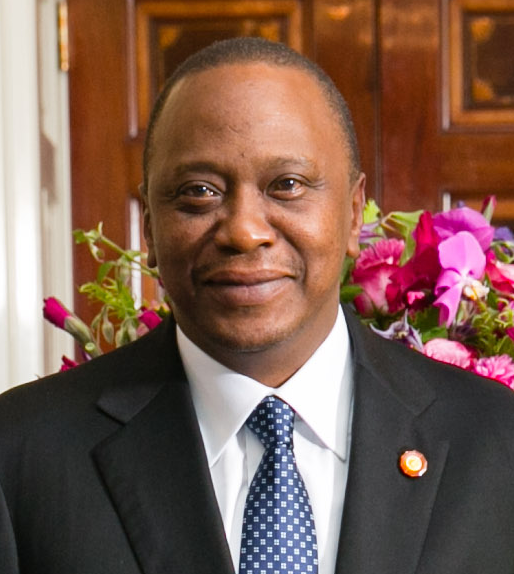
Uhuru Mũigai Kenyatta ( born 26 October 1961) is a Kenyan politician who served as the fourth president of Kenya from 2013 to 2022. The son of Jomo Kenyatta, Kenya's first president, he had previously served as Deputy Prime Minister from 2008 to 2013 and as the leader of official opposition from 2003 to 2007. Daniel Arap Moi had picked Kenyatta as his preferred successor. However, he was defeated by the then opposition leader Mwai Kibaki in the 2002 election, and Kibaki was subsequently sworn in as the President. Kenyatta served as the member of parliament (MP) for Gatundu South from 2002 to 2013 and also as Deputy Prime Minister to Raila Odinga from 2008 to 2013. Currently he is a member and the party leader of the Jubilee Party of Kenya, whose popularity has since dwindled. Kenyatta was previously a member of the Kenya Africa National Union (KANU), a political party that had led Kenya to independence in 1963. He resigned from KANU in 2012 and joined The National Alliance (TNA), one of the allied parties that campaigned for his election victory during the 2013 election. He later on went to form a merger with the United Republican Party (URP) led by William Ruto to form the Jubilee Party. Kenyatta was re-elected for a second and final term in the August 2017 general elections, winning 54% of the popular vote. The win was formally declared on national television by the Chairperson of the Independent Electoral and Boundaries Commission (IEBC), Wafula Chebukati. However, Uhuru's election was challenged in the Supreme Court of Kenya by his main competitor, Raila Odinga. On 1 September 2017, the court declared the election invalid and ordered a new presidential election to take place within 60 days from the day of the ruling. A new presidential election was held on 26 October, which he won, with 39.03% electoral voter participation. In October 2021, Kenyatta and six of his family members including his mother, Mama Ngina, and brother, Muhoho—were named in the Pandora Papers leak as beneficiaries of a secretive network of offshore companies and foundations. The documents revealed that the family held assets valued at over $30 million in tax havens such as Panama and the British Virgin Islands, including a secret investment portfolio and real estate. These revelations drew significant criticism, as the use of offshore entities to shield wealth directly contradicted Kenyatta's public "war on corruption" and his administration's mandate for financial transparency and lifestyle audits for Kenyan state officers.
Uhuru Kenyatta was born on 26 October 1961, to the first president of Kenya, Jomo Kenyatta, and his fourth wife, Mama Ngina Kenyatta (née Muhoho). The second born in the family, he has two sisters, Christine (born 1953), Anna Nyokabi (born 1963) and a brother, Muhoho Kenyatta (born 1965). His family hails from the Kikuyu, a Bantu ethnic group. His given name "Uhuru" is from the Swahili term for "freedom" and was given to him in anticipation of Kenya's upcoming independence. Uhuru attended St Mary's School in Nairobi. Between 1979 and 1980, he also briefly worked as a teller at the Kenya Commercial Bank. After attending St. Mary's school, Uhuru went on to study economics, political science and government at Amherst College in the United States. Upon his graduation, Uhuru returned to Kenya, and started a company, Wilham Kenya Limited, through which he sourced and exported agricultural produce. Uhuru was nominated to Parliament in 1999, he then became the Minister for Local Government under President Daniel Arap Moi and, despite his political inexperience, was favoured by Moi as his successor. Kenyatta ran as KANU's candidate in the December 2002 presidential election, but lost to the opposition candidate Mwai Kibaki by a big margin. He subsequently became Leader of the Opposition in Parliament. He backed Hon. Mwai Kibaki for re-election in the December 2007 presidential election and was named Minister of Local Government by Former President Mwai Kibaki in January 2008, before being appointed as the Deputy Prime Minister and Minister of Trade in April 2008 as part of the new coalition government. Subsequently, Uhuru Kenyatta was Minister of Finance from 2009 to 2012, while remaining Deputy Prime Minister. Accused by the International Criminal Court (ICC) of committing crimes against humanity in relation to the violent aftermath of the 2007 election, he resigned as Minister of Finance on 26 January 2012. He was elected as President of Kenya in the March 2013 presidential election, defeating Raila Odinga with a slim majority in a single round of voting.
In the 1997 general election, Uhuru Kenyatta contested for the Gatundu South Constituency parliamentary seat, once held by his father, but lost to Moses Mwihia, a Nairobi architect. In 1999, Moi appointed Uhuru to chair the Kenya Tourism Board, a government parastatal. In 2001, he was nominated as a Member of Parliament, and joined the Cabinet as Minister for Local Government. He would also later be elected First Vice Chairman of KANU. In the 2002 nomination process, which was widely thought as undemocratic and underhand, Moi influenced Uhuru Kenyatta's nomination as KANU's preferred presidential candidate, sparking an outcry from other interested contenders and a massive exit from the party ensued. This move by the late President Moi was seen as a ploy to install Uhuru as a puppet so that even in retirement, Moi would still rule the country through Uhuru and presumably insulate himself against the numerous charges of abuse of office that plagued his presidency. Uhuru finished second to Mwai Kibaki in the General Elections, with 31% of the vote. He conceded defeat and took up an active leadership role as Leader of the Opposition. In January 2005, Uhuru Kenyatta defeated Nicholas Biwott for chairmanship of KANU, taking 2,980 votes among party delegates against Biwott's 622 votes. Uhuru led his party KANU in the referendum campaigns against the draft constitution in 2005, having teamed up with the Liberal Democratic Party, a rebel faction in the Kibaki government, to form the Orange Democratic Movement. The result of this was a vote against the adoption of the draft constitution by a noticeable margin, which was a great political embarrassment to Emilio Mwai Kibaki. In November 2006, Kenyatta was displaced as KANU leader by the late Nicholas Biwott. On 28 December 2006, the High Court of Kenya reinstated Uhuru Kenyatta as KANU chairman. However, further court proceedings followed. On 28 June 2007, the High Court confirmed Kenyatta as party leader, ruling that there was insufficient evidence for Biwott's argument that Kenyatta had joined another party. In the run up to the 2007 general election, he led KANU to join a coalition (called Party of National Unity "PNU") with President Mwai Kibaki who was running for a second term against Raila Odinga. PNU won the controversial 2007 elections but the dispute over the poll resulted in the 2007–08 Kenyan crisis. Under an agreement between the two parties to end the chaos, Kibaki remained as president in a power sharing agreement with Raila as Prime Minister, while Uhuru Kenyatta was Kibaki's choice as Deputy Prime Minister and Minister For Finance in his share of Cabinet slots. On 13 September 2007, Uhuru Kenyatta withdrew from the December 2007 presidential election in favour of Kibaki for re-election. He said that he did not want to run unless he could be sure of winning. Following the election, amidst the controversy that resulted when Kibaki was declared the victor despite claims of fraud from challenger Raila Odinga and his Orange Democratic Movement, Kibaki appointed Kenyatta as Minister for Local Government on 8 January 2008. After Kibaki and Odinga reached a power-sharing agreement, Kenyatta was named Deputy Prime Minister and Minister of Trade on 13 April 2008, as part of the Grand Coalition Cabinet. He was the Deputy Prime Minister representing the PNU, while another Deputy Prime Minister, Musalia Mudavadi, represented the ODM. Kenyatta and the rest of the Cabinet were sworn in on 17 April. Uhuru Kenyatta was later moved from Local Government and appointed Minister for Finance on 23 January 2009. During his tenure, he spearheaded a number of reform measures that changed how treasury and government by extension transact business, such as the Integrated Financial Management Information System (IFMIS) and a fund for the inclusion of the informal sector in the mainstream economy. In 2013, Uhuru Kenyatta was elected as the 4th President of Kenya under The National Alliance (TNA), which was part of the Jubilee Alliance with his running mate William Ruto's United Republican Party (URP). Uhuru and Ruto won 50.07% of votes cast, with closest rivals, Raila Odinga and running mate Kalonzo Musyoka of the Coalition for Reforms and Democracy garnering 42%. Raila Amolo Odinga disputed the election results at the Supreme Court which however held (7–0) that the election of Uhuru was valid and such irregularities as existed did not make a difference to the final outcome. Uhuru Kenyatta was therefore sworn in as president on 9 April 2013. Uhuru ran for president in the elections held on 4 March 2013 and garnered 6,173,433 votes (50.03%) out of the 12,338,667 votes cast. As this was above the 50% plus 1 vote threshold, he won the election in the first round thus evading a run-off between the top two candidates. He was, therefore, declared the fourth President of the Republic of Kenya by the Independent Electoral and Boundaries Commission (IEBC). According to the IEBC, Raila Odinga garnered 5,340,546 votes (43.4%) and was thus the second in the field of eight candidates. CORD, under the leadership of presidential candidate Raila Odinga, lodged a petition with the Supreme Court of Kenya on 10 March 2013 challenging Uhuru's election. On 30 March 2013, Dr Willy Mutunga, the Chief Justice of Kenya, read the unanimous Supreme Court ruling declaring the election of Uhuru Kenyatta and his running-mate, William Ruto, as valid. On 11 August 2017, the Chairman of the IEBC, Wafula Chebukati announced Uhuru's reelection to a second term in office during the 2017 Kenyan general election, with 54% of the popular vote. This was later contested in court and annulled. Innulment, a second election was required in which Uhuru Kenyatta won with 98% of the vote with a 39% voter turnout. On 9 March 2018 Uhuru Kenyatta agreed on a truce between the opposition leader, Raila Odinga. This action marked the country's watershed moment that redrew its political architecture. On 27 November 2019, Uhuru Kenyatta launched the Building Bridges Initiatives (BBI) in Bomas of Kenya. This is one of the outcomes as a result of the truce with the opposition leader Raila Odinga as its implementations will foresee some amendments in the Kenyan Constitution.
Prior to him becoming president, Kenyatta was named as a suspect of crimes against humanity by the International Criminal Court (ICC) prosecutor Luis Moreno Ocampo, for planning and funding violence in Naivasha and Nakuru. This was in relation to the violence that followed the bungled national elections of December 2007. In furtherance of his political support for Kibaki's PNU at the time, he was accused of organising a Kikuyu politico-religious group, the Mungiki, in the post-election violence. Overall, the post-election violence of 2007 is said to have claimed about 1300 lives. Uhuru maintained his innocence and wanted his name cleared. On 8 March 2011, while serving as minister in Kibaki's government, he was indicted after being summoned to appear before the ICC pre-trial chamber. He was to appear at The Hague on 8 April 2011 alongside five other suspects. On 29 September 2011, while seeking to exonerate himself, Uhuru Kenyatta put up a spirited fight as he was being cross-examined by ICC Chief prosecutor Luis Moreno Ocampo in The Hague, denying any links with the outlawed Mungiki sect. He said Prime Minister Raila Odinga should take political responsibility for the acts of violence and killings that followed the 2007 presidential elections in Kenya. He told the three judges that "by telling his supporters election results were being rigged, fanned tensions and then failed to use his influence to quell the violence that followed the announcement of the 2007 presidential results." Though Uhuru had previously dismissed ICC summons, he changed his decision along the way. Together with his two other co-accused suspects, Head of Civil Service, Ambassador Francis Muthaura and former Police Commissioner Hussein Ali, the trio honoured the ICC Summons that sought to determine whether their cases met the set standards for international trials. On 23 January 2012, the ICC confirmed the cases against Kenyatta and Muthaura although the charges against Muthaura were subsequently dropped. Serious concerns about the case have been raised, particularly the nature of the evidence being used against Kenyatta. There are also serious concerns about witness tampering and indeed, a number of witnesses have disappeared or died, which is the reason cited by the ICC for dropping charges against Mathaura. On a 12 October 2013 speech to the African Union in which he set a belligerent tone, Uhuru accused the ICC of being "a toy of declining imperial powers". On 31 October 2013, the ICC postponed Kenyatta's trial for crimes against humanity by three months until 5 February 2014 after the defense had requested more time. On 8 October 2014, Kenyatta appeared before the ICC in The Hague. He was called to appear at the ICC "status conference" when the prosecution said evidence needed to go ahead with a trial was being withheld. In a speech to the Kenyan parliament Kenyatta said that he was going to The Hague in a personal capacity — not as president of the country — so as not to compromise the sovereignty of Kenyans. Kenyatta did not speak in court, but denied the charges in comments to journalists as he left the court to catch a flight back home. "We as Kenyans, we know where we came from, we know where we are going, and nobody will tell us what to do," he said. The judges adjourned the hearings and charges were dropped on 13 March 2015.
On 20 May 2012, Uhuru Kenyatta attended the elaborately assembled and much-publicized launch of The National Alliance party in a modern high-tech dome at the Kenyatta International Conference Centre. His presence at the TNA launch was a strong indication that he would contest for the party's presidential nomination ticket in his quest for the presidency in the 2013 General Elections. The Justice and Constitutional Affairs Minister Eugene Wamalwa and Eldoret North Constituency MP William Ruto led more than 70 MPs in attending the function. The Speaker of the East African Legislative Assembly, Abdi Ramadhan, Cabinet Ministers Mohamed Yusuf Haji, Jamleck Irungu Kamau, Dr. Naomi Shaaban, Samuel Poghisio, Professor Sam Ongeri and Dr. Mohammed Kuti and MPs Charles Cheruiyot Keter, Aden Bare Duale and Mohamed Maalim Mohamud also attended the event. Speeches at the launch revolved around the need for a thriving economy, the need for the rights of people of all classes in society to be championed, the need for peaceful co-existence, the need for visionary and committed leadership, the need for transformative leadership, the need for a youthful crop of committed professionals in leadership, the need for free and fair nomination and election processes in the General Election, the need for an economically empowered youth and a call to bring an end to divisive and sectarian interests in politics to safeguard Kenya from sliding to dictatorship. Machel Waikenda was the director of communications and secretary of arts and entertainment of the National Alliance, from April 2012 to August 2013 and he led the media and communications department of the party during the 2013 elections.
On 17 September 2012, The National Alliance party had its first real test when it contested various civic and parliamentary positions in a by-election that covered 17 seats in total; 3 parliamentary and 14 civic. Overall, 133,054 votes were cast in the by-elections and TNA led the pack after it garnered 38.89% or 51,878 votes, followed by Orange Democratic Movement with 33.7% or 44,837 votes, Party of National Unity with 4.46% or 5,929 votes, Wiper Democratic Movement with 4.44% or 5,912 votes and United Democratic Forum with 4.15% or 5,520 votes. TNA won civic and parliamentary seats in 7 different counties while its closest challengers, ODM won seats in 4 counties. The National Alliance Party remained a strong contender for the following year's general elections, having received major defections from other big political parties of Kenya. The successful election of TNA's main candidates (Uhuru Kenyatta and William Ruto) continued to enhance TNA's viability. In January 2013, however, TNA merged with URP to form the Jubilee Alliance Party (JAP).
Sources
Net-worth figure: Celebrity Net Worth (October 2026), in USD. Biography and career facts: the person's Wikipedia article and linked reporting. Snapshot date for all StarWorth figures: 28 October 2026.